

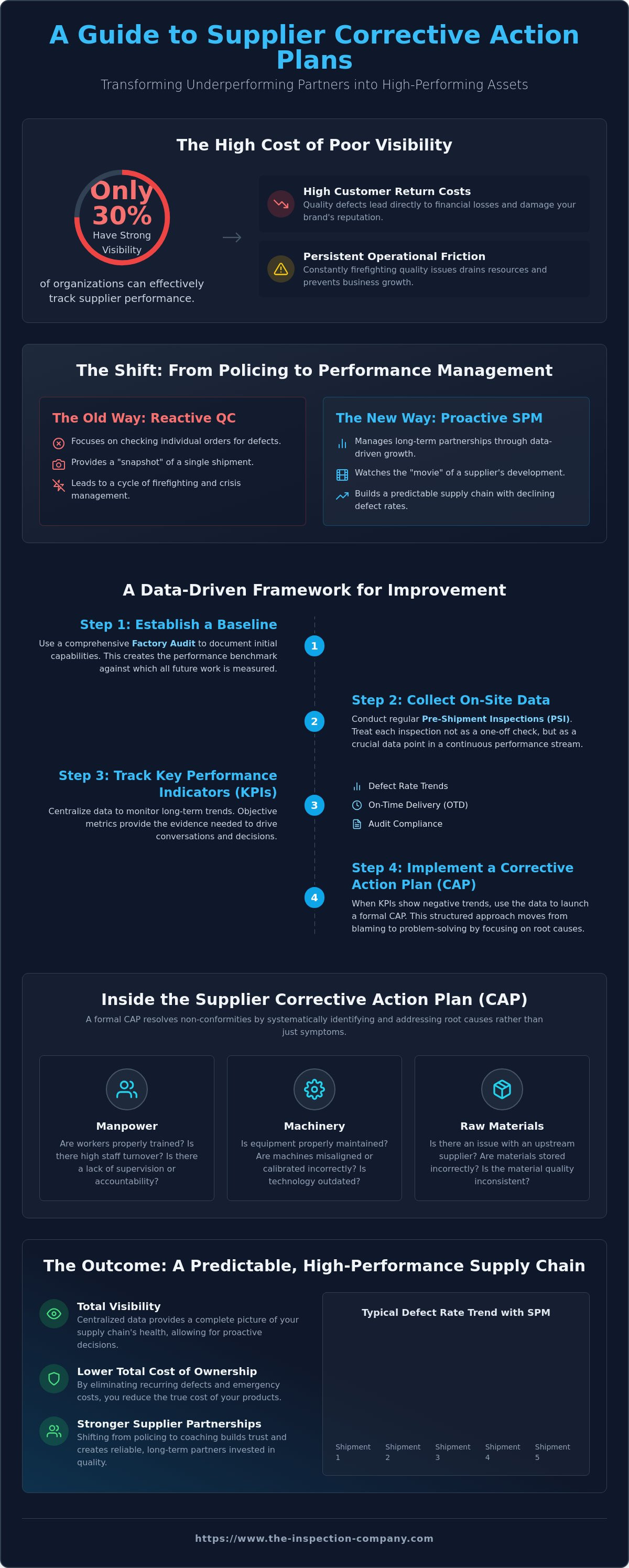
Only 30% of organizations have strong visibility into supplier performance, according to research from Gartner. For most businesses, this lack of transparency translates directly into high customer return costs and persistent operational friction. You're likely familiar with the anxiety of wondering whether a factory can actually improve or if you're simply waiting for the next shipment of defects. Implementing a rigorous supplier corrective action plan is the only way to break this cycle and secure your supply chain against avoidable financial losses.
We understand that managing international vendors requires more than just hope; it requires a methodical approach to risk mitigation. This guide will teach you how to transform underperforming partners into high-performing assets using data-driven inspection cycles and strategic feedback loops. We'll explore a framework for supplier evaluation that ensures declining defect rates and a lower total cost of ownership, giving you the predictability and control your operations demand. You don't have to settle for inconsistency when a data-backed strategy is within reach.
Key Takeaways
- Transition from reactive order-checking to strategic performance management to eliminate the recurring costs of quality defects.
- Use Pre-Shipment Inspections and Factory Audits as objective data baselines to identify long-term quality trends and factory floor issues.
- Establish a formal supplier corrective action plan to resolve non-conformities by identifying root causes in manpower, machinery, or raw materials.
- Centralize your quality data through a digital platform to achieve total visibility and a predictable supply chain with declining defect rates.
The Foundation of Supplier Performance Management (SPM) in 2026
In 2026, the traditional approach to quality control isn't enough. Importers are shifting from simple Quality Control (QC) to Supplier Performance Management (SPM). This transition represents a fundamental change in how international trade operates. While QC focuses on checking individual orders for defects, SPM prioritizes managing long-term partnerships through data-driven growth. It's the difference between taking a snapshot of a single shipment and watching a movie of a supplier's entire developmental trajectory.
Constantly firefighting quality issues is a hidden tax on your business growth. Every time you manage a crisis, you lose time, money, and focus. This reactive cycle is often governed by a Corrective and Preventive Action (CAPA) framework. Without a proactive supplier corrective action plan, these errors repeat themselves, draining your resources. In an era of rising logistics costs, 2026 supply chains require extreme transparency. You can't afford to be blind to factory-floor inefficiencies that eventually manifest as expensive shipping delays or unusable inventory.
Why "Good Enough" Quality is No Longer Competitive
Market standards have shifted. For Amazon sellers, a slight dip in quality can lead to a cascade of negative reviews that destroy a listing's ranking. In the retail world, shelf space is too valuable for products that might be returned. Poor performance doesn't just hurt your reputation; it hits your bottom line through emergency re-productions and the high cost of air-freight to meet deadlines. If your supplier isn't improving, your business is falling behind.
The Shift from Policing to Coaching Your Suppliers
Effective management in Asian manufacturing cultures requires a shift from policing to coaching. Purely punitive measures often lead to suppliers hiding mistakes rather than fixing them. A collaborative approach, supported by a clear supplier corrective action plan, yields better long-term results. By positioning yourself as a partner invested in their operational improvement, you create an environment where transparency is valued. This methodical guidance helps factories understand your specific standards, turning inconsistent vendors into reliable partners over time.
Leveraging On-Site Data: Turning Inspections into Performance Metrics
While many businesses rely on digital ERP systems to manage their supply chain, software alone cannot detect a misaligned sewing machine or a compromised storage environment. Effective Supplier quality management requires physical verification. Pre-Shipment Inspection (PSI) serves as your primary data engine, capturing the ground-level reality of every order. These inspections shouldn't be viewed in isolation. Instead, they form a continuous stream of data that identifies whether a factory is improving or regressing over time.
A successful strategy begins with a Factory Audit to establish a baseline of performance expectations. When combined with a 24-hour reporting turnaround, this on-site data enables agile supply chain decisions that prevent costly shipping delays. Without a verified supplier corrective action plan, these metrics are just numbers; with one, they become a roadmap for operational improvement. The Acceptable Quality Limit (AQL) acts as the primary KPI for quantifying supplier quality across different product categories.
Key Performance Indicators (KPIs) You Must Track
- Defect Rate Trends: Monitor major and minor defects over your last five shipments to spot recurring production failures.
- On-Time Delivery (OTD): Track the gap between promised and actual loading dates to identify logistical bottlenecks.
- Audit Compliance: Verify the factory maintains the standards initially documented during your supplier survey.
Using AQL as a Performance Benchmark
Historical AQL data is a powerful diagnostic tool. It allows you to distinguish between a one-time human error and a systemic production failure. If a vendor consistently hits the upper limits of your AQL, it indicates a lack of process control. This data provides the objective evidence needed to trigger a supplier corrective action plan that targets specific factory departments. For a deeper look at these technical standards, read our AQL Explained guide. If you need assistance interpreting your current factory data, you can consult with our quality experts today.
The Supplier Corrective Action Plan (CAP): A Strategic Tool for Improvement
A supplier corrective action plan (CAP) is more than just a list of fixes. It is a formal roadmap designed to eliminate non-conformities at their source. To be effective, the plan must move beyond symptoms and address the root cause of an error. You must determine if the issue stems from a lack of training (manpower), an uncalibrated tool (machinery), or substandard components from a sub-tier vendor (raw materials). Identifying these distinctions is critical for preventing the same defect from appearing in your next container.
Real-time verification is the missing link in most quality strategies. While a factory may promise changes, During Production Inspections allow you to witness those changes in action while the goods are still on the line. This on-site presence ensures that the factory hasn't simply reverted to old habits once the initial inspector left. Closing the loop requires rigorous re-testing in the subsequent production run to confirm that the remedy is permanent and effective.
5 Steps to an Effective Corrective Action Plan
- Step 1: Define the non-conformity clearly using objective data from your latest inspection report.
- Step 2: Require the supplier to submit a detailed root cause analysis within a strict 48-hour window.
- Step 3: Mutually agree on specific, time-bound remedial actions that address the identified cause directly.
- Step 4: Implement on-site verification, utilizing product sorting if immediate salvage of a current batch is required.
- Step 5: Formally review the effectiveness of the fix during the next pre-shipment inspection.
Recognizing Unfixable Performance: When to Walk Away
Not every supplier is capable of meaningful improvement. Some factories engage in "window dressing," making temporary adjustments that fail as soon as oversight relaxes. If a supplier corrective action plan fails to yield measurable results after two production cycles, it often indicates a deep-seated management failure. In these cases, conducting Social Audits can reveal if the factory’s internal culture and ethics are fundamentally incompatible with your quality standards. If you are struggling with a persistent quality issue, contact our regional experts to evaluate your vendor's capabilities.
Building a High-Performance Supply Chain with The Inspection Company
The Inspection Company acts as your essential eyes and ears across Asian manufacturing hubs. With over 700 inspectors on the ground, we provide the physical verification needed to ensure your supplier corrective action plan is actually being executed on the factory floor. We blend European management standards with a deep local operational presence. This combination ensures that international quality expectations are met within the specific cultural and logistical context of regional manufacturing.
Centralizing your quality data is the only way to achieve true visibility. Our Quality Platform transforms raw inspection reports into clear trend analytics. You won't just see if an order passed or failed; you'll see how your vendor's performance evolves over months and years. This data-backed framework allows you to identify which suppliers are worth the investment and which represent a persistent risk to your bottom line.
The ROI of Long-Term Supplier Management
Investing in consistent oversight pays dividends through reduced operational friction. Top-performing suppliers who have successfully navigated a supplier corrective action plan eventually require lower inspection frequencies, which reduces your costs over time. For businesses selling online, meeting Amazon FBA requirements becomes a routine process rather than a constant source of anxiety. Reliability isn't a happy accident; it's the result of methodical management.
Get Started with a Baseline Audit
You can't manage what you haven't measured. The first step toward improvement is an honest assessment of current factory capabilities. We encourage you to book a Factory Audit to establish your performance baseline today. Once you have an objective starting point, you can scale performance management across multiple countries using our extensive global network. Don't wait for the next shipment of defects to take control of your supply chain.
Securing Long-Term Stability in Your Supply Chain
Transforming an inconsistent vendor into a reliable partner is a process of meticulous verification and data-backed strategy. By moving away from reactive firefighting and embracing a formal supplier corrective action plan, you eliminate the recurring costs of quality defects. Sustainable improvement requires more than just checking boxes; it demands a cultural shift toward transparency and root-cause accountability. You now have the framework to hold your vendors to a higher standard of performance.
The Inspection Company provides the essential oversight needed to manage this transition effectively. With over 700 inspectors across all major Asian manufacturing hubs, we act as your local presence to ensure international standards are met. Our European management team ensures that every detailed inspection report is delivered within 24 hours, giving you the agility to make informed decisions before goods leave the factory floor. This level of transparency is your best defense against operational friction and financial loss.
Secure your supply chain with a professional Factory Audit today and begin the journey toward a more predictable, high-performing supply chain. You have the power to turn your vendors into true strategic partners.
Frequently Asked Questions
How often should I review my supplier’s performance?
You should review your supplier's performance after every shipment for new or inconsistent vendors. For established partners, a comprehensive quarterly review is the industry standard. Continuous monitoring through regular inspection reports allows you to identify quality drift before it leads to significant financial loss. This proactive approach ensures that your supply chain remains resilient and predictable while reducing the risk of unexpected operational friction.
What are the most important KPIs for a manufacturing supplier?
The most critical KPIs include the Defect Rate (measured against AQL), On-Time Delivery (OTD), and Audit Compliance. Tracking the defect rate across multiple shipments reveals systemic production issues rather than isolated errors. OTD measures the reliability of your logistics, while Audit Compliance ensures the factory maintains the standards verified during your initial assessment. These metrics provide the data-backed framework needed for an objective and professional evaluation.
Can a third-party inspection company help improve my supplier?
A third-party inspection company provides the objective, on-site data necessary to implement a supplier corrective action plan. By acting as your eyes and ears on the factory floor, an independent firm verifies that remedial actions are actually performed. This physical verification prevents factories from providing superficial fixes and ensures that your quality standards are consistently upheld through every production cycle, providing you with a sense of security and control.
What happens if a supplier refuses to follow a Corrective Action Plan?
If a supplier refuses to follow a Corrective Action Plan, it usually signals a deep-seated management failure or a lack of commitment to international quality standards. This refusal increases your operational risk and the likelihood of recurring defects. In such cases, you must evaluate the long-term viability of the partnership. Continuing with a non-compliant vendor often leads to a higher total cost of ownership and damaging customer returns that hurt your brand.
Is it better to improve a poor supplier or find a new one?
Improving a poor supplier is often more cost-effective if the issues are process-related and the management is willing to collaborate. However, if the root cause is an ethical failure or a persistent lack of transparency, finding a new partner is the safer investment. A supplier corrective action plan serves as the ultimate test; if the vendor cannot show measurable improvement after two cycles, it is time to transition to a more reliable facility.