
Is your 2026 procurement strategy built on a foundation of hope, or a framework of technical oversight? As the combined sourcing share of China, India, and Vietnam shifted to 54% in 2025, many importers encountered a chaotic layer of operational friction. You've likely felt the sting of high defect rates in recent shipments or the frustration of communication gaps with factory QC teams. Managing supplier quality in Asia isn't just about finding a reliable partner; it's about implementing a meticulous system that prevents financial loss from unsellable inventory before the container leaves the dock.
We understand that a single batch of substandard goods can derail your entire quarter. Master the strategic framework for zero-defect manufacturing in Asia with our comprehensive quality management guide. You'll learn how to secure transparent reporting within 24 hours and implement a scalable quality protocol for 2026. We'll examine how to transition your operations to meet the evolving ISO 9001:2026 standards while maintaining a firm grip on your supply chain's integrity through every stage of production.
Key Takeaways
- Shift your strategy from reactive error-checking to a proactive risk management framework designed for the complexities of the 2026 manufacturing landscape.
- Implement a rigorous vetting process using technical Factory Audits and the "Golden Sample" to establish non-negotiable quality benchmarks.
- Master a multi-stage protocol for managing supplier quality in Asia, utilizing Pre-Production and During Production Inspections to identify systemic errors before they become costly.
- Combine Western quality management standards with localized operational speed to ensure transparent reporting and zero-defect shipments.
The Framework for Managing Supplier Quality in Asia in 2026
Managing supplier quality in Asia isn't a single event; it's a proactive, multi-layered system. It integrates vetting, factory audits, and rigorous multi-stage inspections to ensure your specifications aren't just suggestions. In 2026, the manufacturing landscape demands a shift from reactive checking to a comprehensive framework for quality management. With the ISO 9001:2026 update focusing on digitalization and ethical governance, your oversight must be equally evolved.
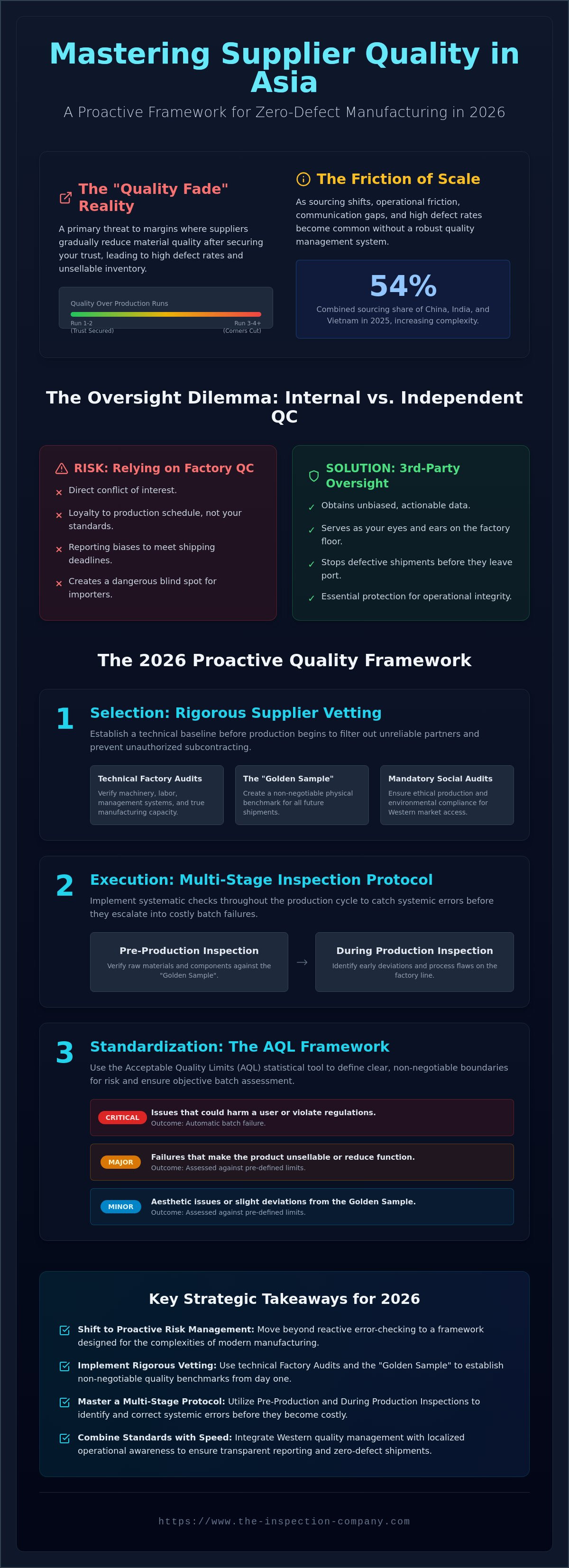
Why the shift? The "Quality Fade" reality remains a primary threat to your margins. This phenomenon involves the gradual, often deliberate reduction in material quality after the third or fourth production run. Once a supplier secures your trust, they may swap components or cut corners to increase their own profitability. Without consistent vigilance, your brand's reputation pays the price for their cost-cutting. It's a slow erosion of standards that eventually leads to high defect rates and unsellable inventory.
Bridging the cultural gap is equally critical. Western quality expectations often clash with local manufacturing practices that prioritize speed over precision. Effective managing supplier quality in Asia requires aligning these different worldviews through clear, technical benchmarks that leave no room for "good enough." You need a partner who speaks the local language of production while enforcing international standards of excellence.
The Hidden Risks of Internal Factory QC
Relying on a factory’s in-house QC team is a direct conflict of interest. Their primary loyalty is to the factory’s production schedule, not your quality standards. This often leads to significant reporting biases. Internal teams may overlook minor defects to meet shipping deadlines or avoid internal reprimands from their supervisors. This lack of transparency creates a dangerous blind spot for importers. You won't know there's a problem until the container arrives at your warehouse.
Independent, third-party oversight is the only way to obtain unbiased, actionable data. An external inspector serves as your eyes and ears on the factory floor. They provide the objective reporting needed to stop defective shipments before they result in financial loss or customer returns. It's an essential layer of protection for any business serious about its operational integrity.
Selection Criteria: Vetting Suppliers via Factory Audits
Successful managing supplier quality in Asia begins long before the first production run. It starts with a technical baseline established through rigorous due diligence. Factory Audits are your primary tool for filtering out unreliable partners. These audits verify that a supplier's machinery, labor force, and internal management systems actually exist and function as claimed. Without this verification, you risk partnering with a "trading company" masquerading as a manufacturer, which immediately compromises your oversight.
A critical step in vetting suppliers involves the creation of a "Golden Sample." This approved specimen serves as your non-negotiable benchmark for every subsequent shipment. It isn't just a reference; it's a physical contract. By 2026, shifting global regulations and the outcomes of the recent G7 Summit have made Social Audits mandatory for many Western markets. Ethical production and environmental compliance are no longer optional "add-ons" but essential requirements for legal market access.
You must also assess manufacturing capacity against actual output. Many factories overpromise and then resort to unauthorized subcontracting to meet deadlines. This practice is the leading cause of "Quality Fade," as you lose all visibility into the secondary facility's conditions. To ensure your potential partner can handle your volume without compromising standards, you can request a capacity verification audit as part of your initial vetting process.
Standardizing the AQL Framework
Defining your Acceptable Quality Limits (AQL) is essential for clear communication. This statistical tool allows you to set clear boundaries for acceptable risk. You should categorize defects into three distinct tiers:
- Critical Defects: Issues that could harm a user or violate regulations. These typically result in an automatic batch failure.
- Major Defects: Failures that make the product unsellable or significantly reduce its function.
- Minor Defects: Aesthetic issues or slight deviations from the Golden Sample that don't affect performance.
AQL is the maximum number of defective units beyond which a batch is rejected. Establishing these limits in your supplier contract ensures that both parties understand the technical requirements for a successful shipment.
Execution: The Multi-Stage Inspection Protocol
Once you've vetted your factory, active oversight begins. You can't rely on luck for managing supplier quality in Asia; you need a chronological defense. A robust Multi-Stage Inspection Protocol ensures that errors are identified and corrected at the earliest possible moment, preventing minor issues from snowballing into a total loss. This systematic approach transforms quality control from a final hurdle into a continuous improvement process.
- Step 1: Pre-Production Inspection. This stage verifies raw materials and components before assembly starts. It prevents the use of substandard materials that lead to the "Quality Fade" mentioned earlier.
- Step 2: During Production Inspection (DUPRO). We recommend this when 20% of the order is finished. It catches systemic errors in the assembly line while there's still time to pivot without losing the entire batch.
- Step 3: Pre-Shipment Inspection (PSI). This is the final gate. It confirms the finished batch meets every technical specification before you release final payment.
- Step 4: Container Loading Inspection. This ensures the correct quantity is loaded and the packing is secure enough to survive international transit.
When to Use Each Inspection Stage
Choosing the right level of oversight depends on your product's complexity and your history with the supplier. For simple goods like basic textiles from a proven partner, a PSI may suffice. However, for complex electronics or first-time orders, a full multi-stage protocol is essential. The "High-Risk" trigger occurs when a DUPRO reveals a failure rate exceeding your AQL. In these cases, you should escalate to full-time monitoring until the production line stabilizes. Don't wait for the final report to find out your shipment is unsellable.
Specialized QC for Amazon FBA Sellers
Amazon FBA sellers face unique pressures regarding compliance. A single labeling error or a crushed box can lead to costly warehouse rejections or even account suspension. An Amazon FBA Inspection focuses specifically on Amazon's strict packaging and barcoding requirements. This specialized oversight ensures your inventory is ready for immediate intake, protecting your seller metrics and ensuring a smooth customer experience. To secure your next shipment, you can book a multi-stage inspection plan here.
Why The Inspection Company is the Strategic Choice for Asia
The Inspection Company offers a unique hybrid model that bridges the gap between Western expectations and Eastern production realities. It's not enough to have eyes on the ground; those eyes must understand your specific technical requirements. Our European management structure ensures that international quality standards are strictly enforced with local operational speed. This combination is the most effective way of managing supplier quality in Asia without the need for your physical presence in the factory.
Our network includes over 700 professional inspectors strategically positioned across China, Vietnam, India, and other major manufacturing hubs. This extensive reach allows us to deploy experts to your factory within 48 hours. We don't just provide a report. We provide a seasoned veteran who understands the specific cultural nuances of regional quality management. This localized presence is critical for managing supplier quality in Asia across multiple borders simultaneously.
Transparency is maintained through our proprietary Quality Platform. You receive comprehensive reports within 24 hours of the inspection, allowing you to make data-driven decisions in real-time. This digital oversight eliminates the ambiguity that often plagues international trade. It's a proactive tool designed to give you total control over your inventory's integrity.
Consider a single day of inspection as a preventative investment. It's a minor cost. It prevents the financial and legal headaches of a recalled shipment or a breach of contract. High-stakes operations require a partner that prioritizes risk mitigation and the reduction of operational friction.
Total Supply Chain Visibility
We help you leverage historical supplier data to predict and prevent future quality issues. Every report includes detailed photo and video documentation. This provides an indisputable record of the production state. This level of detail ensures you're never surprised by unexpected errors once the goods arrive at your warehouse. It's about building a scalable, reliable protocol for the long term.
Secure your 2026 supply chain by booking a professional inspection today.
Secure Your Supply Chain Integrity for 2026 and Beyond
Success in international trade hinges on moving beyond reactive quality checks. By implementing a proactive framework and a multi-stage inspection protocol, you protect your margins from the high costs of "Quality Fade" and the risk of unsellable inventory. Managing supplier quality in Asia requires a meticulous approach that combines technical vetting with consistent, on-the-ground vigilance through every stage of production.
The Inspection Company provides the authoritative oversight needed to maintain these standards. With European management and a network of over 700 local inspectors, we ensure your specifications are met with precision and speed. As a member of major international quality associations, we deliver detailed, fact-based reports within 24 hours via our proprietary platform. This gives you the transparency and security required for high-stakes operations in a complex global market.
Don't let your next shipment be a gamble. Take control of your production today and build a resilient foundation for your brand's future growth. We're here to ensure your products meet the world-class standards your customers expect.
Get an Instant Quote for Your Next Asia Inspection
Frequently Asked Questions
How do I manage supplier quality in Asia if I cannot travel to the factory?
You can effectively manage production standards by partnering with a third-party inspection company that maintains a permanent local presence. These experts act as your on-site representatives, conducting audits and inspections that provide the same level of oversight as a personal visit. By utilizing a digital quality platform, you receive real-time data and visual documentation, ensuring you maintain control over production standards without the expense or logistical burden of international travel.
What is the typical cost of a third-party inspection in Asia in 2026?
While prices vary based on the specific scope and location, industry benchmarks in early 2026 show that a standard, all-inclusive factory audit in major Asian manufacturing clusters is approximately $398 per man-day. More specialized technical or social compliance audits can range significantly higher depending on the complexity of the examination. It's important to view these costs as a preventative investment that forestalls much larger financial losses caused by defective shipments or unsellable inventory.
Can an inspection company help me if my supplier is already failing quality tests?
Yes, an inspection company provides critical intervention when quality standards begin to slip. Through a During Production Inspection or specialized product sorting services, we can isolate defective units and identify the root cause of the failure. This proactive approach allows you to implement corrective actions before the entire order is completed, saving the shipment and protecting your relationship with the factory.
How long does it take to receive an inspection report after the site visit?
You should expect to receive a comprehensive inspection report within 24 hours of the site visit. Speed is a vital component of managing supplier quality in Asia, as delays in reporting can lead to missed shipping windows or increased storage fees. Our digital platform ensures that detailed photos, video evidence, and technical data are delivered quickly, allowing you to make informed decisions about releasing or holding a shipment.
What happens if a Pre-Shipment Inspection (PSI) fails?
If a Pre-Shipment Inspection fails, the factory is typically required to rework the defective goods or replace them at their own expense. You should not release the final payment or authorize the shipment until a successful re-inspection confirms that all issues have been resolved. This protocol prevents the arrival of substandard products at your warehouse and ensures the factory remains accountable for meeting your established benchmarks for managing supplier quality in Asia.