

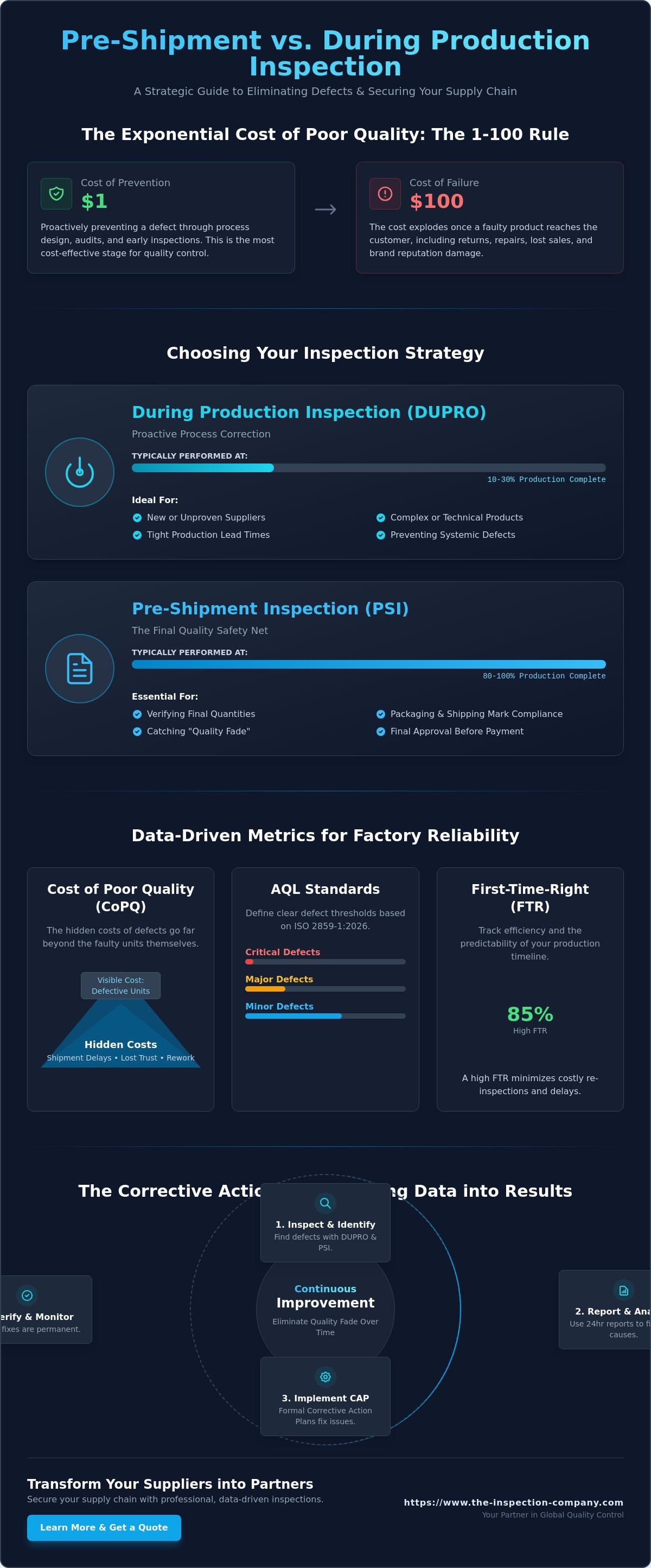
The "1-10-100 Rule" of quality management states that it costs just $1 to prevent a defect, but that cost explodes to $100 once a faulty product reaches your customer. For brands managing international supply chains, this isn't just a theory; it's the daily reality of shrinking margins and damaged reputations. You've likely experienced the frustration of recurring defects and shipment delays despite providing exhaustive specifications. It's exhausting to manage manufacturers who seem to prioritize speed over the precision your brand requires.
This article explores how to strategically balance pre-shipment vs during production inspection to eliminate quality fade and secure your bottom line. By moving from reactive checks to proactive oversight, you'll gain the predictable product quality and reduced rejection rates necessary for scale. We'll examine how the latest ISO 2859-1:2026 standards and risk-based thinking from ISO/IEC 17020:2026 can transform your factory relationships. You'll discover a methodical approach to building a transparent, data-backed partnership with your suppliers that mitigates operational friction and prevents costly financial losses.
Key Takeaways
- Understand the strategic differences between pre-shipment vs during production inspection to determine which quality gate best protects your specific supply chain from financial loss.
- Utilize the Cost of Poor Quality (CoPQ) and updated AQL standards to measure factory reliability and set data-driven performance targets for 2026.
- Learn to implement formal Corrective Action Plans (CAP) that address the root causes of defects, ranging from machine calibration issues to operator error.
- Leverage rapid 24-hour reporting and digital quality platforms to track supplier trends and maintain transparency across multiple production regions.
- Discover how to transform manufacturers into high-performing partners by integrating a continuous feedback loop that effectively eliminates quality fade over time.
Pre-Shipment vs During Production Inspection: Choosing Your Strategy
Managing a global supply chain requires more than just hoping for the best. You need a proactive strategy. When evaluating pre-shipment vs during production inspection, the decision depends on your risk tolerance and the complexity of your order. A Pre-Shipment Inspection (PSI) acts as your final quality gate. It occurs when production is 80% to 100% complete and at least 80% of the goods are packed. Conversely, a During Production Inspection (DUPRO) is an early-stage intervention, typically performed when only 10% to 30% of the production is finished.
Why does this timing distinction matter? Many importers fall into the "whack-a-mole" trap. They rely solely on a final Pre-shipment inspection (PSI) to catch errors. By this stage, if a systemic defect is found, the entire shipment is compromised. This leads to last-minute delays, stockouts, and strained supplier relationships. While PSI focuses on shipment approval, DUPRO focuses on process correction. It allows you to identify issues while there's still time to fix them without restarting the entire production run. Choosing the right balance of pre-shipment vs during production inspection is the difference between a smooth delivery and a logistics nightmare.
When to Prioritise During Production (DUPRO) Oversight
Early intervention is essential when working with new suppliers or manufacturing complex products. If your specifications are technical or easily misunderstood, waiting until the end is a gamble you don't want to take. Use DUPRO when lead times are tight and you cannot afford a "fail" at the final stage. Catching a machine calibration error at 15% completion saves weeks of rework compared to finding it when the container is supposed to be loaded. It's about securing your timeline before the damage becomes irreversible.
The Role of Pre-Shipment Inspection (PSI) as a Final Safety Net
PSI remains the industry standard for a reason. It's your last chance to verify final quantities, packaging compliance, and shipping marks before you release the balance payment. It's also the most effective way to ensure "Quality Fade" hasn't occurred. This is the phenomenon where a factory slowly substitutes cheaper materials or cuts corners during the final stages of mass production. By verifying finished goods against your approved sample, you maintain total control over what actually reaches your warehouse.
Key Metrics for Analysing and Improving Factory Reliability
Measuring supplier performance requires more than a simple "pass" or "fail" result. The ultimate metric for any professional importer is the Cost of Poor Quality (CoPQ). This figure encompasses the obvious price of defective units alongside the hidden expenses of operational friction, shipment delays, and lost customer trust. By tracking CoPQ, you can transform quality control from a recurring expense into a strategic investment that protects your margins.
To set realistic improvement targets for 2026, you must master the AQL (Acceptable Quality Limit). Utilizing the current ISO 2859-1:2026 standard allows you to define clear, statistical thresholds for critical, major, and minor defects. Efficiency is best tracked through the "First-Time-Right" (FTR) ratio; a high FTR minimizes the need for costly re-inspections and ensures your production timeline remains predictable. Choosing between pre-shipment vs during production inspection becomes a data-driven decision once you analyze "Defect Concentration" maps from your reports, which highlight whether issues are isolated or systemic to specific production lines.
Setting a Performance Baseline with Factory Audits
Establishing a baseline begins with a thorough Factory Audit. This is the prerequisite for any performance improvement journey. By evaluating a supplier's Quality Management System (QMS), you can predict the likelihood of future defects before the first unit is even produced. It's about identifying risks in the manufacturing process rather than just finding errors in the finished product.
Quantitative vs Qualitative Performance Data
A comprehensive supplier scorecard balances hard numbers with professional observations. If you need assistance interpreting these metrics, reach out to our technical team for a detailed consultation.
- Quantitative Data: This includes rejection rates, AQL scores, and on-time delivery percentages. These figures provide the raw evidence needed for quarterly performance reviews.
- Qualitative Data: This tracks the factory's responsiveness to feedback and the transparency of their management. A supplier's willingness to admit faults and implement corrective actions is often more valuable than a perfect score on a single report.
The Corrective Action Loop: Turning Inspection Data into Results
Data alone fixes nothing. Finding a defect is only the start of the process. If you don't address the source of the error, you are simply paying to document your own financial losses. This is where the corrective action loop becomes essential. When deciding on pre-shipment vs during production inspection protocols, consider how you will use the resulting data to drive change. Each report should be a catalyst for improvement rather than just a record of failure.
Immediately following a Pre-Shipment Inspection failure, you must issue a formal Corrective Action Plan (CAP). This document shouldn't just list what was wrong; it must specify how the factory will prevent a recurrence. It is vital to differentiate between material failures, machine calibration issues, and operator error. Once the CAP is issued, use a During Production Inspection in the subsequent run to verify implementation. This creates a closed-loop system that transforms your manufacturers into high-performing partners.
Tiering your suppliers allows for smarter resource allocation. High-performers earn reduced oversight, while new partners or those on probation require strict China inspection services to mitigate risk. This strategic approach ensures that your quality control budget is spent where the risk is highest.
Mastering Root Cause Analysis (RCA) on the Factory Floor
Effective RCA moves past surface-level excuses. Use the '5 Whys' method to drill down into the operational reality. If a factory manager claims "human error," ask why the process allowed that error to occur. Our independent inspectors provide the unbiased, physical evidence needed to conduct a successful RCA. This transparency ensures the factory takes accountability for systemic improvements rather than offering vague explanations to protect their margins.
Managing Underperforming Suppliers Fairly
Performance management requires a balance of firmness and fairness. Set clear probationary periods for factories that consistently fail to meet AQL standards. However, you must also recognize when a supplier is "un-coachable." If a manufacturer repeatedly ignores CAP requirements or lacks transparency, it's time to pivot before a catastrophic quality failure occurs. Contact our team to discuss how to audit and transition to more reliable manufacturing partners.
Leveraging Professional Oversight for Scalable Growth in 2026
High-speed data is the backbone of modern supply chain management. When Sourcing from Asia, waiting days for a report is no longer a viable option. Our 24-hour reporting turnaround ensures you can make rapid performance adjustments before errors compound. This speed allows you to act decisively on the results of pre-shipment vs during production inspection reports, preventing minor deviations from becoming major financial liabilities.
Beyond individual reports, the Quality Platform provides a comprehensive view of your entire manufacturing network. By tracking supplier performance trends across multiple regions and years, you can identify which partners are scaling with you and which are falling behind. This professional oversight is a preventative investment that significantly lowers your Total Cost of Ownership (TCO) by reducing returns and administrative friction. The Inspection Company transforms raw factory data into a distinct competitive advantage for global retailers by providing actionable intelligence where others only offer static observations.
European Standards with a Local Asian Presence
Our team of 700+ inspectors acts as your eyes and ears across all major manufacturing hubs. We combine rigorous European quality standards with a localized operational presence to bridge cultural and management gaps. This ensures a consistent approach to Mastering the Supplier Management Process through standardised reporting that's easy to interpret and act upon. You don't have to be on the factory floor to maintain total control over your production quality.
Customised Inspection Programs for Amazon FBA Sellers
Account health is the most valuable asset for an e-commerce brand. We provide tailored Amazon FBA Inspection checklists that meet strict platform requirements. By leveraging historical data, we help you decide between pre-shipment vs during production inspection based on the specific performance of each SKU. This surgical approach to quality control protects your rankings and ensures your products are retail-ready from the moment they arrive at the fulfillment center.
Securing Your Supply Chain for Sustainable Growth
Effective supplier management is a continuous process of refinement rather than a one-time event. By strategically balancing pre-shipment vs during production inspection, you move beyond mere defect detection and begin actively preventing financial loss. You've seen how tracking the Cost of Poor Quality and implementing formal Corrective Action Plans can transform underperforming factories into reliable partners. These proactive measures ensure your margins remain protected while your brand reputation stays intact.
Success in international trade requires a partner who understands the high stakes of quality management. The Inspection Company provides this security through European management standards and a team of over 700 certified inspectors operating across Asia. With detailed digital reports delivered within 24 hours of inspection, you gain the transparent data needed to make critical business decisions with confidence. It's time to stop reacting to quality failures and start driving factory excellence.
Secure your supply chain and improve supplier performance today with The Inspection Company. You have the tools and the strategy; now take the final step toward a more predictable and profitable manufacturing future.
Frequently Asked Questions
How long does it take to see measurable improvements in supplier performance?
Measurable improvements typically appear within two to three production cycles, which generally spans three to six months. This timeline depends on the factory's willingness to implement the Corrective Action Plan (CAP) issued after a failed report. Real change requires consistent feedback and verification through subsequent inspections to ensure new standards are maintained.
What are the most common reasons for a decline in supplier quality over time?
Supplier quality often declines due to "Quality Fade," where a manufacturer slowly substitutes cheaper materials or skips process steps to increase their own margins. Other common factors include high factory staff turnover and a lack of regular oversight. Without a consistent presence, factories may prioritize faster, lower-quality orders from other clients over your specific requirements.
Can I improve supplier performance without significantly increasing my oversight costs?
You can optimize costs by adopting a risk-based strategy for pre-shipment vs during production inspection activities. Instead of inspecting every shipment from a proven partner, focus your budget on new SKUs or high-risk suppliers. Tiering your factory base allows you to maintain high quality standards without paying for redundant oversight on low-risk production runs.
What should I do if a supplier refuses to implement a Corrective Action Plan?
A supplier's refusal to implement a CAP is a critical risk indicator that suggests a lack of transparency or operational control. In these cases, you should immediately begin qualifying alternative manufacturers to protect your supply chain. Continuing a relationship with an "un-coachable" supplier often leads to catastrophic quality failures and significant financial losses.
How often should I conduct factory audits for my long-term, existing suppliers?
Existing suppliers should undergo a comprehensive Factory Audit at least once every twelve months to ensure their Quality Management System remains robust. However, you should trigger an unscheduled audit if you notice a spike in rejection rates or if the factory moves to a new facility. Regular audits prevent complacency and verify that the supplier continues to meet international standards.