

Is your new quality partner prepared to catch the defects your previous provider missed, or are you simply transferring the same communication gaps to a different company? Transitioning to a new third-party provider is a high-stakes strategic alignment, not a simple administrative hand-off. With the July 8, 2026, deadline for CPSC eFiling for U.S. imports fast approaching, the margin for error in your documentation and quality reporting has vanished. Utilizing a structured onboarding a new inspection company checklist is no longer a best practice; it's a requirement for operational survival.
The anxiety of switching partners is real, particularly the fear of miscommunication between the factory and a new set of eyes during a critical production run. You need to know exactly what information and access to provide to ensure your first shipment is defect-free. This guide offers a comprehensive roadmap to integrate a third-party inspection partner into your supply chain while eliminating friction. We will examine the essential protocols for data alignment, factory communication, and regulatory compliance that will keep your operations secure and your quality standards high.
Key Takeaways
- Learn how to eliminate "information silos" by aligning your quality standards with an external partner's execution to prevent costly production errors.
- Discover the technical requirements for transferring Product Specification Sheets and defining AQL thresholds to ensure inspection precision from day one.
- Establish clear communication protocols and lead times using our onboarding a new inspection company checklist to reduce operational friction with your factory.
- Understand why treating your first engagement as a "pilot" run with extra oversight is a critical step in mitigating long-term supply chain risks.
Why a Structured Onboarding Checklist is Critical for Quality Control
Transitioning to a new third-party inspection (TPI) partner is a high-stakes operation. It involves more than signing a contract; it requires a total alignment of your quality standards with an external partner's execution. Without a formal onboarding a new inspection company checklist, you risk creating "information silos." These occur when your factory understands specific production nuances that your new inspector does not. This gap leads to "silent" product defects: errors that pass inspection because the inspector wasn't briefed on what to look for. These oversights often result in costly financial losses and damaged brand reputations.
In 2026, supply chain resilience depends on transparency. With the global TIC market projected to reach $280.46 billion this year, the complexity of international trade has never been higher. A structured start ensures that your quality expectations are codified and communicated. By applying foundational quality control principles, you transform the inspection from a checkbox exercise into a preventative investment. This methodical approach is the only way to mitigate the risk of expensive shipping delays and unexpected product failures.
The ROI of a Professional Onboarding Process
A meticulous onboarding process directly impacts your bottom line. It reduces the frequency of "failed" inspections that stem from administrative errors or missing data rather than actual product defects. These false negatives cause expensive shipping delays and strain factory relationships. By establishing a clear roadmap, you ensure that the inspector and the factory are working from the same set of instructions.
- Minimizing Operational Friction: Clear protocols prevent the confusion that occurs when a new provider enters an established factory environment.
- Faster Time-to-Market: Streamlining the pre-shipment inspection booking process ensures your goods move through the supply chain without unnecessary pauses.
Ultimately, TPI onboarding serves as the vital bridge between procurement and quality assurance, ensuring that the products you pay for are the products you receive.
Phase 1: Technical Alignment and Quality Documentation
Phase 1 of your onboarding a new inspection company checklist begins with the absolute synchronization of technical data. You cannot expect an inspector to identify a deviation if they don't possess the exact blueprint of your requirements. Start by transferring your comprehensive Product Specification Sheets (PSS) to your 3rd-party inspection company. This document acts as the single source of truth. It must include material grades, dimensions, color tolerances, and specific performance benchmarks.
Precise alignment on AQL levels is equally vital. You must define what constitutes a Major, Minor, or Critical defect before the first inspector arrives on-site. By applying ASQ's supplier quality management principles, you ensure that your quality management system is robust enough to handle high-stakes international trade. For those utilizing Amazon FBA services, this phase must also detail specific labeling and packaging requirements to prevent costly rejections at fulfillment centers. If you have questions about specific compliance standards, you can consult with our technical team for guidance.
Defect Classification and Tolerance
Subjectivity is the enemy of quality control. To eliminate it, create a visual defect catalog that provides clear photographic examples of acceptable versus unacceptable variations. You should also set rigid pass/fail criteria for functional tests, such as carton drop tests or hi-pot electrical testing. This clarity prevents inspectors from making "judgment calls" that might not align with your brand's specific standards.
Sample Management Protocols
The "Golden Sample" is your most powerful tool. This phase of the checklist establishes who holds the approved sample and how the inspector will access it during the audit. Beyond the final product, early-stage sample testing plays a critical role in verifying raw material compliance. Testing materials before mass production begins prevents the use of substandard components that could lead to a total batch failure and significant financial loss.
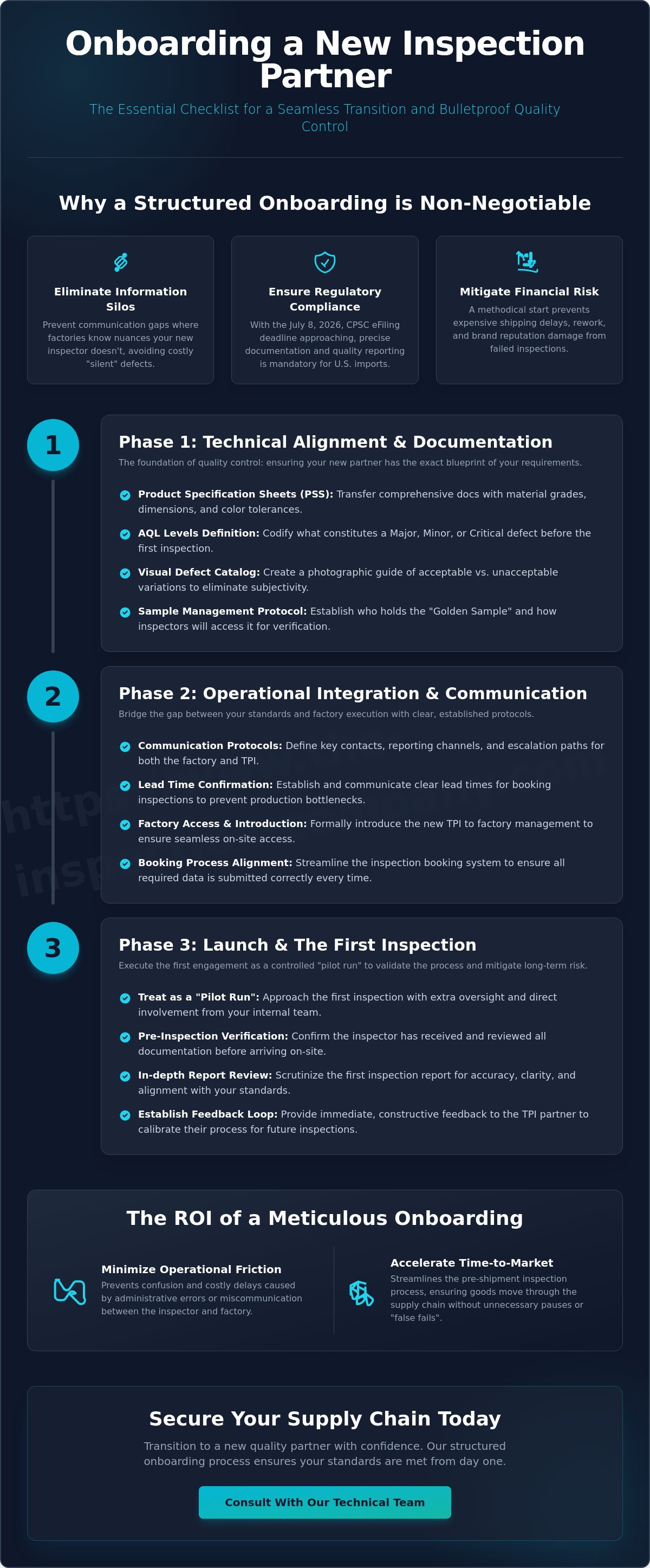
Phase 2: Operational Integration and Communication Protocols
Establishing clear communication lines is the most effective way to prevent operational friction. Your onboarding a new inspection company checklist must formalize the three-way relationship between you, your factory, and your new quality partner. Without a defined protocol, information gets lost, deadlines slip, and quality suffers. Start by introducing the inspection company to your factory contacts. This step establishes the inspector's authority and ensures the factory understands that this partnership is a core part of your procurement strategy.
Timing is critical for logistics planning. You should set a mandatory booking lead time, such as requiring all inspections to be booked at least 5 days before the scheduled container loading date. This window allows the inspection team to allocate the right personnel and review your technical specifications. You must also define the "Report Review" workflow. Decide who on your team receives the final report and set a hard deadline for approval. If your team takes 48 hours to review a report, you risk delaying the shipment or missing the vessel cutoff.
Integrity is the foundation of reliable data. Your onboarding process should include a signed "Ethics and Integrity" policy. This document explicitly forbids any form of collusion or unauthorized "gifts" between factory staff and inspectors. It protects your interests and ensures the data you receive is an honest reflection of production quality. To secure your supply chain with these professional protocols, you can speak with our operations team today.
The Factory Introduction Letter
A formal introduction letter is essential. It grants the third-party team the right to access the production floor and warehouse without interference. This letter should also set expectations for factory cooperation during a during production inspection. When the factory knows you're monitoring work-in-progress, they're more likely to maintain higher quality standards throughout the entire run.
Digital Platform Integration
Efficiency in 2026 relies on digital transparency. Ensure your team has active user accounts on the inspector's quality platform. Automating report delivery through these systems ensures your logistics and procurement teams can act on inspection data within 24 hours. This speed allows you to address defects immediately, rather than waiting for a delayed email attachment while your goods sit in a warehouse.
Phase 3: Launching Your First Inspection with The Inspection Company
The first engagement with a new partner is a high-stakes "pilot" run. It's the moment where your theoretical standards meet physical execution. You should treat this initial phase with extra oversight to ensure no misinterpretations occur. A foundational onboarding a new inspection company checklist isn't complete without a comprehensive factory audit. This audit provides a baseline of the supplier's capabilities, ensuring they can actually meet the quality levels you've defined in the previous phases of your alignment.
Once the first report is processed, conduct a post-inspection debrief. Use these findings to refine your onboarding a new inspection company checklist for future orders. This iterative process allows you to scale from monitoring a single product to a sophisticated supplier management process. By continuously optimizing your quality protocols, you build a resilient supply chain that minimizes financial risk and maximizes operational transparency.
Starting with a Pre-Production Check
Don't wait until mass production is finished to identify problems. Validating raw materials and components via a pre-production inspection is a critical preventative measure. It ensures the factory is truly ready for the production timeline and that the materials match your approved samples. Catching a material discrepancy at this stage prevents a total batch failure and the resulting shipping delays.
Reviewing the First Report
Reading a technical report requires a methodical approach. You must look beyond the final result and analyze the photo evidence, AQL data tables, and specific inspector comments. When reviewing the findings, you will typically face three outcomes:
- Pass: The batch meets all criteria; proceed with shipment according to your logistics schedule.
- Pending: Minor discrepancies were found that require your executive decision before release.
- Fail: Critical defects or AQL limits were exceeded; corrective action or product sorting is mandatory.
Each result requires a documented next step to ensure the factory understands that your quality standards are non-negotiable.
Securing Your Supply Chain for 2026 and Beyond
Success in international trade hinges on the precision of your quality control protocols. By establishing technical alignment and clear communication lead times, you eliminate the ambiguity that leads to costly defects and shipping delays. Utilizing a robust onboarding a new inspection company checklist ensures that your quality standards are never lost in translation between the office and the factory floor. This methodical approach transforms your quality management from a reactive expense into a strategic preventative investment.
The Inspection Company provides the authoritative oversight you need to mitigate operational risk. With European management and a network of over 700 inspectors across Asia, we deliver the transparency required for high-stakes global trade. Our ISO 9001 certified quality management system ensures every detail is captured, with comprehensive reports delivered to your team within 24 hours. Don't leave your product quality to chance during a partner transition. Book a consultation with The Inspection Company to streamline your 2026 QC onboarding. We're ready to help you build a more resilient and predictable supply chain today.
Frequently Asked Questions
How much lead time does an inspection company need for a new client?
Professional agencies typically require a lead time of 5 to 7 working days for initial setup. This window is necessary to conduct a thorough review of your technical specifications and align on AQL standards. Once you complete the onboarding a new inspection company checklist, subsequent bookings usually require only 3 to 5 days of notice before the desired inspection date.
Do I need to be present at the factory during the first inspection?
You don't need to be physically present at the factory. The primary role of a third-party partner is to act as your eyes and ears on the production floor. However, it is highly recommended that you remain available via phone or email during the first "pilot" run. This allows you to provide immediate guidance if the inspector discovers unexpected defects that require a quick executive decision.
What happens if the factory refuses to cooperate with the new inspection company?
Factory resistance is a significant red flag that often suggests hidden quality issues or production delays. You should issue a formal introduction letter that explicitly grants the inspector access to the production floor and warehouse. If the factory continues to block access, you must treat this as a breach of your procurement agreement and withhold payment until the inspection is completed.
Can I use the same onboarding checklist for different product categories?
You cannot use the same technical checklist for different product categories because quality benchmarks are industry-specific. While the operational communication steps remain consistent, your onboarding a new inspection company checklist must be customized with product-specific functional tests. For example, the safety benchmarks for an electrical appliance are vastly different from the stitch-count requirements of a textile product.
How does onboarding differ when switching from an old inspection provider?
When switching providers, the process focuses heavily on historical risk mitigation. You must provide your new partner with data regarding previous defects and "information silos" encountered with your old provider. This transition is the best time to refine your quality protocols and ensure the new team is specifically looking for the errors that the previous company might have missed.