
The most expensive inspection is the one you decide not to book. While some importers view quality control as a secondary expense, a single failed shipment can result in catastrophic financial losses that far outweigh any initial service fee. It's natural to feel frustrated by the lack of transparency in the industry. Between fluctuating man-day rates and unexpected travel surcharges, calculating an accurate pre-shipment inspection cost often feels like guesswork. You shouldn't have to choose between your profit margins and your product integrity.
This guide provides the clarity required to budget effectively for the 2026 fiscal year. You'll learn exactly how pre-shipment inspection costs are calculated and how to optimize your quality control budget without compromising on product safety. We will break down the standard man-day pricing model, identify common hidden fees like reporting surcharges, and provide the data needed to justify these essential preventative investments to your stakeholders. Securing your supply chain shouldn't be a financial mystery; it should be a calculated strategy for long-term reliability.
Key Takeaways
- Master the "man-day" pricing unit to accurately forecast your quality control expenses and avoid hidden reporting fees.
- Identify how variables like factory location and product complexity determine your total pre-shipment inspection cost for the 2026 fiscal year.
- Quantify the return on investment by contrasting the fixed price of an inspection against the catastrophic variable costs of a rejected order.
- Explore strategic budgeting techniques, such as optimizing AQL sampling levels and combining on-site services, to maximize your risk mitigation.
Understanding the Man-Day Pricing Model for Inspections
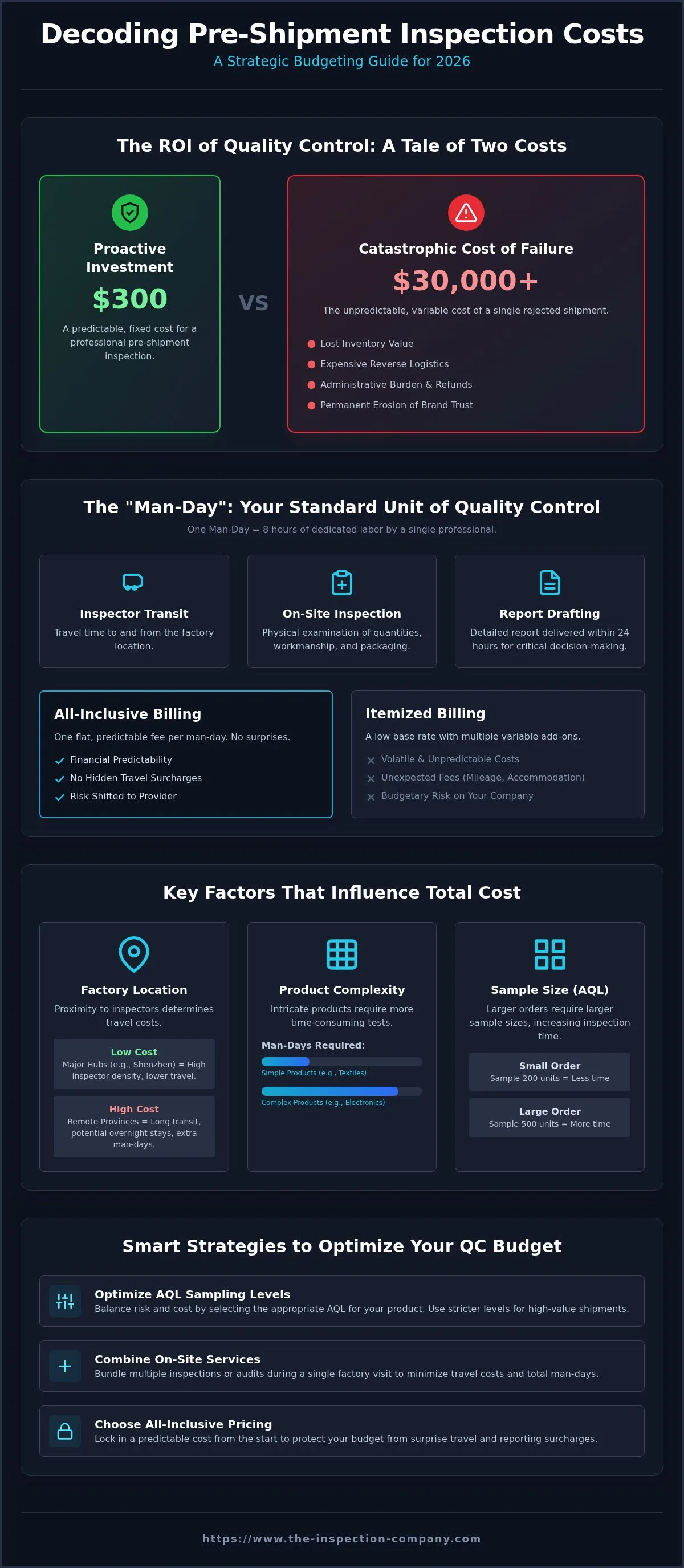
The man-day is the industry-standard unit for quality control pricing. It represents eight hours of dedicated labor by a single professional. When you request a quote, you're essentially purchasing a specific block of expert time. However, not all quotes are created equal. A transparent TIC company will offer an all-inclusive rate that covers every facet of the engagement. This approach eliminates the friction of hidden travel or reporting fees that often plague international trade. Understanding this model is the first step in managing your total pre-shipment inspection cost.
What Exactly Does One Man-Day Cover?
One man-day encompasses more than just time spent on the factory floor. It includes the inspector's transit to the facility, the physical examination of goods, and the final report drafting. During the Pre-shipment inspection (PSI), the inspector verifies quantities, workmanship, and packaging against your specific requirements. The value of this unit of labor also includes the speed of information. In a professional setting, detailed reports are delivered within 24 hours. This allows you to make critical shipping decisions without causing logistical bottlenecks or warehouse delays.
All-Inclusive vs. Itemized Billing
Itemized billing models often present a low base rate to attract buyers, but they hide variable expenses like accommodation and mileage. These costs can fluctuate wildly depending on factory location and local infrastructure. European-managed firms typically favor all-inclusive rates because they provide financial predictability. You pay one flat fee per man-day. This model protects your margins from the volatility of travel surcharges and administrative add-ons. Choosing all-inclusive pricing shifts the logistical risk from your budget to the inspection provider. It's a proactive way to ensure your pre-shipment inspection cost remains fixed and manageable throughout the production cycle.
Key Factors That Influence Pre-Shipment Inspection Cost
Calculating your total pre-shipment inspection cost requires analyzing several operational variables. It isn't just about the base rate. You must account for how your specific order parameters dictate the workload. For instance, according to Incoterms, the buyer and seller must agree on who covers the costs of any pre-shipment inspections. Once responsibility is established, the complexity of the product becomes a primary driver. A simple textile item might require only basic visual checks, whereas a complex electronic device necessitates functional testing and safety certifications. These additional steps consume more man-days, directly increasing the total investment.
The Role of Factory Location in Pricing
Location significantly impacts the final bill. Manufacturing hubs like Shenzhen, China, or Ho Chi Minh City, Vietnam, benefit from high inspector density. This proximity often results in lower travel expenses. Conversely, factories located in remote provinces may require long-distance transit or even overnight stays. When an inspector has to travel five hours each way, the logistical overhead can add an entire man-day to the quote. It's helpful to consult with an expert early to map out these geographic variables and avoid unexpected travel surcharges.
Sample Size and AQL Impact
Order volume is the most objective factor in cost calculation. Most professionals use AQL sampling to determine how many units require checking. A larger order doesn't mean every single item is inspected, but it does mean the statistically significant sample size grows. If your sampling plan requires 200 units for a small batch but 500 units for a larger one, the time required for function tests and workmanship checks will double. More units checked equals more man-days billed. High-stakes shipments often demand stricter sampling levels, which increases the time on-site but significantly reduces the risk of expensive product recalls.
The ROI of Inspection: Why "Cheap" is Often Expensive
Viewing quality control as a simple line-item expense is a tactical error. It's actually a strategic shield. Consider the fundamental math of international trade. A $300 professional inspection is a predictable, fixed cost. Compare this to the $30,000 cost of a shipment rejection at the destination port. The "Cost of Failure" extends far beyond the lost inventory value. It includes the expensive reverse logistics of shipping defective goods back, the administrative burden of refund processing, and the permanent erosion of brand trust. Your total pre-shipment inspection cost is a minor insurance premium against these variable, catastrophic financial losses. When you skip this step, you aren't saving money. You're gambling with your company's solvency in a high-stakes market.
Protecting Amazon FBA Account Health
For e-commerce brands, the stakes are even higher. Amazon's strict receiving protocols mean a single labeling error or a slight defect rate can trigger an immediate shipment rejection. Even worse, repeated quality issues often lead to account suspension and the loss of your "Buy Box" status. Utilizing a specialized Amazon FBA Service ensures your goods meet platform-specific requirements before they leave the factory. This includes verifying barcode scannability, carton weight limits, and polybag suffocation warnings. This proactive approach prevents the logistical nightmare of unfulfillable inventory and keeps your account in good standing.
Avoiding Legal and Compliance Fines
Regulatory compliance is not optional for modern importers. A professional Pre-Shipment Inspection verifies that your products adhere to international safety standards. This includes critical checks for RoHS compliance to ensure hazardous substances are within legal limits. Government fines for non-compliant consumer goods can reach hundreds of thousands of dollars. Spending a fraction of that on a technical audit is the only logical business decision for a serious organization. Don't leave your compliance to chance or trust a factory's unverified claims. Schedule a consultation with our compliance experts today to secure your next batch and protect your brand.
Strategic Ways to Optimize Your Inspection Budget
Optimizing your quality control spend requires a shift from reactive booking to strategic planning. One of the most effective ways to manage your total pre-shipment inspection cost is by combining on-site services. For instance, scheduling a Factory Audit alongside your final inspection reduces travel overhead and provides a comprehensive view of both the facility's capability and the product's quality in a single engagement. Additionally, early booking is essential. Integrating QC into your production timeline at least two weeks in advance helps you avoid rush fees and ensures the most qualified inspectors are available for your specific product category.
Leveraging Technology for Efficiency
Digital transformation has changed how modern importers manage their budgets. Utilizing a centralized quality platform eliminates administrative friction and reduces the risk of manual data errors. These tools provide real-time visibility into inspection progress and deliver detailed reports within 24 hours. Faster reporting means quicker decision-making, which reduces expensive time-to-market delays and warehouse storage fees. Efficiency in data management is a direct contributor to a leaner, more predictable QC budget.
Focusing on "At-Risk" Suppliers
Not every shipment requires the same level of scrutiny. You can optimize your pre-shipment inspection cost by implementing a tiered QC strategy based on vendor performance. High-risk or new suppliers should undergo rigorous AQL Level II inspections to ensure total compliance. However, for proven partners with a consistent history of zero defects, you might transition to AQL Level I spot checks to reduce the total man-days required. Conducting a preliminary Supplier Survey helps you identify which vendors represent the highest risk. This data-driven approach allows you to allocate your budget where it's needed most, ensuring that your resources are focused on preventing the most likely operational failures.
Securing Your Supply Chain for 2026
Predicting your pre-shipment inspection cost is no longer a matter of guesswork. By mastering the man-day pricing model and accounting for variables like product complexity and factory location, you can protect your margins from unexpected surcharges. Professional quality control isn't a sunk cost. It's a preventative investment that shields your brand from the variable, often devastating expenses of rejected shipments and regulatory fines. Strategic budgeting through tiered inspections and combined audits ensures that your risk mitigation remains both effective and affordable.
The Inspection Company (TIC) provides the reliability your high-stakes operations require. With European management standards and a network of 700+ local inspectors across Asia, we deliver the transparency you need to scale with confidence. We deliver detailed photo reports within 24 hours to keep your logistics moving without delay. Get a Transparent, All-Inclusive Inspection Quote Today and take full control of your product quality. Your reputation is your most valuable asset; don't leave it to chance.
Frequently Asked Questions
What is the average man-day rate for product inspections in Asia?
Average industry rates in 2026 vary significantly depending on the specific manufacturing region. Major hubs in China and Vietnam often benefit from lower overall expenses due to high inspector density and established infrastructure. These rates reflect the expert labor required for a standard eight-hour shift. Your total pre-shipment inspection cost doesn't just cover the physical check; it accounts for the meticulous reporting and regional coordination needed.
Are travel and accommodation expenses usually included in the inspection cost?
This depends entirely on the pricing model of your service provider. Professional firms typically offer all-inclusive rates that cover transit and administrative fees to provide financial predictability. However, some agencies use itemized billing where travel surcharges and overnight stays are added separately. Choosing an all-inclusive model protects your budget from the volatility of factory locations and ensures your pre-shipment inspection cost doesn't fluctuate and remains transparent.
How many man-days do I need for my specific order size?
The number of man-days is determined by the AQL sampling plan, which dictates how many units require checking based on your total order volume. A standard batch might only require one man-day, while a complex shipment of 10,000 units could require multiple inspectors or consecutive days. It's also influenced by product complexity and the number of SKUs. Meticulous planning ensures your sample size is statistically significant without overspending.
Is a pre-shipment inspection cheaper than a during-production inspection?
Both services generally utilize the same man-day rate, so the cost per unit of labor is identical. However, the total investment varies based on the time required on-site. A During Production Inspection focuses on early defect detection, while a Pre-Shipment Inspection covers the final finished batch. While the daily rate is the same, investing in both stages often prevents the much higher costs associated with producing defective goods.
Does the type of product (e.g., electronics vs. textiles) change the price?
The base man-day rate usually stays the same, but product complexity dictates the total time required. Inspecting complex electronics involves functional testing and safety checks, which take significantly longer than visual checks for simple textiles. If your product requires specialized technical knowledge or advanced testing equipment, it'll likely increase the number of man-days needed. It's a necessary step to ensure every critical safety standard is verified.