

A single component substitution recently cost one mid-sized electronics importer $92,500 in landed costs. For many importers, this isn't a hypothetical fear; it's a documented reality of international trade in 2026. You've likely felt the anxiety of hitting 'approve' on a wire transfer while wondering if the goods inside those containers actually match your pre-shipment inspection checklist. Are you tired of communication gaps and inconsistent quality that drain your margins?
You can regain control by implementing a standardized, professional quality control process. A comprehensive checklist is a preventative investment that forestalls much larger financial losses. This guide will help you master the art of risk mitigation, ensuring your suppliers meet your exact standards every time. We'll break down the essential components of a modern inspection, from AQL sampling to the latest 2026 CPSC eFiling and EU packaging requirements. By the end, you'll have the clear documentation needed to approve or reject any batch with total confidence.
Key Takeaways
- Learn why a comprehensive pre-shipment inspection checklist acts as your primary defense against costly quality discrepancies and communication gaps with Asian factories.
- Identify the five non-negotiable components of a professional QC document, including precise product requirements and Amazon FBA-compliant packaging standards.
- Understand how to adapt your inspection criteria for different manufacturing stages to catch defects before they impact your final shipment.
- Discover how to transform static checklists into actionable digital protocols verified by a network of over 700 experienced inspectors on the ground.
What is a Quality Control Checklist and Why Is It Your Best Defense?
A quality control (QC) checklist is a technical blueprint that outlines your exact product requirements, tolerances, and testing protocols. In Asian manufacturing hubs, an "Expectation vs. Reality" gap often exists because verbal instructions aren't technically specific. A professional Pre-shipment inspection (PSI) relies on a detailed pre-shipment inspection checklist to ensure that what you ordered is what's being packed. Relying on a factory’s internal QC is a critical error. Their priority is production speed, while yours is quality. Ultimately, a comprehensive checklist is a mandatory risk-mitigation tool for sourcing from Asia.
Using a standardized pre-shipment inspection checklist transforms vague requests into measurable data on the factory floor.
The Financial Impact of Skipping the Checklist
Discovering defects after a shipment reaches your warehouse is a financial catastrophe. By then, you've already paid for the goods, freight, and duties. Industry data shows that poor quality can lead to a 10% to 20% revenue loss through returns, replacements, and long-term brand damage. A checklist identifies these hidden issues while the goods are still at the factory. This allows you to pause payment or demand re-work before your capital is lost.
Standardizing Communication with Your Factory
This document acts as a universal language between you and the production manager. It removes ambiguity. When you define a "minor defect" with a specific measurement, you prevent the quality fade that often occurs over multiple production runs. Consistent documentation ensures that the factory understands you're monitoring every batch against a fixed standard. It creates a culture of accountability that internal factory checks simply cannot provide.
The 5 Essential Components of a Professional QC Checklist
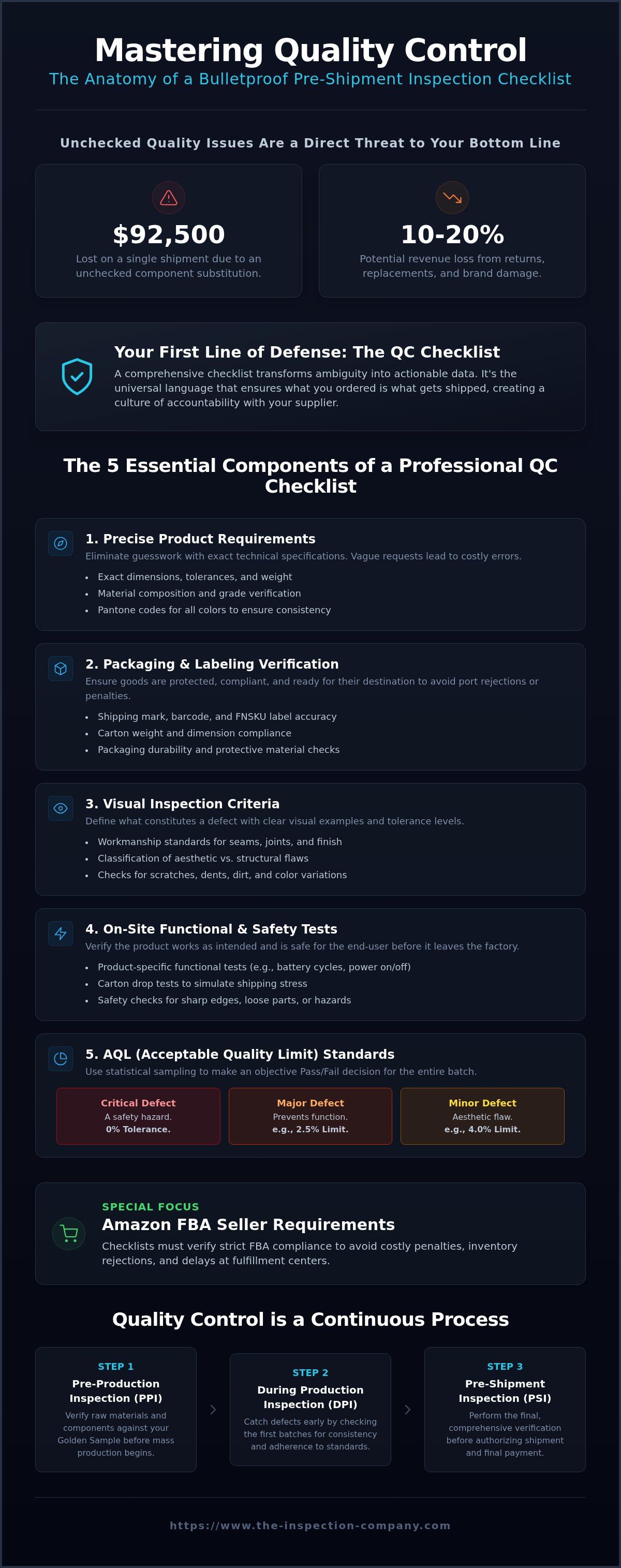
A professional pre-shipment inspection checklist is a technical contract. It must move beyond vague descriptions to include exact dimensions, weight tolerances, and material specifications. Color verification should always reference Pantone codes to eliminate subjective interpretation by factory staff. Packaging and labeling are also critical components, ensuring that shipping marks comply with international standards or specific U.S. import inspection requirements. Failing to document these details often results in non-compliant goods that are seized or rejected at the port of entry.
Visual inspection and on-site testing form the core of the verification process. Your checklist should establish clear boundaries for identifying product defects, ranging from aesthetic flaws to structural failures. Functional tests, such as carton drop tests or battery cycle checks, ensure the product survives the logistics chain. If you are unsure which tests apply to your category, you can request a professional consultation to refine your protocols.
Integrating AQL (Acceptable Quality Limit) Standards
Statistical sampling via AQL is the industry standard for high-volume production. Your checklist must define specific limits for critical, major, and minor defects. For example, a critical defect, such as a safety hazard, usually carries a 0% tolerance. Without these defined limits, your pre-shipment inspection checklist cannot provide a clear "Pass" or "Fail" result, leaving you vulnerable to factory disputes.
Specialized Requirements for Amazon FBA Sellers
Amazon sellers face unique pressures. A specialized Amazon FBA inspection must verify FNSKU labels and carton weight compliance. In 2026, failing to meet these strict dimension requirements can result in significant penalties or warehouse rejections. Your checklist should mandate packaging durability tests to ensure goods arrive at Amazon fulfillment centers in pristine condition, ready for immediate sale.
Customizing Your Checklist for Different Production Stages
Quality management isn't a single event; it's a continuous process of risk mitigation. A one-size-fits-all pre-shipment inspection checklist is often insufficient for complex supply chains. Effective oversight begins with a Pre-Production Inspection (PPI) to verify raw materials against your Golden Sample. This ensures the foundation of your order is sound before mass assembly begins. Moving into the middle of the cycle, a During Production Inspection (DPI) allows you to catch systemic errors in the first batch, preventing a total loss of the production run.
The Pre-Shipment Inspection (PSI) serves as the final gatekeeper. It occurs when at least 80% of your order is packed and ready. This is your last opportunity to verify your pre-shipment inspection checklist points before releasing the balance payment. Finally, a Container Loading Inspection ensures that the correct quantity is loaded securely, protecting your goods from mishandling during the final transition to the port.
Identify Your Product’s Critical Failure Points
Every product has a weak link that needs a dedicated checklist section. You must determine which features are most likely to fail by analyzing historical data and previous batch reports. For electronics, this might be the soldering integrity; for textiles, it's often the seam strength. Focusing your inspection on these high-risk areas ensures that your most vulnerable components receive the most scrutiny.
Define Clear Pass/Fail Criteria
Subjective terms like "high quality" or "industry standard" have no place in a professional inspection. These phrases lead to factory disputes and inconsistent results. You must provide your inspector with objective measurements and clear Go/No-Go instructions. If a dimension deviates by more than 1.5mm, it's a fail. This level of precision removes ambiguity and ensures your standards are met every time. To build a protocol tailored to your specific product, contact our quality experts today.
Turning Your Checklist into Action with The Inspection Company
A comprehensive pre-shipment inspection checklist only provides value when it's executed with precision on the factory floor. The Inspection Company (TIC) bridges the gap between your technical documentation and physical reality. We take your specific requirements and convert them into a rigorous digital protocol on our Quality Platform. This ensures every point you've prioritized is systematically verified by our team of 700+ inspectors across Asia.
Transparency is the foundation of our service. Within 24 hours of the site visit, you'll receive a detailed report featuring high-resolution photos and videos. This rapid turnaround allows you to make informed decisions about approving or rejecting shipments without delaying your supply chain. Our European management structure provides an additional layer of security. It ensures your checklist is interpreted through the lens of international quality standards rather than local factory convenience, providing a blend of global expectations and localized operational presence.
Expert Support in Checklist Creation
Many importers struggle to identify every potential risk. TIC assists you in refining your pre-shipment inspection checklist by drawing on decades of regional manufacturing experience. A third-party perspective often reveals critical failure points, such as material substitutions or subtle packaging flaws, that might've been missed during the design phase. We don't just follow your instructions; we help you strengthen them to forestall significant financial losses and operational friction.
Booking Your Next Inspection
Securing your production is a straightforward, methodical process. Once you've defined your criteria, simply upload your requirements and schedule an on-site visit through our platform. This proactive investment protects your brand from the fallout of defective goods and builds a culture of accountability with your suppliers. Secure your shipment and book a professional inspection today.
Secure Your Supply Chain with Professional Quality Oversight
A well-defined pre-shipment inspection checklist is no longer a luxury; it's a critical requirement for any importer navigating the complexities of 2026 manufacturing. You've learned that standardizing your communication and defining clear, objective pass/fail criteria are the only ways to prevent costly quality fade. By integrating AQL standards and specialized Amazon FBA requirements, you transform a simple document into a powerful shield against financial loss.
The Inspection Company provides the local expertise needed to turn these protocols into action. With European management and over 700 local inspectors across Asia, we ensure your standards are upheld without compromise. You'll receive detailed reports within 24 hours, allowing you to maintain control over your inventory from anywhere in the world. Don't leave your brand's reputation to chance or factory internal checks. Request a Free Inspection Quote and Secure Your Quality Standards today. Protecting your investment starts with professional oversight you can trust.
Frequently Asked Questions
What is the difference between a QC checklist and a product specification?
A product specification defines the design and materials, whereas a QC checklist outlines the specific steps to verify those traits. Think of the spec as the "what" and the checklist as the "how." During a pre-shipment inspection checklist verification, the inspector uses the checklist to confirm the factory followed the specs. This prevents subjective interpretations that lead to quality fade and communication gaps with your Asian suppliers.
Can I use the same quality control checklist for all my products?
You cannot use a universal checklist because different product categories face unique technical risks. While basic shipping marks might be the same, an electronics functionality test is entirely different from a textile seam-strength check. Customizing your pre-shipment inspection checklist for each SKU ensures that critical failure points are monitored. This tailored approach is essential for risk mitigation and maintaining consistent quality across diverse product lines and batches.
How detailed should my QC checklist be for a new supplier?
Your checklist must be exceptionally detailed for new suppliers to eliminate ambiguity. You shouldn't assume the factory understands your quality expectations without written proof. Define every measurement, material grade, and defect tolerance in absolute terms. Granular documentation acts as a technical contract, forcing the supplier to meet your exact standards. This level of detail is a preventative investment that forestalls operational friction and potential financial losses.
What happens if the factory fails the items on my checklist?
When a factory fails an inspection, you must withhold the final balance payment until the issues are resolved. You should demand a formal corrective action plan and require the factory to sort or re-work the defective units. Following the repair, a second inspection verifies the fixes. This process ensures you only pay for goods that meet your standards, protecting your capital and preventing warehouse rejections once the shipment arrives.
Who should create the QC checklist: the buyer or the inspection company?
The buyer provides the initial product requirements, but the inspection company optimizes them into a professional protocol. You understand your customer's needs, while we understand the realities of the factory floor. The Inspection Company assists in identifying risks you might miss, converting your criteria into a digital protocol. This collaborative effort ensures our 700+ inspectors have the precise instructions needed to protect your shipment and brand reputation.