

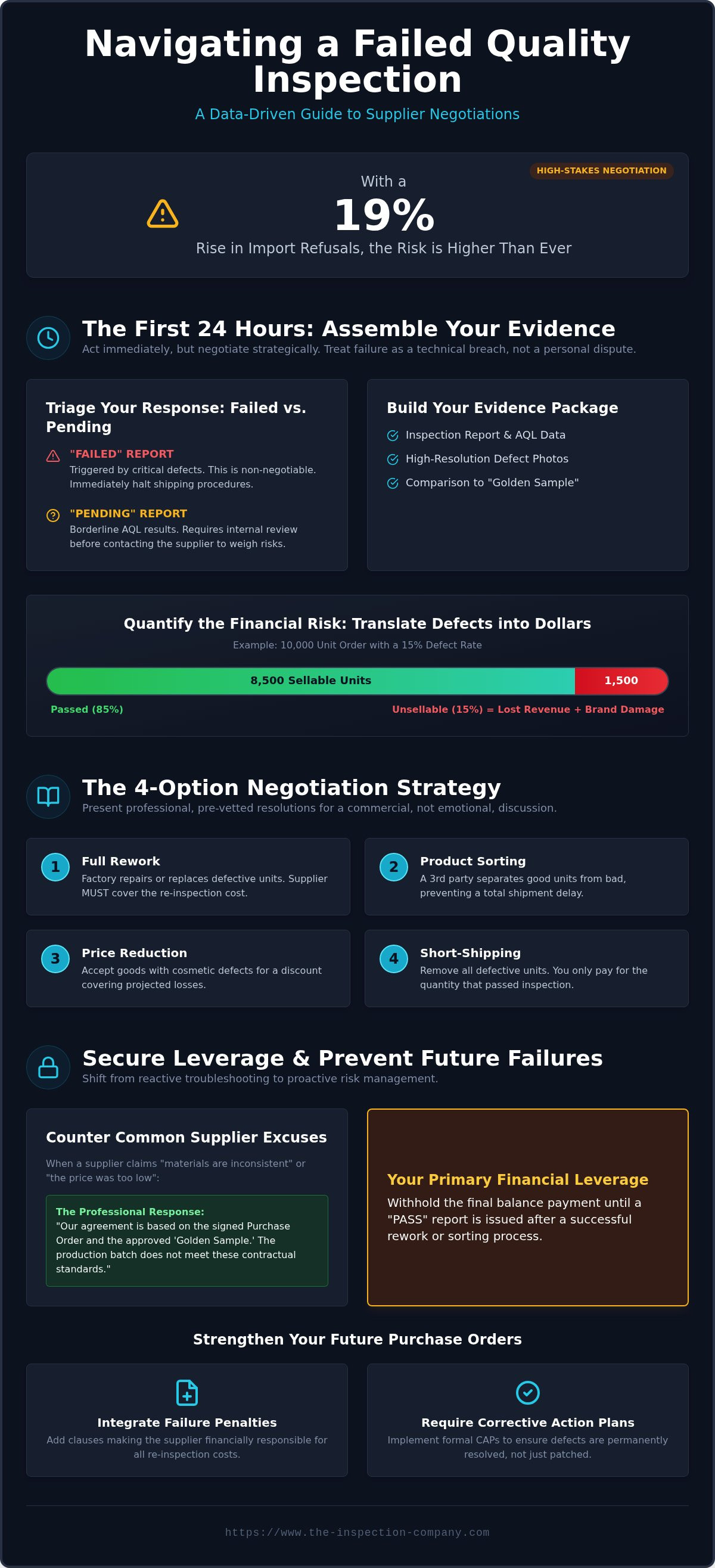
A failed quality report isn't the end of a production cycle; it's the start of a high-stakes financial negotiation. With import refusals rising by 19% in 2026, the risk of shipping sub-standard goods has never been higher. You've likely invested months of capital into this order, only to receive a report filled with critical defects. It's natural to feel trapped between accepting poor inventory or facing catastrophic shipping delays. However, negotiating with supplier after failed inspection scenarios requires more than just frustration. It requires objective, data-driven evidence to overcome factory pushback and face-saving excuses.
How do you resolve these failures without damaging the partnership? This guide provides the professional framework you need to leverage inspection data, hold your manufacturer accountable for re-inspection costs, and secure necessary reworks. You'll master the tactics required to recover order value and protect your brand. We'll examine how to transform a failed report into a roadmap for recovery, ensuring your final shipment meets market standards without sacrificing profit margins. You don't have to accept a loss; you just need a better strategy.
Key Takeaways
- Learn why the first 24 hours following a report are critical for objective data analysis and how to frame a failure as a contractual breach rather than a personal dispute.
- Master a professional four-option framework for negotiating with supplier after failed inspection scenarios that prioritizes commercial resolutions like factory-funded reworks and product sorting.
- Understand how to implement formal Corrective Action Plans (CAP) and re-inspection protocols to verify that defects are permanently resolved without introducing new production errors.
- Discover how to transition from reactive troubleshooting to proactive risk management by integrating failure penalties and stricter quality standards into your future Purchase Order terms.
Assembling Your Evidence: The First 24 Hours After a Failed Inspection
A failed quality report demands immediate action but not immediate confrontation. Successful negotiating with supplier after failed inspection outcomes depend on the "24-Hour Rule." You must acknowledge receipt of the report to the factory within one business day, but you should delay the actual negotiation until you've fully analyzed the data. Treat the "Fail" result as a technical breach of the agreed quality standard rather than a personal dispute. This shift in perspective, rooted in established quality control principles, keeps the conversation professional and objective.
Your first step is consolidating the Evidence Package. This includes your Pre-Shipment Inspection report, high-resolution defect photos, and specific AQL data. Compare these findings directly against your "Golden Sample." By highlighting the delta between the approved sample and the inspected batch, you remove subjectivity. The factory can't argue with a physical comparison that clearly shows where the production deviated from the confirmed standard.
Failed vs. Pending: Triage Your Response
Distinguishing between a "Failed" and "Pending" result is vital for your strategy. A "Pending" report often means the AQL results are borderline or require your specific judgment. Don't contact the factory until internal stakeholders have reviewed the risks. Conversely, a "Failed" result is often triggered by critical defects, such as safety hazards or function failures. These issues are non-negotiable and require an immediate halt to shipping procedures regardless of the total defect count.
Quantifying the Financial Risk
Suppliers often downplay defects as minor inconveniences. You must translate defect percentages into "projected unsellable units" to illustrate the commercial reality. If 15% of a 10,000-unit order is defective, you're looking at 1,500 units of lost revenue. Factor in the cost of customer returns and potential brand damage on platforms like Amazon. This total figure becomes your negotiation floor, providing a clear financial justification for demanding reworks or credits.
The 4-Option Negotiation Strategy: Moving Beyond 'Unacceptable Quality'
Negotiating with supplier after failed inspection scenarios shouldn't be an emotional argument; it's a commercial resolution. Presenting the factory with specific, pre-vetted options demonstrates that you're prepared to move forward while maintaining your quality standards. This professional approach is essential for managing supplier risk and protecting your brand's reputation from the fallout of sub-standard inventory.
Consider these four professional resolutions to resolve the failure:
- Full Rework: The factory repairs or replaces all defective units. Critically, the supplier should cover the cost of a re-inspection to verify the fix.
- Product Sorting: If only a specific portion of the batch is affected, use a 3rd party inspection company to separate acceptable units from failures. This prevents the entire shipment from being delayed.
- Price Reduction: If defects are cosmetic and won't trigger customer returns, you might accept the goods 'as-is' in exchange for a discount that covers your projected loss.
- Short-Shipping: Remove all defective units from the order. You only pay for the specific quantity that passed the inspection.
Countering Common Supplier Excuses
Factories often claim that materials are "naturally inconsistent" or that the price point was too low for higher quality. Don't engage with these subjective claims. Reframe the conversation back to the signed Purchase Order and the AQL standards agreed upon during the pre-production phase. If the goods don't match the "Golden Sample," the factory has failed to meet its contractual obligations.
Securing Financial Leverage
Financial leverage is the primary tool for ensuring supplier cooperation. You must withhold the final balance payment until a "Pass" report is issued following a successful rework or sorting process. If you've already paid in full, your ability to demand accountability drops significantly. If you are facing a difficult supplier, reach out to our team to discuss how to structure your quality evidence for maximum leverage.
Implementing Corrective Action Plans (CAP) and Re-inspection Protocols
A Corrective Action Plan (CAP) is the formal roadmap for resolving production failures. It moves the conversation from blame to technical resolution. In the process of negotiating with supplier after failed inspection, the CAP acts as a binding agreement. This document specifies how the factory will fix current defects and, more importantly, how they'll prevent recurrence. This structured approach aligns with global supplier quality management principles. Industry standard is clear: the supplier covers the cost of all re-inspections following a failure. You must also set a strict deadline for rework. Delays here often lead to missed vessel bookings and expensive air freight costs.
The Anatomy of an Effective CAP
An effective CAP isn't a vague promise to improve. It requires a detailed technical breakdown. First, a root cause analysis identifies if the failure stemmed from faulty machinery, poor raw materials, or untrained staff. Second, it lists specific actions for every defective unit. For example, will they be replaced, repaired, or simply sorted? Finally, it establishes a verification process. The factory's internal QC must approve the goods against the original AQL standards before you send a third-party inspector back to the site.
Monitoring Rework to Prevent New Defects
Rework carries inherent risks. Aggressive repairs can cause new issues, such as chemical cleaning marks, surface scratches, or structural damage. You shouldn't wait until the end of the rework to check the results. Utilizing a During Production Inspection allows you to monitor the repair process in real-time. This proactive oversight ensures the factory doesn't cut corners to meet your deadline. If you need assistance drafting a technical CAP that holds your factory accountable, contact our quality experts for professional guidance.
Strengthening Your Supply Chain: Preventing Future Inspection Failures
Resolving a single failure is necessary, but true operational efficiency requires a shift from reactive crisis management to proactive supplier management. Successful negotiating with supplier after failed inspection outcomes should lead to permanent changes in your procurement contracts. You must update your Purchase Order (PO) terms to include explicit "Failure Penalties." These clauses should mandate that the supplier covers all re-inspection and product sorting fees if a batch fails to meet the agreed AQL. Viewing third-party inspection as a preventative investment rather than a sunk cost reduces long-term friction and protects your margins from unexpected defects.
The process of negotiating with supplier after failed inspection is often exhausting; preventing the failure altogether is the more sustainable goal. Before placing your next order, consider if the supplier possesses the technical capacity to succeed. A professional Factory Audit identifies systemic weaknesses in a manufacturer's quality control system before production begins. It's often more cost-effective to vet a supplier's capability upfront than to manage the fallout of a failed shipment later.
Updating Your Inspection Checklist
Use the data from your failed report to refine your AQL limits. If specific "Major" defects appeared in the last run, reclassify them as "Critical" for the next inspection. This ensures the factory's production team understands that even a single instance of these errors will trigger an automatic failure. Clear, data-driven expectations leave no room for the face-saving excuses often encountered during the negotiation phase.
When to Find a New Supplier
Don't ignore "Chronic Quality Failure." If a factory's Corrective Action Plans never result in lasting improvement, the issue is likely cultural or structural. When re-inspections consistently fail despite repeated promises of rework, it's time to diversify your supply chain. Ready to secure your next shipment? Contact our expert team today for a custom quality strategy.
Securing Your Brand Through Data-Driven Accountability
A failed inspection report is a technical roadmap for recovery, not a commercial dead end. By prioritizing objective data over emotional disputes, you transform a production error into an opportunity for improved supplier performance. Success in negotiating with supplier after failed inspection scenarios relies on having an evidence package that factories cannot ignore. Whether you choose a full rework, product sorting, or price reductions, your leverage remains rooted in the clarity of your quality standards and contractual terms.
Protecting your investment requires a partner who understands the high stakes of international trade. Our European management standards in Asia ensure that every report is transparent and actionable. With over 700 inspectors stationed across major manufacturing hubs, we deliver detailed quality reports within 24 hours to give you immediate leverage. Don't leave your brand reputation to chance. Book your next Pre-Shipment Inspection to protect your brand and ensure your goods meet market standards every time. You have the tools to turn quality failures into lasting supply chain resilience.
Frequently Asked Questions
Can a supplier legally refuse to rework goods after a failed inspection?
A supplier can refuse, but this usually violates the quality standards defined in your Purchase Order. Your standing depends entirely on your contract terms. If you've included specific AQL requirements, a refusal to rework is a breach of agreement. Without final payment as leverage, you'll find it difficult to force compliance. Always ensure your PO defines rework obligations before production begins to mitigate this operational risk.
How much of a discount should I ask for if I accept defective goods?
Your discount request should reflect the total projected loss from the defective units. Don't just ask for the cost of the goods; factor in shipping, duties, and the potential for increased customer returns. If 8% of the batch is defective, a 10% to 15% discount is a reasonable baseline. This ensures you cover the financial friction of handling sub-standard inventory while protecting your profit margins.
Who typically pays for the re-inspection fee after a failure?
Industry standards dictate that the supplier pays for re-inspection fees after an initial failure. This acts as a financial deterrent against poor quality control. When you're negotiating with supplier after failed inspection, you must hold firm on this point. Ensure your third-party inspector provides a transparent invoice that you can deduct from the final balance payment. This keeps the factory accountable for their specific production errors.
Should I negotiate with the factory owner or my sales contact?
You should begin with your sales contact but involve the factory owner if negotiations stall. Sales staff often prioritize their commission and may hide quality issues from management. The owner is more likely to understand the long-term risk of losing a client or damaging their reputation. Escalating the conversation shows you're serious about the data in your report and won't accept sub-standard goods.
Is it better to negotiate via email or a messaging app like WeChat?
Email is the superior medium for formal quality negotiations. While messaging apps like WeChat allow for rapid communication, they lack the structural clarity required for complex agreements. Use email to document your Evidence Package and Corrective Action Plans. This creates a permanent, professional record of the negotiation. You can use messaging for informal follow-ups, but always confirm the final resolution through a formal email thread.
Does a 'Fail' report mean I should cancel the entire order immediately?
A "Fail" result doesn't always justify an immediate cancellation. Many production errors are fixable through professional rework or product sorting. You must triage the defects based on their severity. If the report identifies "Critical" safety flaws, cancellation is often the only way to protect your brand. However, for most "Major" defects, negotiating with supplier after failed inspection to secure a rework is the more efficient business decision.