
Can your profit margins survive an 8,150% increase in Amazon's inbound defect fees? With penalties now reaching as high as $5.72 per unit for non-compliant shipments, a single labeling error is no longer a minor inconvenience; it's a financial catastrophe. You've likely felt the anxiety of wondering if your latest shipment will be the one that gets rejected at the fulfillment center door. It's a valid concern, especially since Amazon discontinued its in-house prep and labeling services at the start of 2026. You're now fully responsible for every barcode and polybag.
Protecting your account health requires a proactive approach to quality control. This guide will teach you how to leverage a pre-shipment inspection for amazon fba to secure zero-defect shipments and maintain a 4.5 star rating. We'll explore the 2026 FNSKU mandates, the impact of new fuel surcharges, and the methodical steps you must take to ensure your inventory is 100% compliant before it leaves the factory floor. By the end of this article, you'll have a clear roadmap to mitigate operational risks and keep your profit margins intact.
Key Takeaways
- Understand why a professional pre-shipment inspection for amazon fba is your best defense against 2026 inbound defect fees.
- Master the technical labeling requirements, including FNSKU and suffocation warnings, to ensure 100% compliance with Amazon’s latest standards.
- Learn why independent random sampling is the only way to get an objective view of your inventory quality before final payment.
- Discover the strategic timeline for booking inspections to identify errors while you still maintain financial leverage with your manufacturer.
The Strategic Role of Pre-Shipment Inspection in Amazon FBA Success
In the 2026 Amazon ecosystem, a generic quality check isn't enough. Standard QC might confirm a product functions, but a pre-shipment inspection for amazon fba verifies that the inventory is actually shippable. Amazon's updated 2026 fee structure heavily penalizes logistical errors. If your goods don't meet exact FBA standards, you aren't just looking at a minor delay; you're facing a direct hit to your bottom line.
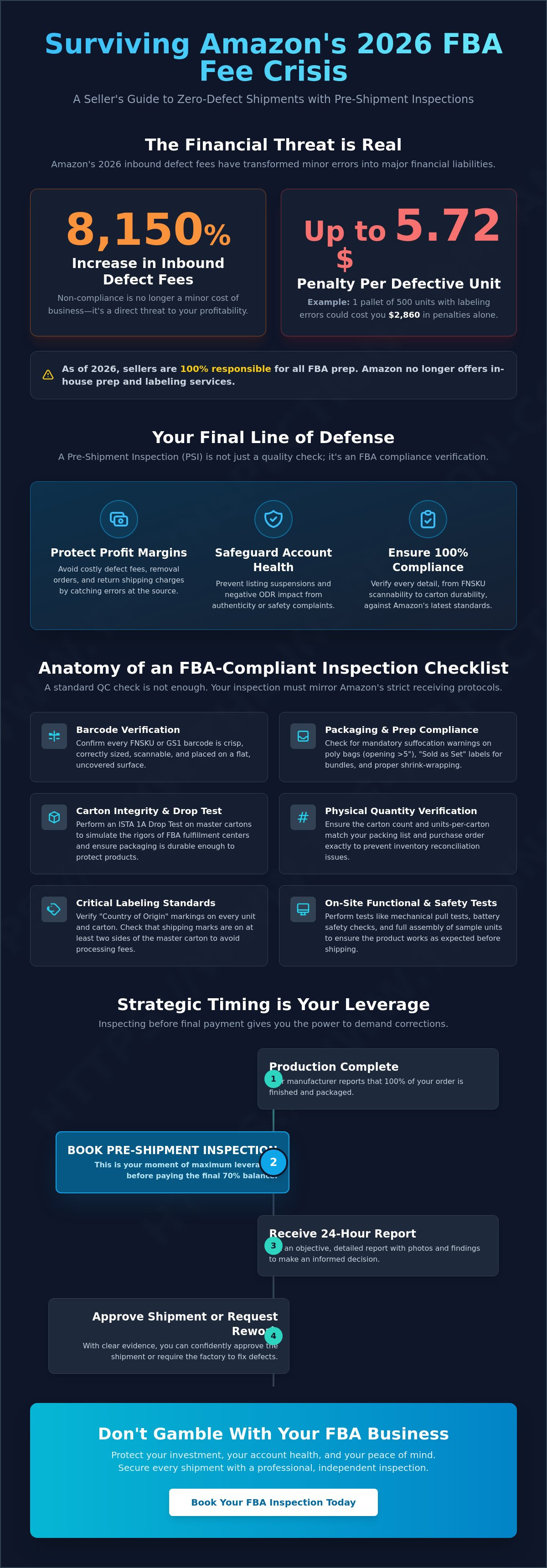
Implementing a pre-shipment inspection for amazon fba is an important quality control method that serves as your final line of defense. The financial math is simple. With inbound defect fees now reaching up to $5.72 per unit, a single pallet of 500 incorrectly labeled items could trigger a $2,860 penalty. This doesn't include the cost of shipping the goods back or the lost sales during the downtime. Investing in a professional inspection is a preventative measure that forestalls these massive financial losses.
Beyond immediate fees, your Amazon Seller Account health is at stake. High defect rates lead to automated account flags. If a customer receives a defective item and reports it, Amazon's algorithms may trigger a "Product Authenticity" or "Safety" complaint. These complaints can suspend your listing or your entire account within hours. In 2026, consumer expectations for precision are higher than ever; a zero-defect strategy is essential for maintaining your Order Defect Rate (ODR).
FBA Rejection: The Hidden Cost of Non-Compliance
When Amazon identifies non-compliant inventory, they often "quarantine" the entire shipment. This logistical nightmare stops your cash flow instantly. You'll be forced to pay for removal orders and third-party prep services to fix errors that should've been caught at the factory. You can learn more about how specific issues like critical or major defects trigger these flags in our guide on Understanding Product Defects. Catching these errors before the 70% balance payment is the only way to maintain control over your supply chain.
Anatomy of an FBA-Compliant Pre-Shipment Checklist
A standard quality check isn't sufficient for the Amazon ecosystem. Your pre-shipment inspection for amazon fba must adhere to a specialized checklist that mirrors Amazon’s strict receiving protocols. These requirements often exceed general international trade requirements, focusing heavily on scannability and transit durability. If a barcode fails to scan at the fulfillment center, your inventory is effectively invisible.
The checklist begins with barcode verification. Inspectors must confirm that every FNSKU or GS1 barcode is crisp, correctly sized, and placed on a flat surface. Packaging compliance is equally critical. Poly bags with an opening of five inches or more must feature legible suffocation warnings. If you sell bundles, "Sold as Set" labels are mandatory to prevent warehouse staff from breaking apart your units. We also perform a physical quantity verification. Short shipments are a common source of reconciliation disputes in Seller Central; we ensure the carton count matches your packing list exactly.
Carton integrity is where many sellers fail. We utilize the ISTA 1A Drop Test to simulate the rigors of the Amazon logistics chain. This involves dropping a master carton from specific heights on its corners, edges, and faces. If the packaging isn't robust enough to survive this test, it won't survive the automated conveyor systems at an FBA warehouse. If you're concerned about your current packaging durability, consult with our specialists to refine your requirements.
Critical Labeling Standards for 2026
Customs and Amazon both require clear "Made in China" country of origin markings on every individual unit and master carton. Shipping marks must be placed on at least two sides of the carton to avoid manual processing fees. Regarding sampling, the Acceptable Quality Limit (AQL) is the statistical standard used to determine if a production lot meets your quality specifications based on a specific number of allowed defects within a random sample.
Functional and Safety Testing on the Factory Floor
On-site testing ensures your product actually works before it leaves Asia. This includes mechanical pull tests for apparel, battery safety checks, and full assembly of at least one unit per batch. For electronics, verifying RoHS compliance is essential to meet safety regulations and prevent hazardous material flags on your listing.
The PSI Workflow: From Factory Floor to 24-Hour Report
Timing is critical when coordinating a pre-shipment inspection for amazon fba. You must book your inspection slot 5 to 7 days before your scheduled "Ship Date." This lead time ensures that the factory has completed 100% of the production and packed at least 80% of the goods. If an inspector arrives and the goods aren't ready, you'll lose valuable time and likely incur a "missed inspection" fee from your provider.
Once on-site, the inspector performs random sampling. This is a non-negotiable step. They must choose cartons from the middle and bottom of the pallets, not just the "top layer" that factories often prepare for show. This methodical approach ensures the sample is statistically significant and truly representative of the entire lot. Within 24 hours of the inspection, you'll receive a digital report. This document includes high-resolution photos of defects, scannability tests for barcodes, and a clear "Pass" or "Fail" result based on your pre-defined AQL standards.
A "Fail" result requires immediate action. It's your leverage. You shouldn't release the final 70% payment until the factory addresses the identified issues. This correction phase is the difference between a profitable launch and a shipment of "quarantined" inventory.
Managing the Supplier Relationship During QC
Communication gaps often lead to quality drift. The European management at The Inspection Company bridges the cultural divide between western expectations and Asian production realities. We ensure your factory understands that the "Golden Sample" isn't just a prototype; it's the mandatory standard for every unit in mass production.
Rework and Sorting Services
If your pre-shipment inspection for amazon fba identifies a high percentage of minor defects, you don't have to scrap the whole batch. You can utilize product sorting and rework to isolate the bad units. We recommend including a "Chargeback" clause in your purchase order. This holds the supplier financially responsible for the cost of re-inspections if the initial lot fails. Ready to secure your next shipment? Contact our team today to schedule your professional inspection.
Why Third-Party Inspection is Non-Negotiable for FBA Sellers
Relying on a factory’s internal quality control is a fundamental risk to your business. A clear conflict of interest exists because a manufacturer is naturally incentivized to meet shipping deadlines and clear inventory, not to identify their own production errors. An independent pre-shipment inspection for amazon fba removes this bias. By utilizing third-party experts, you receive an objective assessment that prioritizes your profit margins over the factory's production schedule.
The Inspection Company provides a localized operational presence with over 700 inspectors across Asia. This vast network allows for rapid deployment and consistent oversight, ensuring that international quality standards are applied directly at the source. It isn't enough to just hope for quality; you need a partner with the geographic reach to be on-site the moment production finishes. This expert presence acts as a powerful deterrent against "quality fade" in mass production.
Managing multiple SKUs requires a centralized data strategy. Our Quality Platform enables you to track defect trends across your entire product line over time. This data is invaluable for identifying recurring issues before they become systemic across your brand. Once your goods pass, closing the loop with container loading supervision ensures that the specific units verified during the pre-shipment inspection are the ones actually loaded into the shipping container, preventing unauthorized "swapping" of goods.
Building a Long-Term Sourcing Strategy
Your inspection data serves as a report card for your suppliers. Consistent pass rates indicate a reliable partner suitable for scaling, while frequent failures signal a need for supply chain diversification. Integrating a pre-shipment inspection for amazon fba with periodic factory audits creates a total risk management approach. This combination ensures your manufacturer remains compliant with both quality standards and ethical management practices throughout the duration of your partnership.
Protect Your Profit Margins with Proactive Quality Control
The 2026 Amazon marketplace leaves no room for logistical error. With inbound defect fees reaching record highs, your success depends on delivering perfect inventory every time. You've seen how a precise checklist and a methodical workflow can prevent account flags and financial penalties. Mastering the pre-shipment inspection for amazon fba is the most effective way to maintain control over your supply chain and protect your seller reputation. It's a preventative investment that pays for itself by avoiding a single rejected shipment.
The Inspection Company provides the expert oversight you need to navigate these high-stakes requirements. Our European management team based in Hong Kong ensures that western quality standards are strictly enforced across our entire network. With over 700 specialized inspectors across Asia and comprehensive digital reports delivered within 24 hours, you get the transparency and speed necessary for agile e-commerce operations. Don't leave your account health to chance or biased factory-led QC.
Secure your FBA shipment today with a professional Amazon FBA Inspection and scale your brand with the confidence of a verified supply chain.
Frequently Asked Questions
What is the difference between a standard PSI and an Amazon FBA inspection?
A standard pre-shipment inspection verifies that a product functions and meets basic aesthetic standards. An Amazon-specific inspection adds critical layers of logistical verification; such as scannability tests for FNSKU barcodes and compliance checks for suffocation warnings on poly bags. It focuses on the specific requirements that prevent Amazon from rejecting your shipment at the fulfillment center door.
How much does a pre-shipment inspection for Amazon FBA typically cost?
The cost of a pre-shipment inspection for amazon fba depends on the number of man-days required to complete the sampling. While industry rates vary; the expense is best viewed as a form of insurance. When compared to the potential $5.72 per-unit inbound defect fees Amazon introduced in 2026, the cost of professional oversight is a fraction of the financial risk associated with non-compliance.
Can Amazon reject my shipment if it arrives without an inspection report?
Amazon doesn't mandate that you upload an inspection report to Seller Central. They will; however, reject your shipment or charge significant manual processing fees if the goods arrive with labeling or packaging errors. A professional inspection ensures your inventory is 100% compliant before it enters the Amazon logistics network, effectively preventing these rejections from occurring in the first place.
What happens if the inspector finds major defects in my Amazon order?
If an inspection results in a "Fail," you should immediately withhold the final balance payment from your supplier. You then require the factory to sort out the defective units and rework the batch. It's standard practice to have the supplier pay for a second inspection to verify the corrections were made before the goods are finally loaded for transit.
How many units will the inspector check in a 1,000-unit order (AQL)?
Inspectors follow the ANSI/ASQC Z1.4 statistical sampling method to determine the sample size. For a batch of 1,000 units under General Inspection Level II, an inspector will typically pull and examine 80 units at random. This sample provides a statistically accurate representation of the entire shipment's quality without the prohibitive cost of checking every single item.