

What if your next shipment from Asia arrived with a 15% defect rate, right as the new Section 122 global surcharge adds 10% to your landed costs? You've likely felt the anxiety of wire-transferring thousands of dollars to a factory you can't visit, hoping the goods match your specifications. It's a common fear because the financial stakes in 2026 are higher than ever, with average US tariff rates reaching 11.0%. Setting up a quality management system for imports isn't just about paperwork; it's about installing a remote-control mechanism for your supply chain.
We recognize that receiving a container of defective goods is more than a setback; it's a direct threat to your brand's reputation and bottom line. You'll learn how to build a robust quality management system that secures your supply chain and eliminates the risks of importing from Asia. This guide provides a methodical framework for quality control, ranging from initial factory audits to final container loading inspections, ensuring your operations remain resilient against hidden costs and communication barriers.
Key Takeaways
- Transition your operations from reactive damage control to proactive prevention by establishing clear product specifications and statistical AQL thresholds.
- Discover the five critical steps for setting up a quality management system for imports that integrates rigorous QC protocols into your legal purchase agreements.
- Mitigate risk at the source by conducting comprehensive Factory Audits to verify a manufacturer's capacity and quality standards before you commit capital.
- Eliminate the inherent conflict of interest in factory-led reporting by employing independent third-party verification to ensure unbiased results.
- Protect your brand reputation through targeted Pre-Shipment and Container Loading Inspections that ensure only compliant goods are shipped.
What is an Import Quality Management System (QMS)?
An Import QMS is a structured framework of procedures designed to ensure that products manufactured abroad consistently meet your specific quality standards and regulatory requirements. It is a formalized architecture of control that governs every interaction between your brand and your remote factory. Rather than relying on trust, a Quality Management System (QMS) provides a verifiable paper trail and a set of operational "fail-safes" that protect your capital. Ultimately, define an Import QMS as a preventative investment against supply chain friction.
Why does this matter in 2026? Successfully setting up a quality management system for imports shifts your business from a reactive state to a proactive one. Most importers operate in a reactive loop; they discover defects only after the container is opened at their warehouse. By then, the capital is gone and the supplier has little incentive to help. A robust QMS forces you to identify and prevent defects at the source, long before the final invoice is paid.
The 2026 trade landscape has made these systems non-negotiable. With the revised ISO 9001:2026 standard emphasizing risk-based thinking and the FDA’s Quality Management System Regulation (QMSR) now in full effect, compliance is more complex. Modern systems now utilize digital reporting and real-time data through specialized quality platforms. This technology allows you to monitor production milestones and inspection results from thousands of miles away, providing the transparency needed to manage remote manufacturing with confidence.
The Cost of 'No System' vs. The Value of QMS
Operating without a QMS is an expensive gamble. When quality fails, the visible defect is only the beginning of your financial loss. Consider the hidden costs that erode your margins:
- Expedited air freight charges to replace unsellable inventory.
- Lost sales and stockouts during the 60 to 90 day reproduction cycle.
- Damaged brand equity and the high cost of processing customer returns.
- Increased administrative friction and legal risks associated with non-compliant goods.
A QMS acts as a risk-mitigation insurance policy for your capital. By performing a Factory Audit and establishing clear protocols early, you eliminate the "surprise" expenses that typically plague international trade. It transforms quality from an unpredictable variable into a manageable asset.
Core Elements of a Quality Framework for Remote Manufacturing
Traditional quality systems often focus on internal office processes. When you are sourcing goods from thousands of miles away, your system must operate on the factory floor. Setting up a quality management system for imports requires a bridge between your brand's standards and the manufacturer's operational reality. Without this bridge, you leave your capital vulnerable to "quality fade" and cultural misunderstandings that lead to production delays.
The foundation of this framework is a set of detailed product specifications. These shouldn't just be CAD drawings or basic descriptions. They must include material requirements, tolerance levels, and packaging standards. This level of detail supports Informed Compliance with customs regulations, ensuring your goods are correctly valued and described. Beyond specifications, you must define Acceptable Quality Limits (AQL). This statistical threshold serves as the "pass or fail" line, determining how many minor, major, or critical defects are permitted in a batch before the entire lot is rejected.
Standardizing defect classification is equally vital for supplier accountability. A "minor" scratch on a consumer item might be a "critical" failure if it impacts electrical safety or structural integrity. By categorizing these issues before production begins, you provide the factory with a clear definition of what constitutes a failure. Finally, your purchase agreements must establish the explicit "right to inspect" at any stage of the manufacturing cycle. If you need help drafting these technical requirements, you can consult with our regional experts to ensure your standards are enforceable.
Defining Your Quality Standards
Everything begins with the "golden sample." This is the physical benchmark that both you and the factory have signed off on. It serves as the ultimate reference point during all future production runs. Alongside this sample, build a comprehensive inspection checklist. This document should leave no room for factory assumptions regarding testing methods, color matching, or aesthetic finishes. Integrating a Pre-Shipment Inspection as a non-negotiable milestone ensures that these standards are verified before the final payment is triggered. This proactive step prevents the financial disaster of shipping sub-standard goods across the ocean.
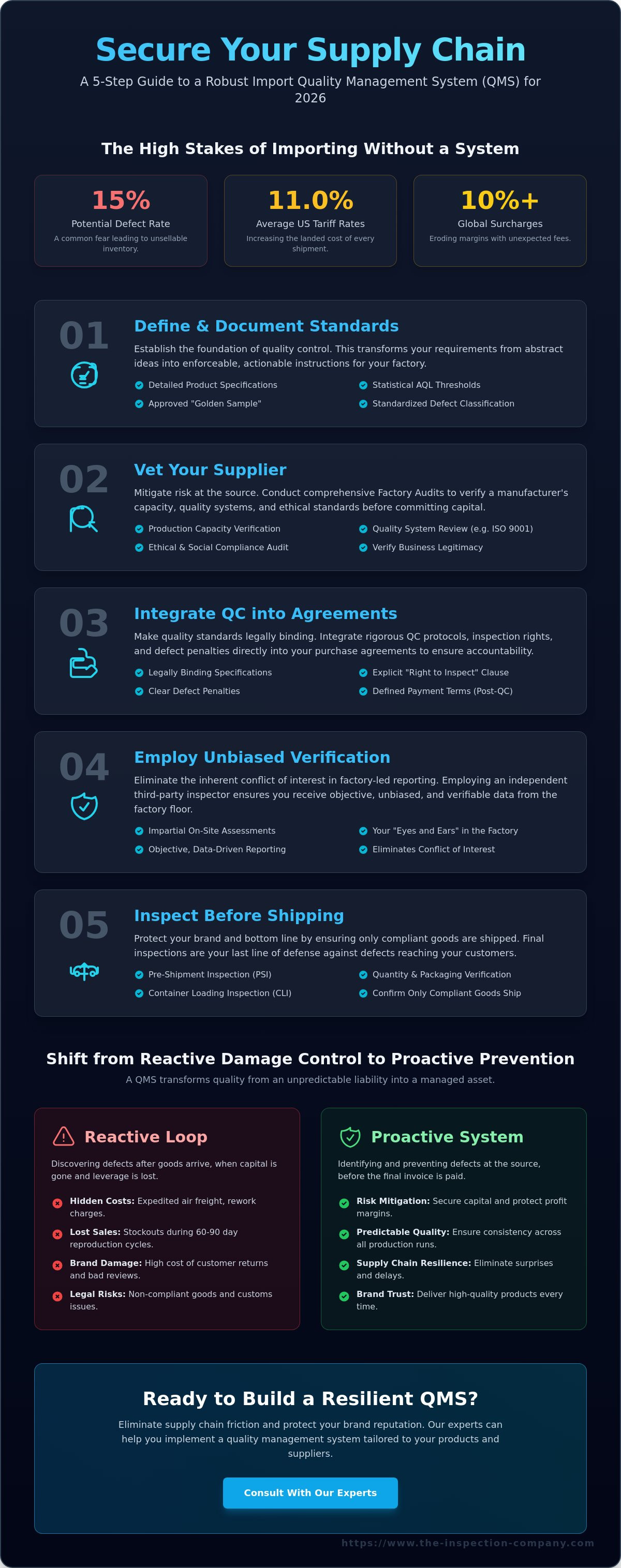
5 Steps to Setting Up Your QMS for Imports in 2026
Executing a methodical strategy is the only way to move from theoretical quality to actual compliance on the factory floor. Successfully setting up a quality management system for imports requires a five-stage approach that secures your capital at every milestone. This process ensures that your expectations are not just communicated but physically verified before goods leave the country of origin.
- Step 1: Supplier Vetting. Your system is only as strong as the manufacturer's infrastructure. Perform a Factory Audit to verify that the supplier possesses the technical capacity, machinery maintenance schedules, and internal QC systems required to meet your specific needs.
- Step 2: Documentation. Draft rigorous Quality Control (QC) protocols and integrate them directly into your Proforma Invoices. This documentation must align with relevant FDA Import Requirements if you are dealing with regulated products, ensuring legal and operational alignment.
- Step 3: In-Process Monitoring. Don't wait until the end of a production run to find a systemic error. Use During Production Inspections to catch defects when only 10% to 20% of the order is finished. This allows for immediate corrective action before the entire batch is compromised.
- Step 4: Final Verification. Conduct a Pre-Shipment Inspection (PSI) once production is 100% complete. This is your final opportunity to verify the AQL of the order and ensure that the "golden sample" standards established earlier have been maintained throughout the run.
- Step 5: Continuous Improvement. Use the data from your inspection reports to refine your standards. If a factory consistently struggles with a specific defect, update your specifications or provide targeted feedback to prevent the issue from recurring in the next cycle.
Ready to secure your next production run? Contact our regional experts to schedule your first factory audit.
Special Considerations for Amazon FBA Sellers
Amazon FBA sellers face unique risks, as a single labeling error can lead to entire shipments being rejected or quarantined. Your QMS must integrate Amazon-specific requirements for carton marking, FNSKU labeling, and palletization. Because Amazon's standards are rigid, an Amazon FBA Inspection is a critical sub-set of your management system. It provides the final layer of security needed to ensure your inventory is "Prime-ready" the moment it hits the fulfillment center, preventing costly storage fees and account health issues.
Executing Your QMS: Why Third-Party Verification is Non-Negotiable
The structural framework discussed in previous sections provides the blueprint, but the execution phase is where your capital is actually at risk. Even with the most detailed specifications, setting up a quality management system for imports fails if you rely on the factory's internal QC team for reporting. A manufacturer's primary objective is to meet production quotas and ship goods to collect the final payment. This inherent conflict of interest means that internal "pass" results are often biased, masking defects that only become apparent once the container is opened at your destination. Factories often prioritize their own margins over your brand's reputation.
Real control requires having "boots on the ground." Local inspectors who understand the regional manufacturing culture can spot subtle signs of quality fade that a remote manager would miss. These experts act as your eyes and ears, ensuring that the statistical AQL thresholds you established are strictly enforced. By utilizing 24-hour reporting cycles, you receive the data necessary to approve or reject shipments with total confidence. A QMS without independent verification is merely a suggestion, not a system.
Data-driven decisions are the hallmark of a professional supply chain. When you receive a detailed inspection report within hours of the site visit, you remove the guesswork from your procurement process. You're no longer hoping for quality; you're verifying it. This transparency allows you to hold suppliers accountable and negotiate from a position of strength if corrective actions are required before shipment.
Choosing the Right Inspection Partner
To bridge the cultural and quality gap, look for an inspection partner that combines European management standards with deep local expertise. This combination ensures that international quality expectations are translated accurately into factory-floor actions. It's also vital to verify that your chosen 3rd party inspection company holds ISO 17020 certification. This accreditation is the industry benchmark for the competence of inspection bodies, providing the assurance that your risk mitigation strategy is being handled by a credible, recognized authority.
Securing Your Global Supply Chain for 2026
The complexity of international trade in 2026 demands more than just trust; it requires a verifiable system of control. Successfully setting up a quality management system for imports transforms your procurement process from a high-stakes gamble into a predictable operational cycle. By integrating clear specifications, statistical AQL thresholds, and rigorous third-party verification, you ensure that your capital is protected before products ever leave the factory floor. These proactive steps move your business beyond damage control and into a state of sustainable growth.
Relying on a factory's internal reporting is a risk no brand should take. True security comes from having an experienced partner on the ground who understands both international standards and regional manufacturing cultures. With European management and a network of over 700 inspectors across Asia, we provide the transparency you need through ISO 9001 and 17020 certified processes. Our detailed reports are delivered within 24 hours, giving you the data-driven confidence to approve or reject shipments in real-time.
Don't leave your brand reputation to chance. Secure your supply chain; book a professional Factory Audit today. Taking this proactive step now will prevent costly complications later, ensuring your business remains resilient in a dynamic global market.
Frequently Asked Questions
Is a Quality Management System the same as Quality Control?
No, they are distinct but related components of your supply chain. A Quality Management System is the overarching framework of procedures and standards you establish to govern production. Quality Control refers to the tactical actions, such as a Pre-Shipment Inspection, used to verify those standards are met on the factory floor. Think of the QMS as the strategic blueprint and QC as the physical verification of that plan.
How much does it cost to implement a QMS for my imports?
Implementation costs vary depending on the frequency of inspections and the complexity of your product specifications. You should view these costs as a preventative investment rather than a simple expense. Successfully setting up a quality management system for imports typically involves costs for factory audits and per-shipment inspections. This investment is significantly lower than the financial loss of a rejected container or a brand-damaging product recall.
Can I set up a QMS if I only order small quantities from Alibaba?
Yes, a QMS is vital regardless of your order size. Small-scale importers often have less leverage with suppliers, making them more vulnerable to quality fade or shipping errors. Implementing basic protocols like sample testing and pre-shipment inspections ensures that your limited capital isn't wasted on unsellable inventory. It builds a repeatable, professional process that provides security as your business and order volumes grow.
What happens if a shipment fails an inspection under my QMS?
A failed inspection triggers a predefined corrective action plan within your system. You might require the factory to sort and repair the defective units at their own expense before scheduling a re-inspection. Because your QMS requires verification before the final payment is triggered, you maintain the financial leverage needed to ensure the manufacturer corrects the errors. This prevents the arrival of sub-standard goods at your warehouse.
Do I need to visit the factory in person to set up a QMS?
No, you don't need to travel internationally to manage your quality standards effectively. Professional third-party inspection firms act as your local presence, providing the expertise and cultural management needed to monitor production. By utilizing services like Factory Audits and During Production Inspections, you gain total transparency into the manufacturing process from your home office. This remote-control mechanism is a core benefit of setting up a quality management system for imports.