

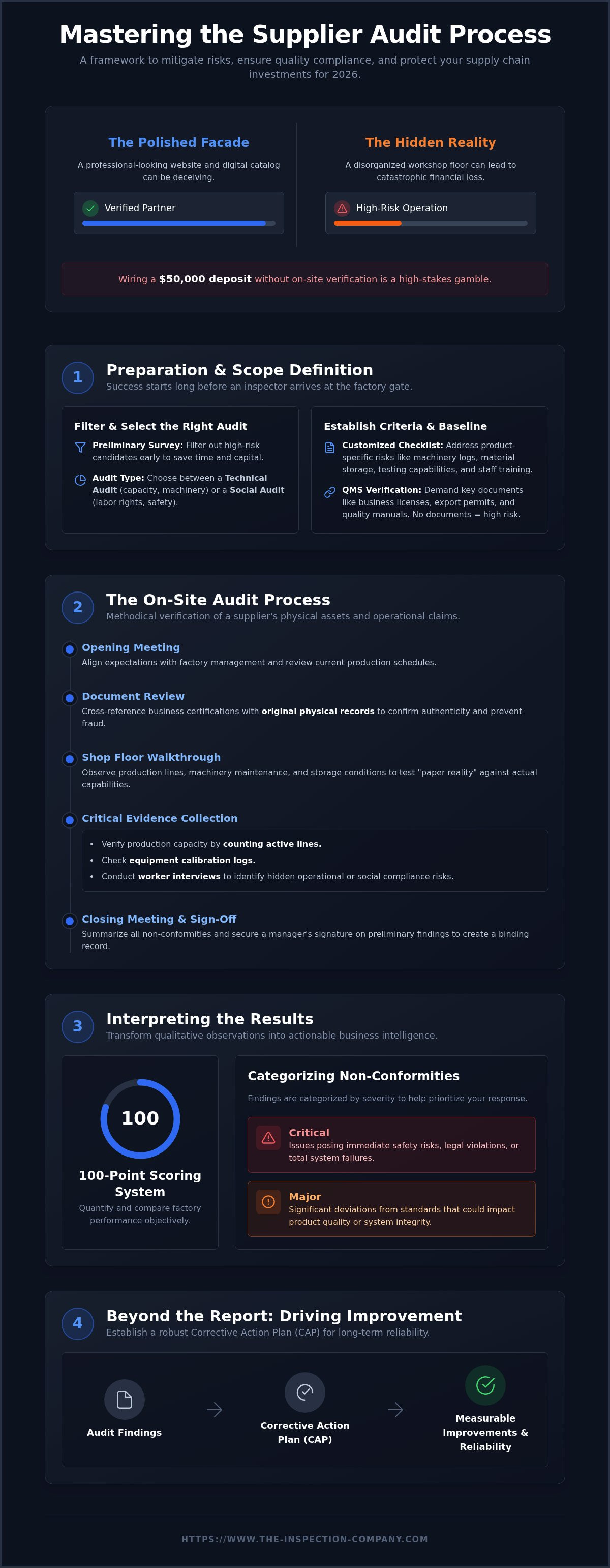
Would you wire a $50,000 deposit to a stranger based only on a professional-looking website? For many importers sourcing from Asia, this is the exact risk they take when they fail to implement a formal supplier audit process before signing a contract. You understand that the gap between a polished digital catalog and a disorganized workshop floor can lead to catastrophic financial loss. The fear of receiving sub-standard products or paying an unverified middleman is a valid concern in the high-stakes world of international manufacturing.
Mastering these verification steps is the only way to transform operational anxieties into a controlled, strategic roadmap. This guide provides the essential framework to mitigate risks and ensure strict quality compliance across your vendor network. We'll examine how to gather objective data to negotiate better terms and protect your supply chain investments for 2026. You'll gain the clarity required to commit to large orders with total confidence in your manufacturing partners.
Key Takeaways
- Define clear audit objectives and utilize preliminary surveys to identify manufacturing red flags before committing resources.
- Master the seven-step supplier audit process to physically verify a factory's production capacity and quality management systems on-site.
- Learn to interpret complex risk scores and categorize non-conformities to make data-driven decisions about your supply chain partners.
- Establish a robust Corrective Action Plan (CAP) to transform audit findings into measurable improvements and long-term vendor reliability.
Defining the Scope: Preparation and Audit Criteria
Success starts long before an inspector arrives at the factory gate. Defining the scope ensures you aren't wasting resources on irrelevant data while helping you identify if your primary risk is social compliance, technical capacity, or quality management. The supplier audit process begins with meticulous preparation. Using a supplier survey allows you to filter out high-risk candidates early, saving both time and capital.
Establishing an "Audit Standard" like ISO 9001 provides a universal benchmark for measurement. However, a generic checklist isn't enough. You need customized criteria that address specific product risks and industry requirements. A tailored checklist should include:
- Machinery maintenance logs and calibration records.
- Raw material storage and moisture control protocols.
- In-house testing capabilities for your specific product category.
- Staff training certifications for critical assembly stages.
Selecting the Right Audit Type for Your Business
Importers often confuse a technical Factory Audit with a Social Audit. While the former focuses on machinery and production capacity, the latter examines labor rights and safety standards. This structured approach to the supplier audit process transforms a vendor into a transparent partner. A simple survey works for initial vetting, but high-value orders require a full-day on-site assessment to verify physical assets and operational claims.
Establishing the Quality Management System (QMS) Baseline
Verifying a factory's internal QMS is the best way to prevent defects before they reach the assembly line. A robust system ensures consistency across thousands of units. During this phase, you must demand key documentation: business licenses, export permits, and quality manuals. If a vendor cannot produce these documents, it's a clear signal of operational friction and potential financial risk. This baseline verification protects your investment from unexpected errors during mass production.
The On-Site Execution: A 7-Step Supplier Audit Process
The on-site audit is a methodical verification of a supplier's physical assets and operational claims. This stage of the supplier audit process begins with an opening meeting to align expectations with factory management and review current production schedules. During the subsequent document review, inspectors cross-reference business certifications with original physical records to confirm authenticity. This prevents the common risk of relying on forged or expired digital documents.
The shop floor walkthrough offers a real-time view of production lines, machinery maintenance, and storage conditions. It's during this phase that the "paper reality" of a factory is tested against its actual capabilities. Physical observation is the only way to detect hidden operational friction before it affects your bottom line.
Critical Evidence Collection on the Shop Floor
Inspectors meticulously verify production capacity by counting active lines and checking equipment calibration logs. They don't just look at machines; they conduct worker interviews to identify hidden operational risks or social compliance issues. These face-to-face interactions often reveal bottlenecks or labor practices that a standard quality report might overlook. If you have specific concerns about a vendor's technical capacity, it's best to consult with an expert to tailor your examination criteria.
The Closing Meeting and Preliminary Findings
The process concludes with a closing meeting where the inspector summarizes all non-conformities with factory management before leaving the premises. This ensures there are no surprises when the final report is issued. Securing a manager's signature on these preliminary findings is a critical step in the supplier audit process. It creates a binding record of the day's observations and prevents the factory from disputing the findings once the inspector is gone.
Interpreting the Results: Risk Scoring and Reporting
An audit report is only as valuable as the data it clarifies. At The Inspection Company, we utilize a rigorous 100-point scoring system to quantify factory performance. This objective metric removes guesswork from the supplier audit process, allowing you to compare potential partners on a level playing field. It transforms qualitative observations into actionable business intelligence.
Findings are categorized into three distinct levels of severity to help you prioritize your response:
- Critical: Issues posing immediate safety risks, legal violations, or total system failures.
- Major: Significant failures in quality management likely to result in product defects or shipment delays.
- Minor: Small deviations from standards that don't compromise the final product but indicate room for improvement.
Professional reports must adhere to the "Photographic Evidence" rule. Every claim, whether it concerns a blocked fire exit or a dusty warehouse, requires visual proof. This transparency prevents factories from downplaying serious issues. Ultimately, you'll evaluate the Global Score to decide between Approve, Conditional Approve, or Reject as the final step of your supplier audit process review.
Identifying 'Deal-Breaker' Defects
Critical non-conformities are non-negotiable. Examples include child labor, falsified business licenses, or structural building hazards. These findings should lead to an immediate halt in the partnership to protect your brand reputation and financial interests. For more context on how these issues manifest in your orders, see our guide on understanding product defects.
The 24-Hour Reporting Standard
Speed is the cornerstone of an effective supplier management process. We deliver comprehensive reports within 24 hours of the site visit. This rapid turnaround allows you to mitigate risks and make critical decisions before production begins. If you need immediate clarity on a potential vendor's status, contact our team to schedule an audit today.
Beyond the Report: Corrective Action Plans (CAP) and Management
Receiving the audit report marks the transition from investigation to active management. The most critical component of the supplier audit process is the development of a Corrective Action Plan (CAP). This document must outline specific remediations for every non-conformity found, accompanied by strict deadlines. Without clear accountability, an audit is merely an expensive observation rather than a preventative investment.
Verification of these changes occurs through either a "Desktop Review" or a "Follow-up Audit." A Desktop Review is suitable for minor documentation issues. However, a Follow-up Audit requires an inspector to return to the factory to physically confirm that machinery has been repaired or safety hazards removed. Integrating these results into your long-term strategy for sourcing from Asia ensures you only move to Pre-Shipment Inspection with vendors who have proven their commitment to your standards.
Holding Suppliers Accountable for Quality
Use the CAP as a strategic negotiation tool within your overall supplier audit process. If a factory shows resistance, the audit data provides the leverage needed to adjust pricing or service level agreements (SLAs). You can link performance improvements to future order volumes or payment terms. If a supplier refuses to implement corrective actions, you must be prepared to diversify your vendor base. Persistence here prevents the financial loss associated with chronic quality failures and operational friction.
Closing the Loop: Continuous Monitoring
Quality is not a permanent state. Partnerships often suffer from "quality fade" as factories look to cut costs over time. Annual re-audits are essential to maintain control and verify that standards haven't slipped. By leveraging our Quality Platform, you can track performance trends across your entire supply chain in real-time. This data-driven approach ensures that today's reliable partner doesn't become tomorrow's operational liability.
Securing Your Manufacturing Future in 2026
A rigorous supplier audit process is more than an administrative hurdle; it's a strategic shield against sub-standard production and financial risk. By moving from initial vetting to on-site execution and active CAP management, you transform your supply chain from a source of anxiety into a competitive advantage. You don't have to navigate these complexities alone. With European management standards and a network of 700+ inspectors across Asia, we provide the localized expertise required to protect your investments. Our reports are delivered within 24 hours of the audit, giving you the speed needed to make high-stakes decisions without delay.
Don't leave your quality to chance when objective data is within reach. It's time to take control of your vendor relationships and ensure every shipment meets your exact specifications. Establish a foundation of trust built on verified facts and professional oversight. Secure your supply chain-Book a professional factory audit today. Your path to a reliable, risk-free manufacturing partnership starts with a single, authoritative step.
Frequently Asked Questions
How long does the typical supplier audit process take?
A typical on-site audit is completed in a single business day. However, the full supplier audit process includes preparation and post-audit analysis. We deliver a comprehensive report within 24 hours of the site visit. This speed allows you to make critical sourcing decisions without delaying your production timeline. Scheduling usually requires three to five days of lead time to coordinate with factory management.
What is the difference between a factory audit and a product inspection?
A factory audit evaluates a supplier's overall manufacturing capability, quality systems, and social compliance before you commit to an order. In contrast, a product inspection focuses on the specific units being produced. Inspections verify that goods meet your technical specifications and quantity requirements. While audits vet the partner, inspections vet the product. Both are essential for comprehensive risk mitigation in international trade.
Can I customize the audit checklist to my specific product requirements?
Customization is a fundamental part of a professional supplier audit process. While we use ISO-certified standards as a baseline, we encourage clients to include specific examination criteria unique to their product category. This might include testing specialized machinery, verifying raw material moisture levels, or checking specific certifications. Tailoring the checklist ensures that the most critical operational risks to your business are physically verified on-site.
What happens if a supplier fails the audit?
If a supplier fails an audit, the primary tool for resolution is a Corrective Action Plan (CAP). This document identifies non-conformities and sets clear deadlines for remediation. Depending on the severity of the findings, you might choose a "Conditional Approve" status while waiting for improvements. If the factory refuses to address critical safety or quality failures, it's safer to terminate the partnership before wiring a deposit.
Is a supplier audit necessary if the factory already has ISO certification?
On-site verification remains necessary even if a factory claims ISO certification. Paper certificates can be forged, expired, or obtained for a different facility entirely. An independent audit confirms that the quality management systems described in the documentation are actually being followed on the shop floor. It's the only way to ensure that the factory's current operational reality matches its official claims and standards.