How much of your projected profit is currently at risk because of a single unreadable barcode or a slightly oversized pallet? You've invested significant capital to scale your brand, yet Amazon's inbound requirements are becoming increasingly unforgiving. It's a common frustration to see margins eroded by unexpected prep fees or, worse, to face the threat of account suspension due to high defect rates. Utilizing a professional amazon fba inspection checklist is no longer optional; it's a critical, preventative investment for your business continuity and account health.
This guide provides the exact criteria needed to pass strict inbound audits and ensure fast check-in at fulfillment centers. We'll master the specific standards for zero-defect shipments and 100% scannable barcodes that keep your inventory moving. You'll gain a clear preview of the AQL-based quality checks and FNSKU verification steps required to protect your bottom line. By the end of this article, you'll have a methodical framework to transform your pre-shipment inspections into a powerful shield against operational friction and financial loss.
Key Takeaways
- Understand why standard quality control doesn't meet Amazon's complex logistics requirements and how to bridge the gap to protect your account health.
- Master the four pillars of a professional amazon fba inspection checklist to ensure 100% quantity accuracy and workmanship compliance using AQL standards.
- Discover the critical on-site scannability tests and physical measurements required to prevent unexpected prep fees and shipment rejections at fulfillment centers.
- Learn to use detailed inspection reports as a high-stakes tool for holding suppliers accountable and securing necessary rework before inventory leaves the factory.
Why a Standard Inspection Fails the Amazon FBA Standard
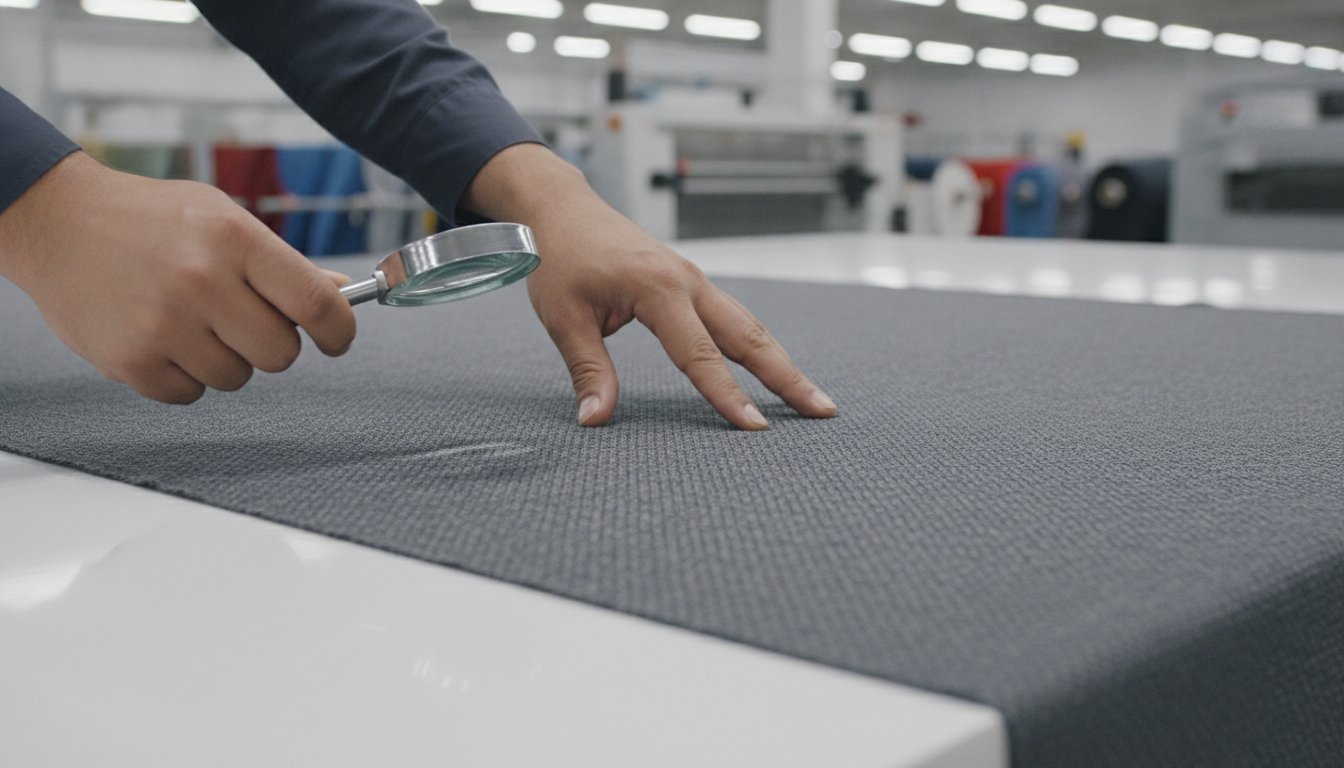
A standard Pre-Shipment Inspection (PSI) ensures your product functions, but it doesn't guarantee Amazon will accept the shipment. Integrating a specialized amazon fba inspection checklist into your workflow transforms the process from a simple quality check into a comprehensive compliance audit. This hybrid approach merges traditional quality control principles with the rigid logistics requirements of a modern fulfillment center.
Neglecting these logistics-heavy requirements puts your seller account health at direct risk. Minor defects or incorrect labeling don't just lead to negative customer reviews; they trigger suppressed listings and shipment rejections. The financial impact of poor compliance includes:
- Unplanned Prep Fees: Amazon charges significant per-unit costs to relabel or repackage non-compliant items.
- Shipment Rejections: Entire containers can be turned away, forcing you to pay for return freight and emergency storage.
- Stockouts: Processing delays at the dock mean your inventory isn't live during peak selling windows.
These inspections must happen at the factory level. Once your goods reach an Amazon Fulfillment Center (FC), corrective action becomes exponentially more expensive and logistically complex. Identifying a labeling error in Asia is a minor fix; finding it in a California warehouse is a financial disaster.
FBA Compliance vs. General Quality Control
General QC focuses on aesthetics and workmanship. Conversely, FBA compliance prioritizes technical logistics like "scannability" and "sortability." A product can be high quality yet still face rejection if the FNSKU barcode is blurry or the carton weight exceeds 2026 limits. Your amazon fba inspection checklist must verify that every unit is ready for automated sortation without manual intervention.
The Acceptable Quality Limit (AQL) is a statistical sampling standard that defines the maximum number of defective units allowed before a shipment is deemed a "fail" under Amazon's strict quality expectations.
The Essential Amazon FBA Inspection Checklist: 4 Pillars
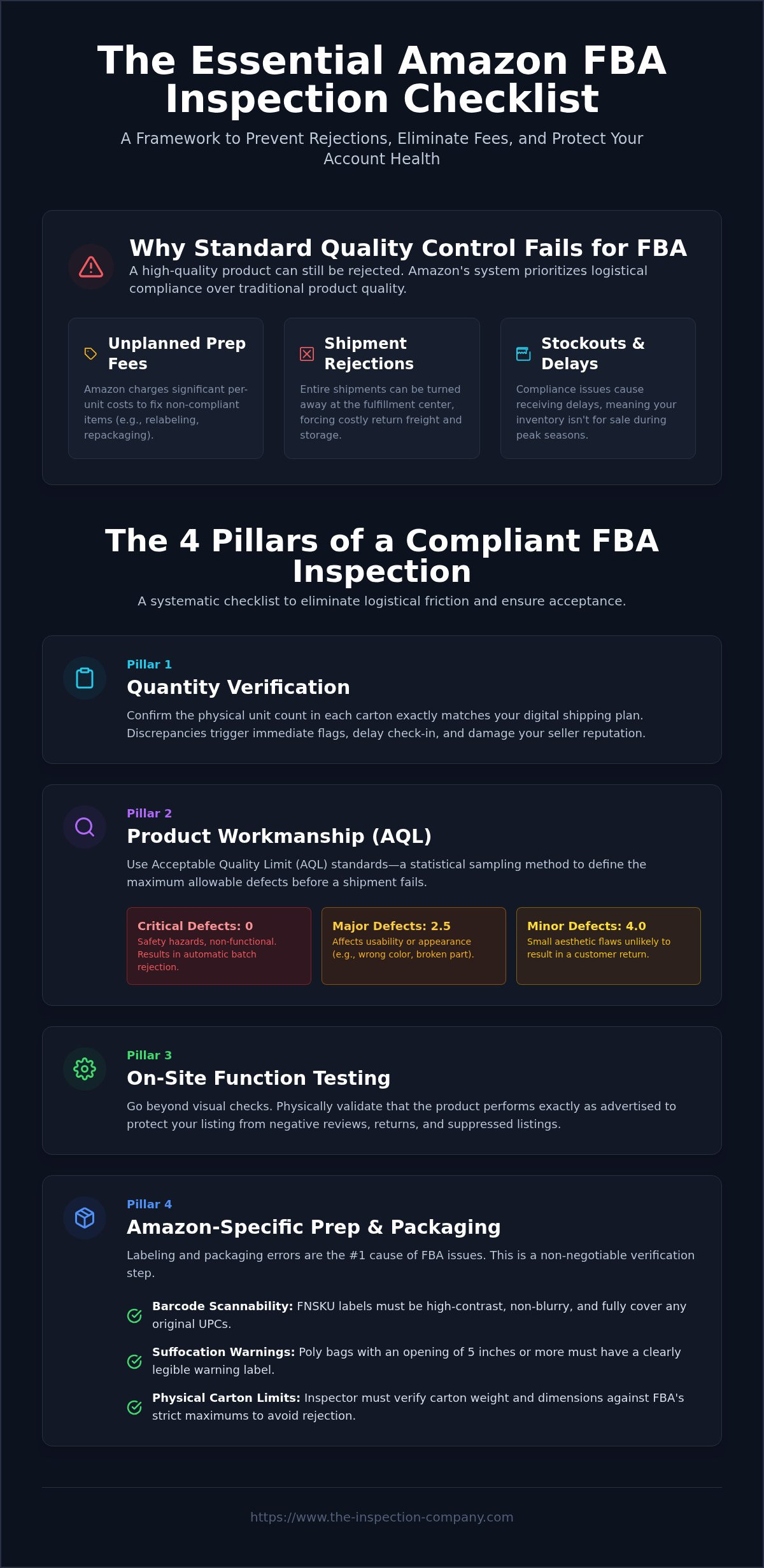
A rigorous amazon fba inspection checklist is built on four non-negotiable pillars designed to eliminate logistics friction. First, quantity verification ensures that the physical units per carton exactly match your digital shipping plan; discrepancies trigger flags that don't just delay check-in but also damage your seller reputation. Second, product workmanship utilizes statistical sampling to identify defects before they reach customers. Third, on-site function testing confirms the product performs as advertised, protecting your listing from early negative reviews. Finally, Amazon-specific prep focuses on labeling and packaging integrity to determine whether your stock is sellable or sidelined upon arrival.
Product Quality & Workmanship (AQL Standards)
Managing production quality requires a systematic approach similar to the Baldrige Performance Excellence Framework. For Amazon sellers, standard AQL levels are typically set at 0 for critical defects, 2.5 for major, and 4.0 for minor. Critical defects, such as safety hazards or sharp edges, trigger an automatic batch rejection. You can find a deeper breakdown in our guide on AQL Explained: The Ultimate Guide to Acceptable Quality Limit.
FBA-Specific Labeling & Packaging Requirements
Labeling errors are the primary cause of unplanned prep fees. Your amazon fba inspection checklist must verify that FNSKU barcodes are placed correctly, covering any original UPCs. For poly bags over five inches, inspectors must confirm the presence of legible suffocation warnings. Looking toward the 2026 sustainability update, our Amazon FBA service now verifies that eco-friendly packaging materials comply with Amazon's 'Climate Pledge Friendly' criteria, delivering detailed reports within 24 hours to keep your inventory moving. If you're unsure about your current packaging, consult with an expert to review your requirements.
Executing Critical On-Site Tests for FBA Shipments
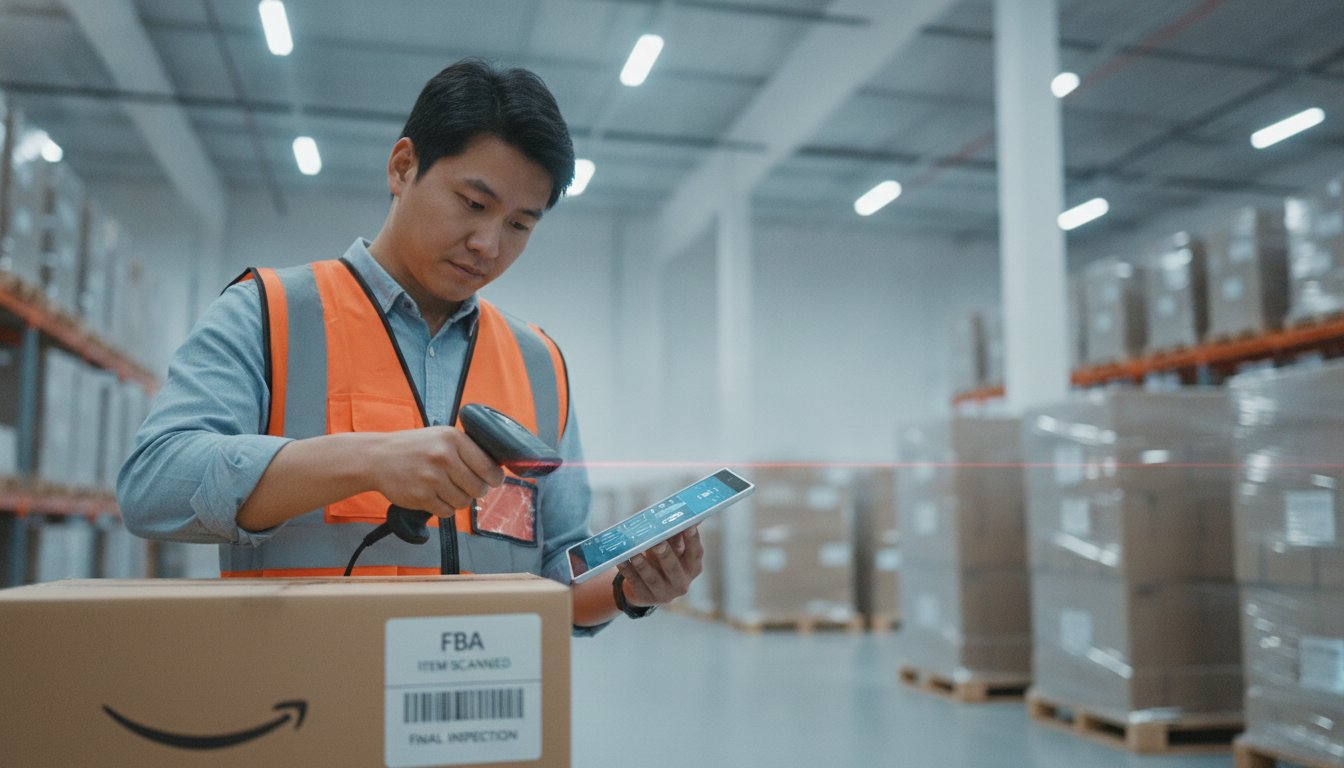
Verification moves beyond visual checks once production finishes. An effective amazon fba inspection checklist requires physical validation using industry-grade tools to simulate the rigors of the fulfillment process. Inspectors use handheld scanners to confirm that FNSKU and GS1 barcodes are readable under harsh warehouse lighting. Even a minor printing blur or excessive glare from glossy packaging can lead to immediate rejection at the intake dock. Physical measurement is equally vital. We verify that carton dimensions and weights strictly adhere to Amazon's updated 2026 limits. This prevents "oversize" flags that trigger tiered storage surcharges. For bundled items, inspectors confirm the high-visibility placement of "Sold as Set" and "Do Not Separate" labels. This simple check prevents warehouse staff from accidentally breaking apart your multi-unit inventory.
The 3-Step Carton Drop Test Procedure
This test is your primary defense against shipping damage and "unsellable" returns. First, we identify the required drop height based on the carton's specific weight according to ISTA 1A standards. Second, the inspector performs a precise 10-drop sequence targeting the most vulnerable corners, edges, and faces. Finally, a post-drop inspection assesses both the outer carton's integrity and the internal product's functionality. Failure in this test indicates a high risk of transit damage that could lead to account-level shipping defects.
Suffocation Warnings & Poly Bag Integrity
Child safety is a critical compliance pillar that Amazon monitors closely. We verify that suffocation warnings meet specific print size and placement requirements for all poly bags with an opening of five inches or larger. Seal strength is physically tested to ensure bags don't burst during high-speed automated sortation. Inspectors also check that barcodes remain scannable through transparent layers, ensuring no glare or plastic wrinkles obstruct the laser. Secure your shipment's integrity by booking a certified FBA inspection today.
Protecting Your Business with Professional FBA Inspections
Professional reports categorize your shipment's readiness with a clear Pass, Fail, or Pending status. A "Fail" result indicates that the production run has violated the non-negotiable criteria of your amazon fba inspection checklist. These reports provide the objective, photographic evidence required to hold your supplier accountable. Use this data to negotiate rework or refunds before releasing final payments. Integrating these audits into your workflow is a fundamental step in mastering the supplier management process for risk-free sourcing.
The financial logic is undeniable. A standard inspection costs a few hundred dollars, yet it protects shipments worth tens of thousands. Compare this small preventative investment to the catastrophic cost of a $10,000 shipment rejection. Between return freight, storage fees, and lost sales, the cost of an error at the Amazon dock is often terminal for small brands. Inspections don't just find defects; they provide operational security and peace of mind.
Avoiding Fulfillment Center Rejections
When a shipment fails Amazon's inbound audit, you're forced into the "removal order" process. This means paying Amazon to ship your non-compliant inventory to a third-party facility for expensive manual correction. Specialized Amazon FBA Inspection services act as your final gatekeeper, using a comprehensive amazon fba inspection checklist to catch errors while the goods are still at the factory. We ensure your barcodes scan and your packaging survives the journey. Don't risk your account health on a supplier's promises. Contact our expert team to secure your next Amazon shipment and maintain a zero-defect inbound record.
Secure Your FBA Growth with Proactive Compliance
Success on Amazon in 2026 requires more than just a high-quality product. It demands a rigorous logistics strategy that bridges the gap between factory production and fulfillment center intake. By implementing a comprehensive amazon fba inspection checklist, you transform your quality control from a simple check into a powerful risk mitigation tool. You now have the methodical framework needed to verify barcode scannability, packaging integrity, and workmanship standards before your goods ever leave the factory floor.
At The Inspection Company, we provide the localized expertise necessary for high-stakes international trade. With over 700 inspectors across Asia and European management standards, we deliver 24-hour detailed photo reports that give you total transparency. Don't let a minor labeling error derail your brand's momentum or lead to costly removal orders. Book Your Amazon FBA Inspection & Prevent Rejections to protect your account health and ensure a zero-defect inbound experience. Your scalable success starts with a shipment that passes every test with confidence.
Frequently Asked Questions
What is the difference between a standard inspection and an Amazon FBA inspection?
A standard inspection primarily verifies product workmanship and functionality. An Amazon FBA inspection adds a critical layer of logistics compliance, focusing on scannability, palletization, and labeling. While a general check ensures the product works, the amazon fba inspection checklist ensures the shipment actually reaches the shelf without incurring unplanned prep fees or immediate rejection at the fulfillment center. It's a hybrid approach combining quality control with rigid supply chain requirements.
Does Amazon provide its own product inspection services at the factory?
Amazon doesn't offer off-site or factory-level inspection services. Their role begins once your inventory arrives at their dock, where they perform their own inbound audits. If your shipment fails their internal check, you'll face removal orders or prep fees. This makes third-party inspections essential. You need a partner on the ground to act as your final gatekeeper before the goods leave the factory floor.
What is an FNSKU and why is it critical for my checklist?
An FNSKU is a Fulfillment Network Stock Keeping Unit. It's the unique identifier Amazon uses to track your specific inventory within their warehouses. It's critical because it distinguishes your products from identical items sold by other sellers. If your FNSKU is unreadable, missing, or placed over the wrong barcode, Amazon can't track your stock. Verifying these labels is a non-negotiable step in any professional amazon fba inspection checklist.
How much does a professional Amazon FBA inspection cost in 2026?
Inspection costs vary based on the quantity of units, the complexity of the product, and the geographic location of your factory. Most professional firms provide a flat daily rate rather than per-unit pricing. While we don't quote specific industry averages, the investment is a fraction of the cost of a rejected shipment. Consider the price a preventative insurance policy against the thousands of dollars lost during a warehouse rejection.
What happens if my shipment fails the FBA inspection at the factory?
If your shipment fails, the factory must perform a full rework to correct the identified defects or labeling errors. You shouldn't release the final payment until a follow-up inspection confirms all issues are resolved. This proactive approach ensures that compliance problems are fixed in Asia at the supplier's expense. It's much cheaper to relabel a batch at the factory than to pay Amazon's high-priced removal and prep fees.