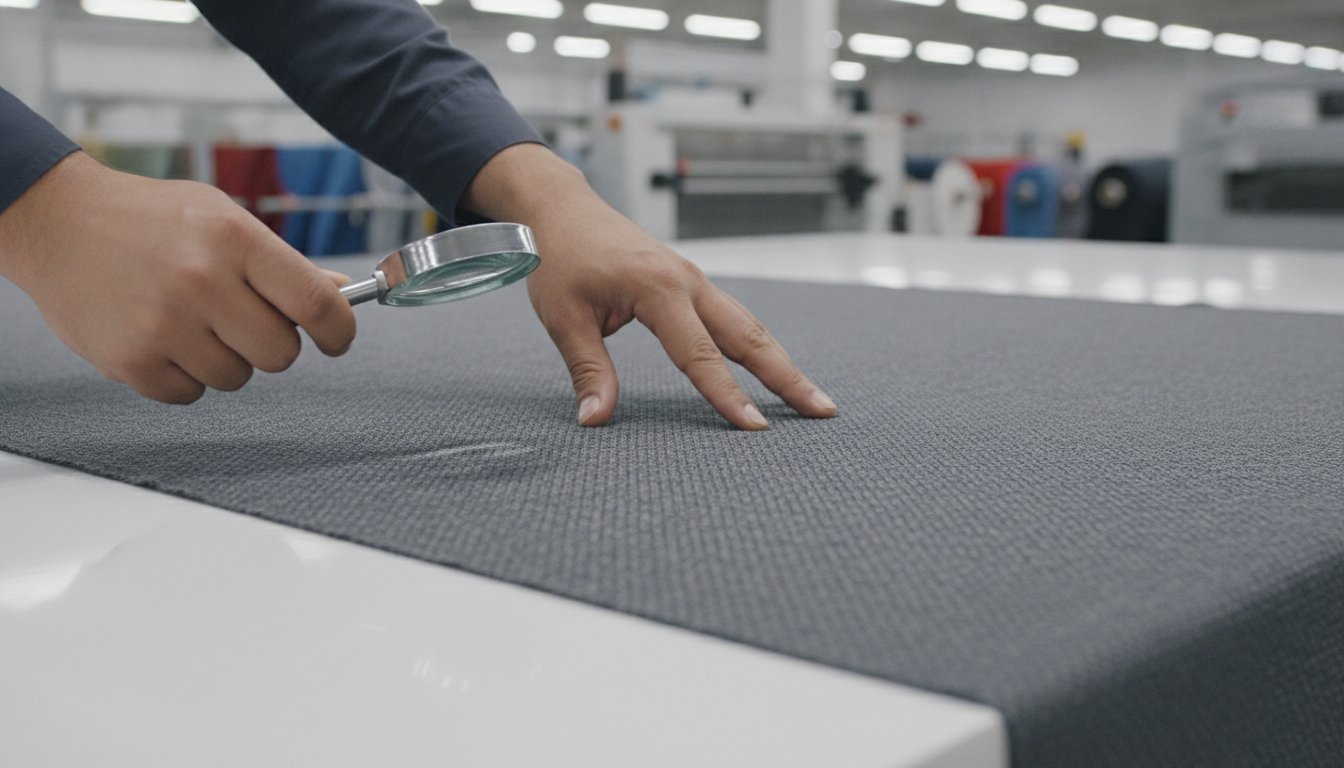

Waiting until 100% of your goods are finished to check for quality isn't quality control; it's an autopsy. By the time the final carton is sealed, any systemic defect is likely unfixable, leaving you to manage financial loss rather than a successful product launch. You've likely experienced the anxiety of late-stage rework or the friction of communication gaps with factory floor managers who seem to prioritize speed over your specific requirements. Utilizing a comprehensive during production inspection checklist at the 20% to 50% completion mark is your only true "undo button" in the manufacturing process.
It's understandable to feel that mid-production checks are just another line item, but they're a vital safeguard for your budget. New 2026 standards like ISO 2859-1:2026 and stricter CPSC eFiling requirements mean the margin for error has vanished. This guide will help you master the DUPRO process with a professional framework designed to catch defects while they can still be fixed. You'll gain a clear roadmap to identify issues early, use data-backed leverage to force factory corrections, and secure total peace of mind before you authorize that final payment.
Key Takeaways
- Identify why the 20% to 50% production stage is the critical "sweet spot" for catching systemic defects before they result in total inventory loss.
- Master the five essential pillars of a professional during production inspection checklist to verify actual workmanship and production line status.
- Learn why 24-hour digital report turnaround is non-negotiable for making real-time adjustments while the manufacturing line is still active.
- Gain the necessary leverage to negotiate immediate Corrective Action Plans (CAP) using unbiased, photo-heavy inspection data as evidence.
- Understand how independent third-party oversight bridges communication gaps with factory managers to ensure your specific quality standards are met.
What is a During Production Inspection (DUPRO) and Why is the Checklist Unique?
A During Production Inspection (DUPRO) is an on-site evaluation performed when approximately 20% to 50% of your order is finished. It isn't just a standard status update; it's a strategic intervention based on fundamental quality control principles. While a Pre-Production Inspection focuses on raw materials and a Pre-Shipment Inspection looks at the final result, the DUPRO stage examines the actual manufacturing process in real time.
Using a specific during production inspection checklist provides a unique psychological advantage. It signals to factory management that you're monitoring the process, not just the outcome. This presence often deters the factory from taking shortcuts that lead to systemic failures later. It transforms your role from a passive buyer into an active partner in the manufacturing flow.
The ROI of Catching Errors Early
The financial logic is simple: fixing an error at the 20% mark is significantly cheaper than replacing a finished product. If a machine is misaligned, a DUPRO identifies the issue before it ruins the entire batch. This proactive approach is the best way to catch product defects while they're still manageable. It also prevents "Quality Fade," where a factory slowly substitutes cheaper materials or simplifies processes during long production runs to save their own costs at your expense.
When to Schedule Your DUPRO Visit
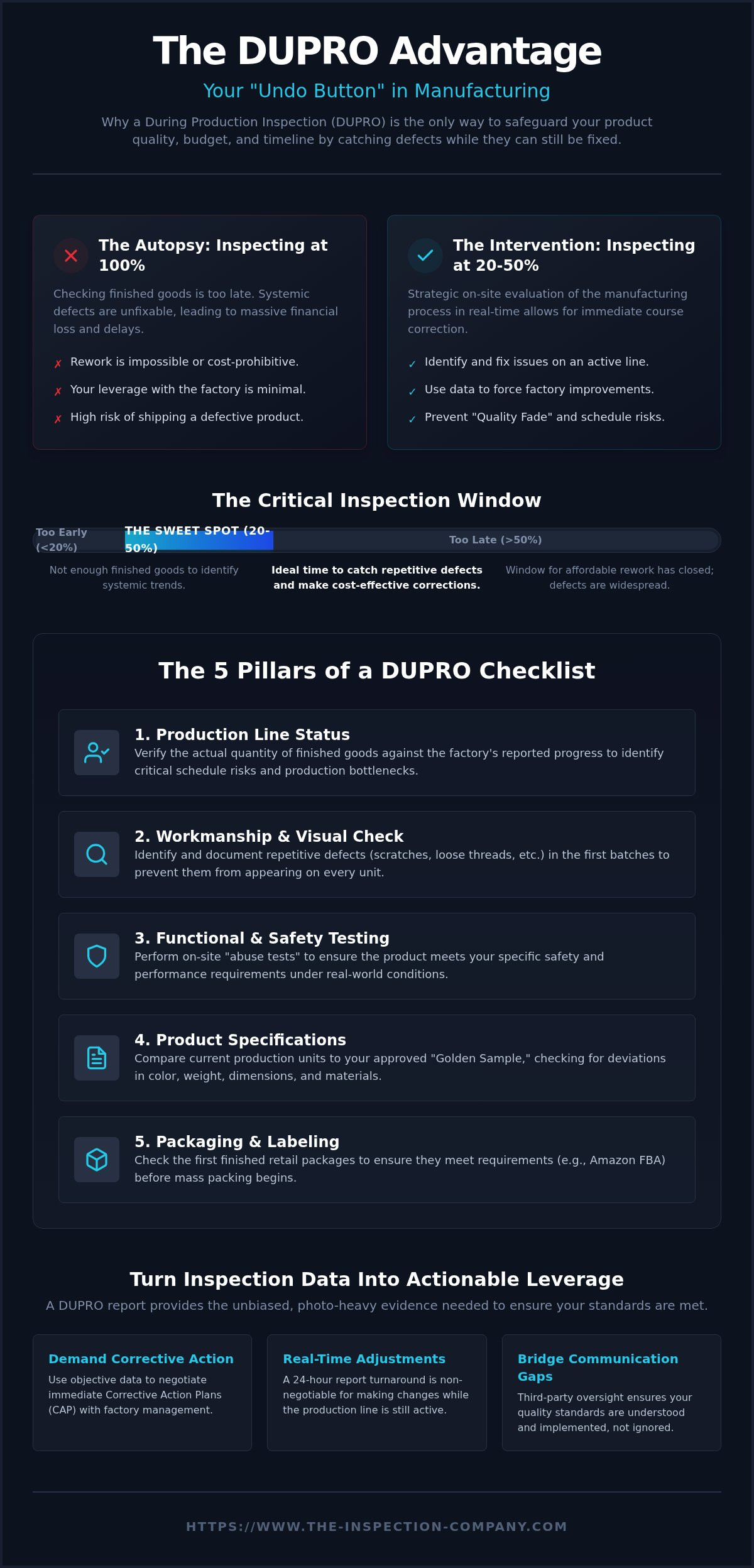
Timing is everything. We recommend the "Rule of 20-50%." If you inspect too early, you haven't seen enough finished goods to spot trends. If you wait until 80%, you've lost the window for cost-effective rework. An effective during production inspection checklist requires the production line to be active. This allows the inspector to observe worker behavior, machine settings, and the flow of goods, ensuring the factory's reported progress matches the reality on the ground.
The Essential During Production Inspection Checklist: 5 Key Pillars
A professional during production inspection checklist serves as your primary defense against systemic manufacturing failures. It isn't enough to simply look at the product; the inspector must verify the entire ecosystem of the production run. This process focuses on five core pillars designed to provide total transparency into the factory's performance while there's still time to course-correct.
- Production Line Status: We verify the actual quantity of finished goods against the factory's reported progress. If a manager claims 50% completion but the floor shows 10%, you've identified a critical schedule risk.
- Workmanship & Visual Check: Inspectors identify repetitive defects in the first batches. Catching a scratch or a loose thread now prevents it from appearing on every unit in the container.
- Functional & Safety Testing: On-site "abuse tests" ensure the product meets your specific safety and performance requirements under real-world conditions.
- Product Specifications: We compare the current production units to your "Golden Sample," checking for deviations in color, weight, and dimensions.
- Packaging & Labeling: The first finished units are checked to ensure they meet retail or Amazon FBA inspection standards before mass packing begins.
Workmanship and Repetitive Defect Analysis
Identifying a single defect is helpful, but identifying a pattern is vital. Our inspectors use AQL standards to categorize major, minor, and critical defects found mid-production. Detailed photo documentation for every issue provides the objective evidence you need to demand immediate changes. If you're concerned about specific defect trends in your category, you can consult with our technical team to refine your inspection criteria.
Verifying Production Capacity and Timelines
Factories often provide optimistic ship dates that don't align with reality. By calculating the actual daily output rate during the DUPRO, we can predict if your deadline is achievable. This analysis uncovers bottlenecks in the assembly process. Identifying these hurdles early prevents the factory from rushing the final units, a common cause of late-stage quality drops that lead to expensive rework.
How to Execute the Checklist for Maximum Risk Mitigation
Execution is where most importers fail. Having a during production inspection checklist is pointless if the person holding it is biased or slow. Relying on a factory's in-house QC is a conflict of interest. They're incentivized to hide errors to avoid the expense of rework. Partnering with an independent 3rd party inspection company ensures you receive raw, unfiltered data directly from the factory floor.
Speed is your greatest asset during mid-production. A 24-hour reporting turnaround is non-negotiable. If you receive a report three days after the site visit, the factory has already produced thousands of potentially defective units. You must be able to make decisions while the line is still running. Our European-managed structure acts as a cultural bridge, translating Western quality expectations into precise, actionable instructions for Asian manufacturing teams.
The Value of On-Site Photo and Video Evidence
Don't settle for a simple "Pass" or "Fail" checkbox. Demand high-resolution imagery of the production environment, including machine settings and worker stations. Video evidence of functional tests provides a level of security that static photos cannot match. It proves the test was performed correctly, rather than just staged for a quick snapshot. This visual proof is essential for forcing factory corrections when they deny a workmanship issue.
Utilizing a Centralized Quality Platform
Managing multiple inspections through scattered email threads leads to operational friction and missed details. Hosting your reports and checklists on a centralized quality platform allows you to track defect trends over time. This data helps you vet supplier reliability across multiple runs and identifies if a factory is improving or declining. If you're ready to secure your supply chain with professional oversight, contact our team today to schedule your next DUPRO.
Turning Your DUPRO Report into Actionable Improvements
Receiving a "Fail" or "Pending" result on your during production inspection checklist isn't a sign of failure; it's a critical window for intervention. This is the only stage where you can force a factory to pivot without scrapping finished inventory. Use the objective data in your report to demand an immediate Corrective Action Plan (CAP). This document must specify how the factory will rectify current workmanship issues and, more importantly, what process changes they'll implement to protect the remaining 80% of the production run.
Adopting a "Pilot Run" mentality is essential for long-term success. By treating the first 20% of production as a learning phase, you identify systemic risks before they scale. Integrating these findings with periodic factory audits allows you to track whether a supplier is truly capable of maintaining your quality standards over time or if they're simply reacting to your presence on the floor.
Developing a Corrective Action Plan (CAP)
A CAP must have teeth to be effective. Define clear, non-negotiable deadlines for the factory to implement the fixes identified during the inspection. If the defect rate is significantly higher than your AQL limits, you should trigger a product sorting service immediately. This ensures that every defective unit is identified and removed from the line before mass packaging begins, preventing bad units from being buried in the middle of a container.
Securing the Final Shipment
A successful DUPRO simplifies the final pre-shipment inspection by removing the element of surprise. When you catch errors early, you're in a much stronger position to negotiate. You can use the DUPRO data to demand better terms or discounts if the factory's initial output didn't meet specifications. This proactive oversight ensures that by the time you're ready for final payment, the goods are exactly what you ordered.
Protect your production-Contact our experts for a custom DUPRO checklist
Secure Your Manufacturing Timeline with Proactive Oversight
Waiting for the final shipment to discover errors is a risk your budget cannot afford. By implementing a standardized during production inspection checklist at the 20% to 50% completion mark, you transform quality management from a reactive autopsy into a proactive investment. You now have the framework to identify repetitive defects, verify actual production capacity, and use objective data to enforce corrective action plans before systemic issues become permanent financial losses.
The Inspection Company provides the boots on the ground you need to maintain total control over your orders. With over 700 full-time inspectors stationed across Asian manufacturing hubs and European management ensuring global standards, we bridge the gap between Western expectations and factory floor realities. Our digital reports deliver photo-heavy evidence within 24 hours while the production line is still active. This speed gives you the power to make critical adjustments in real time, protecting your timeline and your bottom line.
Don't leave your brand's reputation to chance. Secure your supply chain; contact us for professional inspection services and ensure your 2026 production runs remain on track. We're ready to help you turn manufacturing data into a competitive advantage.
Frequently Asked Questions
What is the difference between a DUPRO and a Final Random Inspection (FRI)?
The primary difference is timing and the ability to enact changes. A DUPRO occurs when 20% to 50% of your production is complete, allowing you to catch and fix systemic errors while the line is still running. In contrast, a Final Random Inspection (FRI), or pre-shipment inspection, happens when at least 80% of the order is finished. While an FRI is a final gatekeeper, it's often too late to fix defects without causing massive delays.
Can a During Production Inspection prevent shipping delays?
Yes, a DUPRO is one of the most effective ways to prevent shipping delays caused by late-stage rework. By identifying workmanship issues early, the factory can adjust its process for the remaining 80% of the order immediately. If you wait until the entire order is finished to discover a major defect, the factory must redo everything. This inevitably leads to missed vessel dates and significant logistical friction that could've been avoided.
How many samples are checked during a DUPRO using AQL?
The sample size is determined by the ISO 2859-1 (AQL) sampling tables, usually following General Inspection Level II. During the site visit, the inspector bases the sample size on the quantity of goods actually finished at that moment. Using a professional during production inspection checklist ensures the inspector pulls a statistically significant sample. This allows them to identify repetitive defect patterns before the factory finishes the rest of your production run.
What happens if the factory refuses to stop production to fix errors?
You should use the inspection report as objective leverage to hold final payment or demand a formal Corrective Action Plan. Factories are often reluctant to stop an active line, but a "Fail" result from an independent third party provides the evidence you need to force a negotiation. If they refuse to comply, you have the data necessary to escalate the dispute or prepare for a product sorting service to protect your budget.
Is a DUPRO necessary for repeat orders with a trusted supplier?
Yes, mid-production checks are essential even for repeat orders to prevent "Quality Fade" over time. Manufacturing conditions change; factories might switch raw material sub-suppliers or hire new staff between your orders. Utilizing a during production inspection checklist on every run ensures your standards remain consistent. It signals to the supplier that you're still monitoring the process, which prevents them from growing complacent or cutting corners to save costs.