
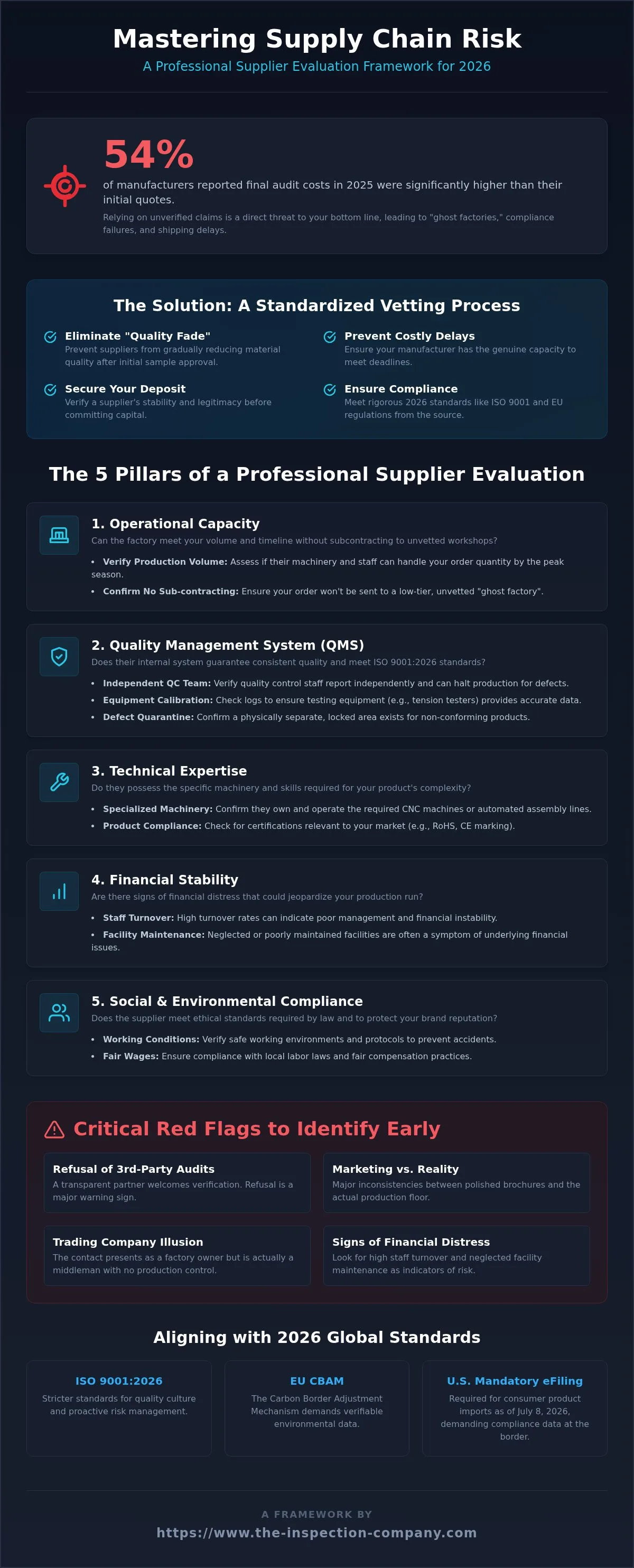
Did you know that 54% of manufacturers reported their final audit costs in 2025 were significantly higher than their initial quotes? In 2026, a supplier's polished digital profile is often just marketing. Relying on unverified claims isn't just risky; it's a direct threat to your company’s survival. You likely feel the mounting pressure of new regulations like the EU Carbon Border Adjustment Mechanism and the mandatory eFiling for U.S. consumer product imports that began on July 8, 2026. The fear of losing capital to a ghost factory or facing an Amazon ban due to social compliance failures is a justified concern for any professional importer.
You deserve a proactive way to secure your investments and maintain control over your production. This guide provides a professional-grade supplier evaluation checklist designed to help you master supply chain risk and vet manufacturers for quality, compliance, and reliability. We'll show you how to identify red flags before sending a deposit, verify physical factory claims, and ensure your partners meet the rigorous new ISO 9001:2026 standards. We will walk through a structured framework to rank potential suppliers and protect your bottom line from unexpected operational friction.
Key Takeaways
- Standardize your vetting process to eliminate "quality fade" and prevent shipping delays caused by unreliable manufacturers.
- Implement a professional-grade supplier evaluation checklist to verify technical capacity, financial stability, and ethical compliance before sending a deposit.
- Identify critical red flags early, such as a manufacturer’s refusal to allow a third-party factory audit or inconsistencies between marketing materials and the production floor.
- Move beyond "desktop" verification by using physical inspections to confirm that a supplier’s Quality Management System (QMS) meets 2026 regulatory standards.
- Utilize preliminary supplier surveys as a cost-effective filter to rank potential partners before committing to deeper technical evaluations.
Why a Supplier Evaluation Checklist is Your Best Risk Mitigation Tool
A supplier evaluation checklist is a standardized tool used to assess a manufacturer's technical, financial, and ethical capabilities. It serves as the foundation for a robust supplier evaluation process, ensuring that your procurement decisions are based on empirical data rather than polished marketing promises. Without this framework, importers remain vulnerable to operational friction that can derail an entire fiscal year.
Skipping this verification step leads to "quality fade," a phenomenon where a manufacturer gradually reduces material quality to increase their margins after the initial samples are approved. This negligence results in catastrophic shipping delays and product recalls. While a high-level supplier management process provides the strategy, the checklist handles the on-ground reality. It forces a physical verification of claims, bridging the gap between what a supplier says they can do and what their machinery actually produces.
The Difference Between a Vendor and a Manufacturer
You must determine if you are communicating with a trading company or the factory owner. Trading companies often present themselves as manufacturers but lack control over the production line. This leads to the "ghost factory" phenomenon, where your order is sub-contracted to an unvetted, lower-tier workshop. These hidden facilities rarely follow safety protocols, creating massive risks for your brand's reputation and product consistency.
Aligning the Checklist with Global Standards
Your evaluation criteria must evolve alongside international regulations. With the update to ISO 9001:2026, manufacturers are now held to stricter standards regarding quality culture and risk management. A professional supplier evaluation checklist incorporates these ISO principles to ensure the factory's internal systems are mature. Additionally, the checklist must verify specific product compliance markers, such as RoHS or CE marking. In 2026, failing to verify these certifications at the source can result in immediate border rejections, particularly with the mandatory eFiling requirements for U.S. imports that took effect on July 8, 2026.
The 5 Pillars of a Professional Supplier Evaluation Checklist
A professional supplier evaluation checklist isn't just a list of questions; it's a strategic audit of five critical areas that determine your project's success. First, assess operational capacity. Can the factory realistically meet your volume by the 2026 peak season? Many manufacturers overpromise to secure a deposit, only to sub-contract the work to unvetted workshops. Second, evaluate the Quality Management System (QMS). Use key supplier evaluation criteria to determine if their internal processes can sustain long-term quality. Third, verify technical expertise. Ensure they possess the specific CNC machinery or automated assembly lines required for your SKU. Fourth, monitor financial stability. Signs of distress, such as high staff turnover or neglected facility maintenance, often precede a complete production failure. Finally, verify social and environmental responsibility to protect your brand from mounting regulatory penalties.
Quality Control and Management Systems
True quality control requires an independent team that doesn't report to production managers. Your supplier evaluation checklist should verify the presence of on-line inspectors who have the authority to stop a line if defects arise. Check calibration logs for all testing equipment. If a factory hasn't calibrated its tension testers or moisture meters in years, their data is useless. A robust system must also include a clear protocol for non-conforming products. These items should be physically quarantined in a locked area to prevent them from accidentally being packed into your final shipment.
Ethical and Social Compliance Standards
In 2026, social compliance is a legal necessity rather than an optional badge. With the EU's increased focus on supply chain transparency, you must verify fair wages and safe working conditions at the source. A professional social audit acts as your first line of defense against modern slavery or child labor. If you are unsure how to score these specific criteria, you can consult with our regional experts for tailored guidance on local labor laws and international expectations.
Red Flags to Watch for During the Evaluation Process
Identifying warning signs during the vetting stage is a preventative investment that saves your company from catastrophic financial loss. A professional supplier evaluation checklist serves as your early warning system. The most glaring red flag is a manufacturer's refusal to allow a third-party factory audit. Reliable suppliers welcome transparency because it validates their claims. If a factory blocks access to their production lines, they are likely hiding sub-standard conditions or unauthorized sub-contracting.
Pay close attention to discrepancies between the administrative "showroom" and the actual production floor. It's common for factories to maintain a polished office for visitors while the assembly area is disorganized, poorly lit, or visibly unsafe. Additionally, a lack of clear documentation for raw material sourcing is a major hazard. In 2026, you cannot afford rohs compliant failures. If a supplier cannot provide tracing for their components, your goods risk being seized at the border for non-compliance.
Communication and Transparency Issues
Vague answers regarding production lead times or the specific location of your production are unacceptable. If a supplier provides evasive responses about who actually owns the machinery, they are likely a trading company posing as a factory. Watch for pressure to pay via non-secure methods or into bank accounts that don't match the registered company name. These are classic signs of financial instability or potential fraud.
Technical Inconsistency
Technical gaps often appear between the sample stage and mass production. A "First Article" might look perfect because it was handcrafted by a senior engineer. However, if the factory lacks the automated machinery to replicate that quality at scale, your shipment will suffer from "quality fade." To mitigate this, link your initial supplier evaluation checklist results to a first article inspection. This ensures the pilot run actually matches the approved prototype before you authorize full production.
Don't leave your supply chain to chance. Contact our specialists today to schedule an on-site verification and secure your production run.
How to Execute Your Checklist: DIY vs. Professional Audits
Executing a supplier evaluation checklist requires physical presence. Relying on "desktop" audits, which involve reviewing websites or PDF certificates, is insufficient. Digital assets are easily forged or outdated. For a preliminary filter, a supplier survey allows you to screen out unsuitable candidates before investing in deeper technical audits. However, the true ROI comes from hiring a 3rd party inspection company. Professional auditors identify hidden risks that a remote buyer would miss entirely. These findings provide leverage during price negotiations; if an audit reveals operational inefficiencies, you can demand lower costs or better payment terms to offset the identified risks.
The Inspection Company’s Approach to Factory Audits
We provide a localized operational presence with over 700 inspectors stationed across major Asian manufacturing hubs. Our team acts as your eyes and ears on the ground, conducting thorough physical verifications of every point on your supplier evaluation checklist. You receive detailed reports featuring photo and video evidence within 24 hours of the site visit. This speed allows for rapid decision-making in a high-stakes environment. For those selling on global platforms, we ensure your manufacturer meets strict FBA requirements, preventing costly rejections at the fulfillment center.
Next Steps After the Evaluation
An audit rarely results in a perfect pass. If a promising manufacturer has minor deficiencies, we help you create a Corrective Action Plan (CAP). This document outlines the specific improvements required before production begins. Once the factory addresses these issues, scheduling a pre-shipment inspection is vital. This step confirms that the standards established in your initial checklist were maintained throughout the entire production run. It's the final preventative investment to ensure your goods arrive exactly as specified.
Secure Your Supply Chain and Protect Your Capital
International trade in 2026 leaves no room for error. A professional supplier evaluation checklist isn't just a document; it's your primary defense against quality fade, unethical labor practices, and financial loss. You've learned that physical verification is the only way to bridge the gap between a supplier's marketing and their actual production reality. By focusing on the five pillars of operational excellence and identifying red flags early, you position your brand for sustainable growth rather than catastrophic delays.
The Inspection Company combines European management standards with a localized operational presence across Asian manufacturing hubs. We deliver detailed audit reports with photo and video evidence within 24 hours. This speed is why global retailers and Amazon sellers trust us to verify their manufacturers before authorizing a single deposit. Don't leave your supply chain to chance. Book a Professional Factory Audit to Verify Your Supplier Today. With the right data in hand, you can move forward with the confidence that your partners are as reliable as your brand.
Frequently Asked Questions
What are the most important criteria in a supplier evaluation checklist?
The most critical criteria include the manufacturer's Quality Management System (QMS), operational capacity, and regulatory compliance. You must verify if they possess the specific machinery to handle your production volume and if their technical expertise aligns with your product's complexity. In 2026, verifying adherence to ISO 9001:2026 and social compliance standards is also essential to avoid legal penalties and potential market bans.
Can I perform a supplier evaluation remotely without visiting the factory?
Remote evaluations, often called "desktop audits," are insufficient for verifying a factory's true capabilities. While you can review digital certificates and business licenses, these documents are easily forged or outdated. A reliable supplier evaluation checklist requires a physical presence to inspect the production floor, witness machine operation, and verify that the administrative "showroom" actually matches the manufacturing environment.
What is the difference between a factory audit and a supplier evaluation?
A supplier evaluation is the broad strategic framework used to assess a potential partner's fit, while a factory audit is the specific on-site procedure used to gather that data. The evaluation checklist defines the standards you require for your supply chain. The audit provides the physical evidence and photo documentation needed to score the manufacturer against those standards. Think of the evaluation as the strategy and the audit as the execution.
How often should I re-evaluate my existing suppliers?
You should re-evaluate your primary suppliers at least once per year to ensure standards haven't slipped. However, high-risk manufacturers or those producing critical components may require semi-annual reviews. If a supplier relocates, changes ownership, or shows signs of "quality fade," an immediate supplier evaluation checklist review is necessary to prevent financial loss and operational friction. Continuous monitoring ensures your supply chain remains resilient.
What should I do if a supplier fails my evaluation checklist?
If a supplier fails the evaluation, you can either issue a Corrective Action Plan (CAP) or terminate the relationship. A CAP allows the manufacturer to fix specific deficiencies within a set timeframe, followed by a formal re-audit to verify the changes. If the failure involves critical red flags like unethical labor practices or severe financial instability, you should immediately source a more reliable partner to protect your brand's reputation.