
In 2026, a garment inspection checklist is no longer just a quality tool; it's a legally binding shield against the U.S. CPSC’s mandatory electronic safety certificates and the EU’s strict Green Claims Directive. You likely already understand that a single batch of sizing inconsistencies or a missed formaldehyde limit can lead to massive financial losses or an immediate Amazon account suspension. It's frustrating to watch "quality fade" erode your margins over multiple production runs while you're miles away from the factory floor. Maintaining control over a global supply chain requires more than just trust; it demands a methodical, data-driven approach to quality management.
This guide provides you with a professional-grade garment inspection checklist designed to secure your supply chain and protect your brand reputation from costly defects. You'll learn exactly how to navigate the latest 2026 compliance standards, including France’s PFAS ban and new REACH restrictions. We will preview the essential physical testing requirements and the specific criteria needed to ensure your apparel meets every global regulation before it ever leaves the port. This is your roadmap to transitioning from reactive crisis management to proactive, assured quality control.
Key Takeaways
- Discover how a standardized garment inspection checklist serves as a strategic insurance policy against "quality fade" and hidden factory cost-cutting.
- Identify the five critical pillars of apparel quality control, including workmanship standards, fabric integrity, and precise color matching requirements.
- Learn to consolidate complex technical specifications into actionable "Critical to Quality" (CTQ) features that protect your brand from safety hazards and recalls.
- Understand the operational risks of factory self-inspection and why third-party objectivity is vital for maintaining high-stakes international shipping deadlines.
Why a Garment Inspection Checklist is Your Strategic Insurance Policy
A garment inspection checklist is much more than a simple list of flaws. It's a standardized document that strictly defines the workmanship, material, and packaging requirements for every unit your factory produces. Without it, you're essentially operating on a handshake in a high-stakes environment. This lack of clarity often leads to "quality fade," a phenomenon where factories gradually substitute cheaper materials or skip finishing steps to preserve their own margins. Silence is often interpreted as permission to lower standards.
When sourcing from Asia, linguistic and cultural nuances can create massive gaps in expectation. A detailed checklist bridges this divide by providing a universal technical language that both parties understand. This process often begins with a thorough Fabric inspection to ensure raw materials meet your specifications before the first cut is even made. Legally, this document serves as the objective baseline for "acceptable" goods. It gives you the necessary leverage to reject shipments that don't meet the agreed-upon standards in your supplier contracts.
The ROI of Professional Quality Control
The true cost of a defective garment isn't just the production price. It's the sum of wasted freight charges, non-refundable customs duties, and long-term damage to your brand reputation. For those selling on Amazon, the stakes are even higher. High return rates and negative customer reviews triggered by poor quality can lead to immediate account suspension. Investing in a professional garment inspection checklist prevents these financial leaks by stopping sub-standard products at the source before they reach your warehouse.
Checklists as a Supplier Management Tool
Establishing clear criteria from day one is essential to a successful supplier management process. It signals to the factory that you're a meticulous partner who won't tolerate shortcuts. When issues do arise, the data captured in your garment inspection checklist allows you to negotiate fact-based Corrective Action Plans (CAP). Instead of arguing over subjective opinions, you can use the inspection results to demand specific improvements and hold the factory accountable for their performance over multiple production runs.
The 5 Pillars of a High-Performance Apparel QC Checklist
A comprehensive garment inspection checklist must move beyond basic aesthetics to address technical performance. It serves as a blueprint for the inspector to verify that every specification is met. If your checklist lacks granular detail, you leave the door open for factory shortcuts. A robust framework typically rests on five critical pillars:
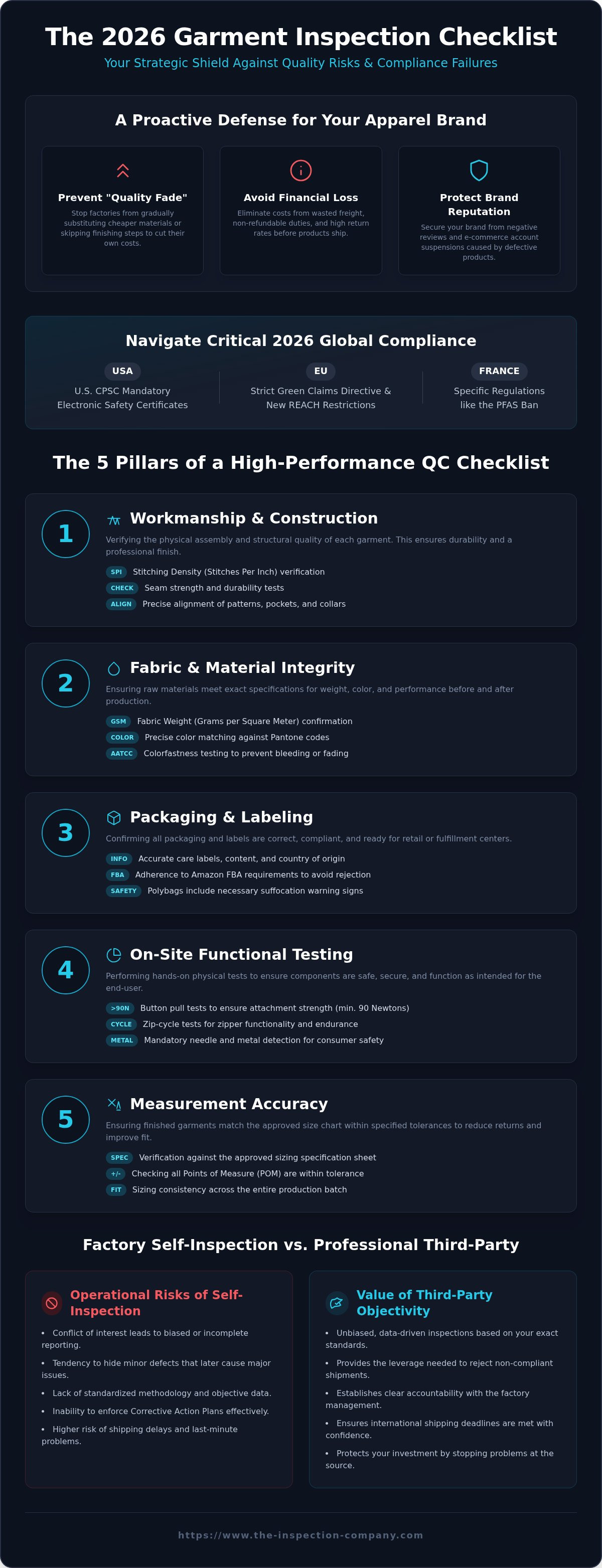
- Workmanship and Construction: This involves checking stitching density, measured in Stitches Per Inch (SPI), and seam strength. It also covers the precise alignment of patterns and pockets.
- Fabric and Material Integrity: Inspectors verify fabric weight using Grams per Square Meter (GSM) and ensure color matching against Pantone codes. Integrating AATCC test methods for colorfastness is essential for maintaining long-term quality and preventing color migration.
- Packaging and Labeling Compliance: This pillar ensures care labels are accurate and polybags include necessary warning signs. For e-commerce brands, meeting Amazon FBA requirements is critical to avoid shipment rejection at the fulfillment center.
- On-Site Functional Testing: This includes pull tests for buttons to ensure they withstand a force of at least 90 Newtons, zip-cycle tests, and mandatory needle detection for consumer safety.
- Measurement Accuracy: Verifying that the finished garment matches the specified size chart within acceptable tolerances to prevent high return rates.
Ensuring these pillars are documented helps you maintain control over the production floor. If you need assistance defining these technical parameters for your specific product line, you can consult with our technical team for expert guidance.
Integrating AQL Standards into Your Checklist
Performing a 100% inspection on every unit is rarely cost-effective for large production runs. Instead, professional inspectors use the Acceptable Quality Limit (AQL) to determine a statistically significant sample size. This method allows you to classify product defects into three categories. Critical defects pose safety risks; Major defects affect salability; and Minor defects are small deviations that don't impact the garment's function.
Visual Standards and the Golden Sample
Your garment inspection checklist must always reference a "Golden Sample." This is the factory-produced prototype you've personally approved for fit, feel, and color. It acts as the physical benchmark for the entire production run. When an inspector finds a deviation, they should document it with high-resolution photography. Clear visual evidence eliminates ambiguity and forces the factory to acknowledge the discrepancy rather than dismissing it as a subjective opinion.
Step-by-Step: How to Build Your Garment Inspection Checklist
Creating an effective garment inspection checklist requires a methodical approach that aligns with ISO 9001 quality management principles. It isn't just about listing defects; it's about creating a roadmap for consistency across your entire supply chain. A well-structured document ensures that your factory understands exactly what constitutes a "pass" or a "fail" before production begins.
The process starts with consolidating your technical specifications. You must gather your complete tech pack, including detailed size charts and a comprehensive Bill of Materials (BOM). Don't forget to include specific safety and environmental standards, such as RoHS compliance, to ensure your products meet international regulatory requirements and avoid costly customs delays.
Next, you must identify "Critical to Quality" (CTQ) features. These are non-negotiable items that trigger an immediate shipment rejection. Examples include safety hazards like broken needles, the presence of mold, or incorrect labeling that violates consumer protection laws. Identifying these early protects your brand from liability and expensive recalls.
To ensure your checklist is practical, consult with a 3rd party inspection company. Professional inspectors can verify if your proposed tests are feasible within a factory setting. Finally, you must localize the document. Translating key criteria into the local language ensures floor workers and supervisors understand your requirements, removing the linguistic barriers that often lead to "quality fade."
If you are ready to secure your next production run, contact our technical team to develop a customized inspection protocol.
Category-Specific Customization
Your garment inspection checklist should vary based on the product type. For activewear, your focus must remain on four-way stretch recovery, moisture-wicking properties, and the integrity of flatlock stitching. Conversely, outerwear requires an emphasis on water resistance, zipper durability, and the even distribution of insulation. A one-size-fits-all approach often misses the technical nuances that define high-quality apparel.
Iterating Based on Production Data
A checklist is a living document. You should use findings from a During Production Inspection (DPI) to refine your final pre-shipment criteria. If a specific supplier consistently struggles with a particular seam or fabric shade, update your checklist to prioritize those areas. This iterative process allows you to address recurring issues proactively and maintain a high standard of quality management over time.
Executing the Checklist: Why Professional Inspectors are Essential
Even the most detailed garment inspection checklist is only as effective as the person executing it. Relying on a factory to perform its own quality control creates an inherent conflict of interest. Factories are often under immense pressure to meet strict shipping deadlines and avoid the high costs associated with rework or scrap. This "self-inspection trap" frequently leads to overlooked defects and "quality fade" that only becomes apparent after you've paid the final balance and the ship has sailed.
The Inspection Company provides the necessary third-party objectivity to protect your investment. Our inspectors act as your eyes and ears on the factory floor, ensuring every point on your garment inspection checklist is verified without bias. Once the physical check is complete, our digital reporting system delivers a photo-heavy report within 24 hours. This rapid turnaround allows you to make an immediate, data-backed "Go/No-Go" decision while the goods are still at the source. To secure the final stage of the journey, a Container Loading Inspection ensures your verified goods are packed correctly and securely, preventing transit damage or quantity discrepancies.
Boots on the Ground Across Asia
We maintain a localized operational presence with over 700 inspectors across Asia. This geographic advantage means our team understands regional manufacturing shortcuts and cultural nuances that an overseas manager might miss. Beyond product-level checks, integrating factory audits into your strategy ensures your suppliers remain compliant with social and environmental standards, mitigating long-term brand risk and legal exposure.
Leveraging the Quality Platform
Managing quality across multiple suppliers requires a centralized, transparent approach. Our Quality Platform allows you to store and manage your garment inspection checklist in one secure location, ensuring consistency across different factories. Real-time data visualization allows your brand to spot quality trends and recurring defects before they evolve into systemic failures. This proactive management style transforms quality control from a reactive hurdle into a reliable competitive advantage.
Securing Your Apparel Brand’s Global Future
A robust garment inspection checklist is more than a document; it's the definitive line between a profitable shipment and a financial disaster. By standardizing your workmanship pillars and integrating rigorous AQL sampling, you transform vague quality expectations into enforceable technical requirements. You've seen how localized, third-party oversight eliminates the inherent risks of factory self-inspection, ensuring that every unit meets the high standards your customers demand. Relying on factory-led quality control is a risk your brand simply doesn't need to take.
The Inspection Company offers the meticulous "boots on the ground" needed to execute these complex protocols. With European management and over 700 localized inspectors across Asia, we provide the transparency and speed required in today's fast-moving market. Our detailed, photo-rich reports are delivered within 24 hours, giving you the clarity to maintain your Amazon FBA health and international compliance status. Don't leave your brand reputation to chance when you can secure it with data-backed certainty. Secure your supply chain with a professional inspection today. We're ready to help you build a more resilient and reliable production process.
Frequently Asked Questions
What is the difference between a garment inspection checklist and a tech pack?
A tech pack is a design blueprint used for production, while a garment inspection checklist is a quality control tool used to verify the finished product. The tech pack contains the technical instructions for the factory, such as patterns and Bill of Materials. The checklist defines the specific pass or fail criteria for the inspector, focusing on defect classification, packaging accuracy, and functional testing to ensure the output matches your approved sample.
Can I use the same QC checklist for manufacturers in different countries like China and Vietnam?
You should maintain consistent product quality standards across all regions, but your garment inspection checklist must be localized for specific factory environments. While the technical specifications for a garment remain the same in China or Vietnam, you may need to adjust for local language translations or specific regional shipping compliance requirements. Maintaining a universal standard ensures your brand identity remains stable regardless of the manufacturing origin.
How many items should be on a standard garment inspection checklist?
A comprehensive garment inspection checklist typically includes between 20 and 50 specific checkpoints depending on the garment's technical complexity. These points are grouped into categories like workmanship, measurement tolerances, and functional testing. For a basic t-shirt, the list might be shorter; however, technical outerwear requires a more extensive set of criteria to cover specialized features like waterproofing, seam sealing, and insulation distribution.
Should I share my full quality control checklist with the supplier before production begins?
You must share your full quality control criteria with the supplier well before production starts. Transparency allows the factory to align their internal quality standards with your expectations, reducing the likelihood of expensive rework or rejected shipments. When a factory knows exactly what an inspector will look for, they're less likely to take shortcuts that lead to quality fade or failed inspections during the final review.
What happens if a factory fails an inspection based on my checklist?
If a production lot fails an inspection, you have the contractual right to put the shipment on hold. You should demand a Corrective Action Plan (CAP) where the factory identifies the root cause and performs the necessary rework or sorting. A follow-up inspection is then required to verify that the defects have been resolved before you authorize final payment and container loading, protecting you from receiving sub-standard goods.