

Waiting until your goods are finished to check for quality isn't just a risk; it's a gamble with your brand's reputation and your shipping deadlines. You've likely dealt with the frustration of a factory reporting "unforeseen" production issues only days before a scheduled vessel departure. These last-minute surprises lead to costly rework cycles, stockouts, and a total loss of customer trust. It's a reactive cycle that many importers find themselves trapped in, but it isn't inevitable.
Using during production inspection to prevent delays acts as a strategic firewall, allowing you to identify defects while your order is still on the line. This proactive approach aligns with the evolving global standards of ISO 9001:2026, which emphasize a robust quality culture and early risk mitigation. Discover how a During Production Inspection (DUPRO) provides the transparency needed to secure predictable shipping dates and protect your bottom line. We will break down why catching errors when only 20% to 60% of production is complete is the most effective way to eliminate the excuses that typically derail your lead times.
Key Takeaways
- Avoid the "Rework Trap" by understanding how late-stage defect discovery forces total production restarts and damaging retail stockouts.
- Learn why using during production inspection to prevent delays is the strategic choice for importers who require full transparency into factory operations.
- Discover the "20-60% Rule" and why this specific production window is the most cost-effective time to implement corrective actions.
- Master the process of setting "Must-Pass" criteria to ensure your factory meets quality standards without sacrificing your shipping deadlines.
- Secure your 2026 supply chain by leveraging international quality standards and localized expertise to ensure objective, mid-production reporting.
The High Cost of Late-Stage Discovery: Why Waiting for PSI Causes Delays
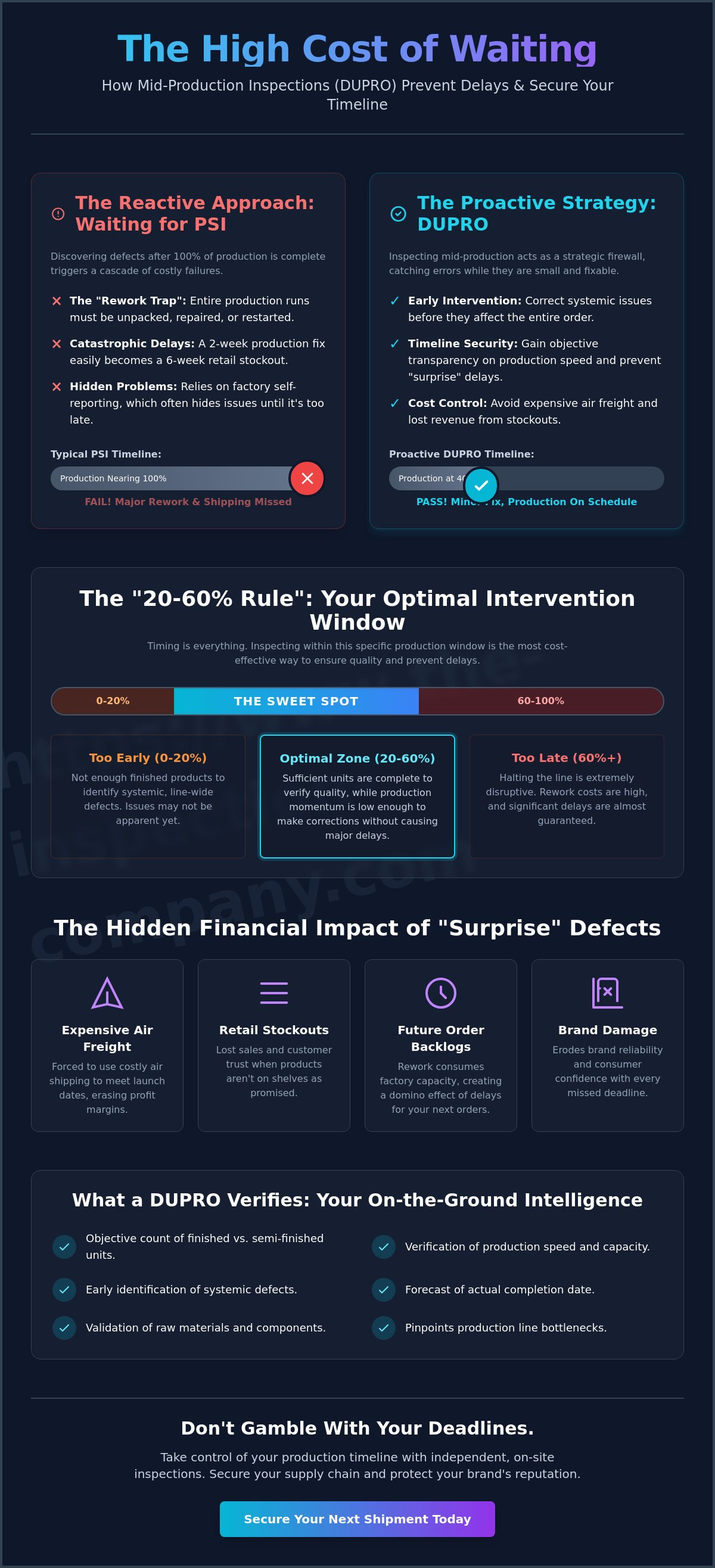
Finding out your entire shipment is defective when it's already packed and ready for the vessel is a logistical nightmare. This is the "Rework Trap." When defects are discovered at 100% completion, the factory often has to unpack, repair, or even restart the entire production run. This doesn't just cost money; it destroys your timeline. A two-week production delay doesn't stay two weeks. By the time you miss your ocean freight window and wait for the next available slot, that delay often balloons into a six-week retail stockout. It's a cascade of failure that erodes your brand's reliability in the eyes of your customers.
While a Pre-Shipment Inspection is a vital final check, it's often too late for time-sensitive launches. Using during production inspection to prevent delays allows you to catch systemic errors while the goods are still on the line. This is a core principle of Inspection in manufacturing; identifying a flaw in the first 20% of the run means you can correct the process before the remaining 80% is impacted. It transforms your quality control from a reactive hurdle into a proactive scheduling firewall.
The Financial Impact of "Surprise" Defects
The costs of late-stage discovery extend far beyond the unit price. When production stalls, you're forced into expensive air freight surcharges to meet launch dates. These costs can easily erase your entire profit margin. Beyond that, late-stage rework consumes the factory's floor capacity. This creates a secondary delay for your next order, as the factory struggles to clear the backlog created by the initial error. You aren't just paying for the fix; you're paying for the lost opportunity of having your products on shelves when demand is highest.
Why Factories Hide Problems Until the Last Minute
Factories often operate on a "hope for the best" mentality. They might notice a minor deviation but assume it will be acceptable to the client or that it can be masked during final assembly. This psychological barrier is why sourcing from Asia requires independent, expert eyes on the floor. Without a During Production Inspection, you're relying on the factory's self-reporting. This is rarely transparent when things go wrong, as the factory fears the financial penalties of a delayed shipment.
The Mechanics of Prevention: How DUPRO Secures Your Timeline
The real value of a DUPRO lies in its timing. Industry experts generally agree that the window between 20% and 60% completion is the "sweet spot" for meaningful intervention. If you wait until 80% or 90%, the momentum of production is too high to stop without causing a significant delay. By using during production inspection to prevent delays, you gain the leverage to halt the line and fix systemic issues before they become permanent fixtures of the entire order. This approach aligns with NIST manufacturing standards, which emphasize that early detection is the most cost-effective way to ensure supply chain resilience and product quality.
A DUPRO also serves as a critical reality check for your production schedule. Factories frequently report that they're "on track" or "50% finished" to keep clients happy. An independent inspector on the ground provides an objective count of finished versus semi-finished units. This transparency allows you to see if the factory is actually hitting its milestones or if they're falling behind. If a critical defect is identified, such as a tooling misalignment or a raw material variance, it can be addressed immediately. This prevents the need for a total production restart later.
Verifying Production Speed and Capacity
Inspectors don't just look at quality; they audit the assembly line's flow. By analyzing the ratio of raw materials to semi-finished goods and final packed units, an inspector can forecast the actual completion date with high accuracy. This helps you identify bottlenecks, such as a slow-moving paint line or a shortage of specific components, before they cause a total standstill. If you're concerned about your current order's progress, you can speak with our team to schedule an on-site visit.
Raw Material and Component Validation
Delays often stem from the very beginning of the supply chain. If a factory uses sub-standard raw materials discovered mid-stream, the entire batch may need to be scrapped. A DUPRO validates that the materials being used match your specifications and the samples approved during the first article inspection. This verification ensures that you don't reach the final stage only to find out the core components were flawed from the start.
Implementing a DUPRO Strategy to Maintain Production Momentum
A successful inspection strategy requires more than just a presence on the factory floor. It demands a structured approach to data and decision-making. Using during production inspection to prevent delays transforms quality control from a passive observation into an active management tool. This proactive framework ensures that every stakeholder knows exactly what happens when a deviation is found. To maintain momentum, importers should follow these four essential steps:
- Step 1: Define "Must-Pass" Criteria. Establish clear thresholds in your initial QC checklist. There should be no ambiguity regarding what constitutes a major or minor defect.
- Step 2: Timing is Critical. Schedule the inspection when the factory estimates 30% completion. This provides enough finished product for a representative sample while leaving 70% of the run open for immediate correction.
- Step 3: Digital Reporting. Require a digital report within 24 hours. In international trade, a two-day delay in information can mean a missed vessel booking.
- Step 4: Execute a CAP. Develop a Corrective Action Plan (CAP) immediately based on the inspector's findings to realign production without stopping the line.
The Corrective Action Plan (CAP) Framework
The goal of a CAP is to fix the process, not just the product. When you identify systemic product defects mid-stream, you can negotiate rework that happens alongside the remaining production. This avoids the total standstill that occurs during final-stage discovery. By setting "Stop-Ship" thresholds for major issues, you protect your brand while giving the factory a clear path to resolution. If you need assistance in developing these thresholds, you can contact our technical team for guidance.
Leveraging Real-Time Data for Logistics Planning
Information lag is the primary cause of missed containers and expensive air freight. Using during production inspection to prevent delays provides the raw data needed to confirm your bookings with freight forwarders. If the inspector's unit count reveals the factory is lagging behind its 30% milestone, you can adjust your logistics plan weeks in advance. This transparency eliminates the "last-minute surprise" and allows for predictable, reliable shipping dates.
Choosing the Right Partner to Safeguard Your 2026 Supply Chain
The effectiveness of your quality control depends entirely on the integrity of the people on the factory floor. European management combined with deep localized expertise in Asia creates a necessary layer of accountability that factories respect. This structure ensures that reporting remains objective and isn't influenced by local production pressures. When you're using during production inspection to prevent delays, you need a partner who understands both international quality standards and the cultural nuances of regional manufacturing.
Modern supply chains require digital agility. Relying on paper reports or delayed emails creates an information gap that leads to missed deadlines. Through a centralized quality platform, importers can manage transparency across a network of over 700 inspectors. This scale allows for rapid deployment and consistent data collection. It transforms the supplier management process from a series of disconnected checks into a cohesive strategy for risk mitigation.
The ROI is clear. When you consider that a single missed shipping window can result in massive air freight surcharges or total retail stockouts, the cost of a mid-production check becomes a negligible insurance premium. Using during production inspection to prevent delays is a proactive investment that protects your profit margins from the financial losses described earlier. It's the difference between a predictable delivery and a logistical crisis.
The TIC Advantage: Speed, Transparency, and Reliability
Speed is the most critical factor in mid-production intervention. We provide a 24-hour report turnaround with detailed photo documentation, allowing you to make informed decisions before the next shift begins at the factory. For Amazon FBA sellers, this level of detail is essential to avoid rejections at fulfillment centers and protect account health. Don't leave your lead times to chance. Protect your production timeline. Book a DUPRO with TIC today.
Secure Your Supply Chain Before the Final Shift
Relying on luck at the end of a production run is a strategy for failure. By identifying defects when only 20% to 60% of your goods are complete, you eliminate the "Rework Trap" and keep your shipping dates predictable. Consistently using during production inspection to prevent delays is the only way to gain true transparency into your factory floor operations. This proactive investment transforms your quality control from a final hurdle into a powerful logistics firewall. It's about maintaining momentum and protecting your brand from the financial friction of late-stage discovery.
With a network of over 700 inspectors across Asia and 24-hour detailed reporting, we provide the localized presence needed to enforce rigorous European management standards. Our digital platform ensures you have the data to make critical decisions in real time. Don't wait for a stockout to realize the value of early intervention. Secure your production timeline with a professional DUPRO inspection and ensure your next launch is defined by success rather than surprises.
Frequently Asked Questions
How does a During Production Inspection (DUPRO) specifically prevent delays?
A DUPRO prevents delays by catching systemic manufacturing errors while the goods are still on the assembly line. By identifying defects early, you avoid the catastrophic "Rework Trap" where a factory must unpack and repair 100% of finished goods. Using during production inspection to prevent delays allows corrective actions to occur simultaneously with the rest of the production run, ensuring you maintain your original shipping window and avoid retail stockouts.
What is the ideal time to schedule a DUPRO during the manufacturing cycle?
The ideal window is when 20% to 60% of your order is completed and the factory has started the initial packing process. This stage provides a representative sample of the final quality while leaving enough of the production run open for process adjustments. Scheduling at this point also allows an inspector to verify the actual unit count, providing an objective forecast of the completion date rather than relying on factory estimates.
Can a DUPRO inspection actually cause a delay if the inspector finds issues?
Identifying a major issue mid-production is a preventative measure that forestalls much larger, unmanageable delays later. While a factory might need to pause briefly to calibrate tooling or replace a material batch, this short term intervention is far more efficient than a total production restart. It's an essential investment that replaces the risk of a six week stockout with a manageable, controlled adjustment period during the active manufacturing phase.
What is the difference between DUPRO and Pre-Shipment Inspection (PSI)?
The primary difference lies in the opportunity for corrective action. A PSI is a final gatekeeper that occurs when 100% of goods are finished, meaning any discovered failure results in a total production halt. Using during production inspection to prevent delays gives you the leverage to fix problems before they are "baked in" to the entire shipment. While PSI confirms final quality, DUPRO manages the production process to ensure the final inspection is a success.
Is a DUPRO necessary if I have already conducted a Factory Audit?
Yes, because a Factory Audit and a DUPRO serve entirely different functions in your risk management strategy. An audit confirms that a supplier has the capacity and systems to meet your standards, but it doesn't monitor the daily execution of a specific order. A DUPRO provides floor level transparency into your actual goods, catching human errors or material variances that occur regardless of a factory's general certifications or past performance.