

Your production line is currently one minor misunderstanding away from a total financial loss. While many importers believe a signed contract provides enough protection, failing to define what is a golden sample in manufacturing leaves your quality standards open to interpretation. You've likely experienced the frustration of receiving a shipment where colors are slightly off or materials feel cheaper than the initial prototype. This quality fade isn't just an annoyance; it's a direct threat to your brand's reputation and your bottom line.
We understand that arguments with suppliers over quality tolerances are exhausting and expensive. This guide will help you master the essential role of the golden sample in protecting your product quality and preventing costly errors before they leave the factory floor. We'll explain how to establish a legally binding benchmark that third-party inspectors can use for verification. By the end of this article, you'll know exactly how to use this tool to reduce the risk of shipment rejection and ensure your next production run meets your exact specifications every time.
Key Takeaways
- Understand what is a golden sample in manufacturing and why it serves as the definitive reference point for every unit produced in your factory.
- Learn how a sealed sample prevents "quality fade" by stopping factories from substituting cheaper materials during long-term production runs.
- Implement the "Rule of Three" to ensure your office, the factory manager, and your third-party inspector all hold identical, tamper-proof benchmarks.
- Discover the specific methods professional inspectors use to compare mass-produced goods against your master sample to catch deviations in color, weight, and function.
- Establish a clear, contractually binding quality standard that eliminates arguments with suppliers over acceptable tolerances and defects.
Defining the Golden Sample: Your Manufacturing North Star
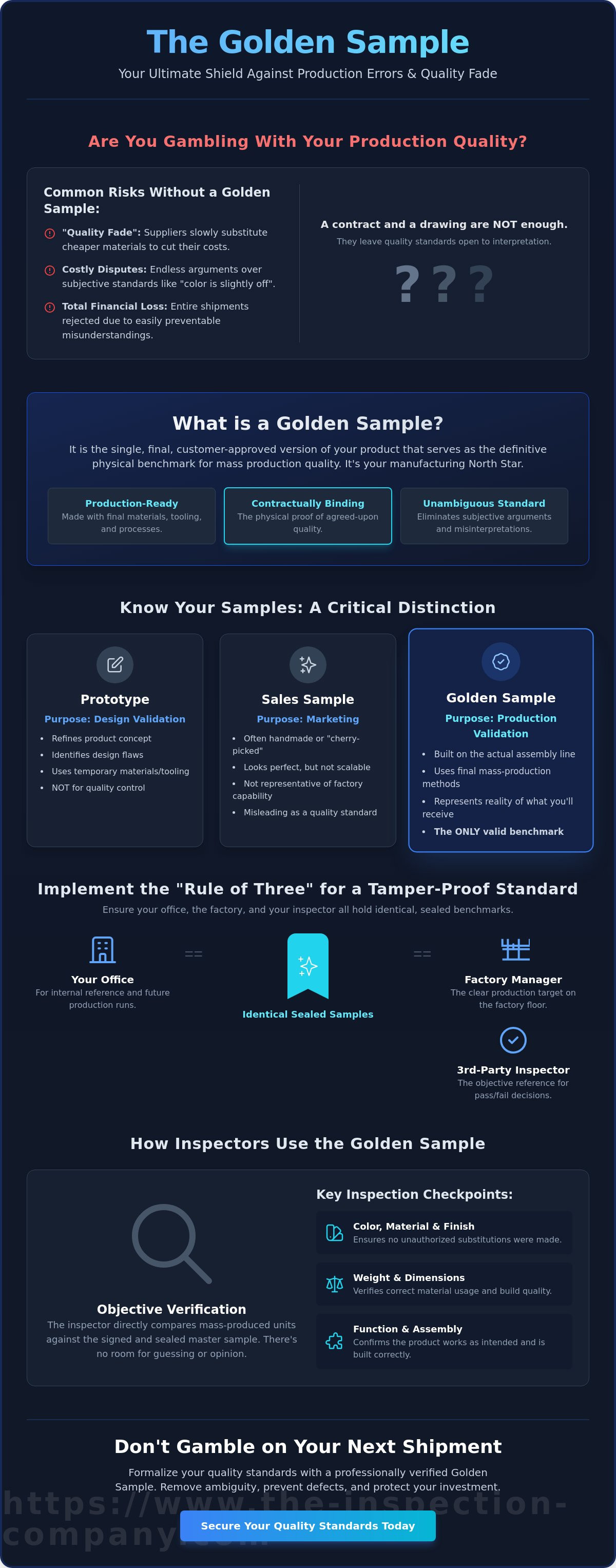
Many importers operate under the dangerous assumption that a signed contract and a technical drawing are enough to secure their quality standards. They aren't. In the complex reality of international trade, what is a golden sample in manufacturing represents the only bridge between your expectations and the factory's output. It's the final, customer-approved version of your product that has been manufactured using the exact materials, processes, and tooling intended for mass production.
This sample serves as the perfect execution of your Bill of Materials (BOM) and design specifications. It proves that the factory possesses the technical capability to meet your requirements before you commit to a full production run. A golden sample is the definitive physical benchmark for mass production quality. Without this physical reference, you leave your brand vulnerable to quality fade, where a factory slowly substitutes cheaper components to increase their margins at your expense.
Golden Sample vs. Prototype: Knowing the Difference
Confusing a prototype with a golden sample is a common mistake that leads to significant manufacturing friction. Prototypes are created during the early stages of development for design validation. They are meant to test form and function; they often use soft tooling or temporary materials that aren't sustainable for high-volume runs. In contrast, golden samples are for production validation. They represent the reality of what will arrive at your warehouse.
- Prototypes: Used to refine the product concept and identify design flaws.
- Sales Samples: Often handmade or cherry-picked to look perfect for marketing, but not representative of actual factory capabilities.
- Golden Samples: Built on the actual assembly line using mass-production methods and final materials.
If you use a prototype as your quality standard, you'll likely face arguments with your supplier regarding tolerances. The factory will claim that the precision achieved in a one-off prototype is impossible to replicate at scale. By utilizing professional sample testing services, you can ensure your golden sample is technically sound. It then serves as a contractually binding reference for all future pre-shipment inspections.
Why a Golden Sample is Essential for Quality Risk Mitigation
Protecting your margins requires more than just a good relationship with your supplier. One of the most significant threats to long-term profitability is "quality fade." This occurs when a factory, under pressure to maintain its own margins, slowly substitutes cheaper components or materials over time. Because you've defined what is a golden sample in manufacturing as your absolute standard, you have a physical benchmark to detect these subtle, unauthorized changes before they ruin your reputation.
A golden sample creates a "meeting of the minds" between your brand and the factory manager. It eliminates the ambiguity of technical drawings and translated emails. By holding a physical version of the finished product, both parties agree on what constitutes acceptable quality. This alignment is critical for reducing the risk of product defects, as it provides a clear pass/fail reference for every unit on the assembly line.
During a pre-shipment inspection, this sample serves as the foundation for AQL sampling. Inspectors don't just guess; they compare the mass-produced goods directly against the signed and sealed master. If the production units don't match the weight, texture, or functionality of the golden sample, the shipment fails. This objective comparison removes emotion from the quality control process.
The Cost of Proceeding Without an Approved Sample
Proceeding to mass production without an approved sample is a high-stakes gamble. Imagine the financial impact of producing 5,000 units with the wrong matte finish or a slightly off-brand color. Verbal agreements fail in cross-border manufacturing because they leave too much to interpretation. You can't ship a verbal promise back for a refund. To secure your next production run, consider how our team can help you formalize your quality standards through professional oversight.
The Golden Rules of Sample Management: Sealing, Signing, and Storing
Establishing what is a golden sample in manufacturing is only the first step. Without a disciplined management protocol, your reference unit becomes a liability rather than an asset. Factories often juggle multiple clients and production runs; if your sample isn't clearly identified and protected, it can easily be misplaced or replaced by a version that doesn't meet your current specifications. To forestall these risks, you must implement a strict chain of custody.
We recommend the "Rule of Three" for sample distribution. This ensures that all parties operate from the same baseline. You should maintain three identical, approved samples:
- The Factory Sample: Stays on the production floor as a daily reference for workers and supervisors.
- The Importer Sample: Kept at your head office. This is your ultimate "control" version for resolving disputes.
- The Inspector Sample: Held by your 3rd-party inspection company. This prevents the factory from presenting a "cherry-picked" sample to the inspector during quality checks.
Sealing the sample is a critical procedural stage. Use tamper-evident tape and ensure that signatures and company chops (official stamps) span across the tape and onto the product or its packaging. This makes it impossible to open the package or swap the contents without leaving visible evidence of tampering. A correctly sealed golden sample must include the date of approval, signatures from both the buyer and factory manager, and a clear reference to the PO number.
Golden Samples vs. Limit Samples: When to Use Which?
While the golden sample represents perfection, limit samples define the boundaries of acceptability. These are essential for products with natural variations, such as wood grain textures or textile dye lots. A limit sample shows the maximum "acceptable" deviation, such as the lightest and darkest shades of a specific color. By providing both, you eliminate the factory's ability to claim that a defect is merely a "natural variation." To ensure your standards are contractually binding, contact our team today to formalize your sample management process.
How Professional Inspectors Use Your Golden Sample to Secure Shipments
Establishing a standard is only half the battle. Without an objective third party to enforce it, your reference unit is just a piece of plastic or fabric sitting on a shelf. Our inspectors treat what is a golden sample in manufacturing as a contractually binding physical template. During a Pre-Shipment Inspection (PSI), we retrieve the sealed master and place it side-by-side with units pulled from the production line. This direct comparison is the most effective way to catch errors before they become your financial burden.
We look for even the slightest deviations that could signal a lapse in quality control. This includes color shifts that the human eye might miss without a reference, weight discrepancies indicating material substitution, and differences in texture or finish. Functionality is also tested against the master. If the buttons on a production unit feel loose or the hinges lack the tension of the golden sample, it's flagged immediately. This level of scrutiny is vital for Amazon FBA inspections, where strict adherence to product standards is required to avoid costly returns or account suspensions.
Integrating Samples into Your Quality Control Strategy
To maximize security, you should send your master sample to The Inspection Company before production concludes. This ensures our team has the benchmark in hand, preventing the factory from providing a tampered or "cherry-picked" version on the day of inspection. Our final report doesn't just list data; it provides a detailed comparison documenting every difference between the "Golden" standard and the actual shipment. This documentation gives you the leverage needed to demand rework or a refund before you release the final payment to your supplier.
Securing Your Supply Chain with Professional Standards
A golden sample is more than a reference; it's a preventative investment that secures your brand's future. By masterfully managing your master samples through sealing and signing, you remove the factory's ability to claim ignorance or allow quality fade. Understanding what is a golden sample in manufacturing provides you with the leverage needed to hold suppliers accountable and protect your margins from unexpected operational friction.
The Inspection Company bridges the gap between Western quality expectations and localized Asian manufacturing reality. With over 700 inspectors across Asia and European management standards, we provide the meticulous oversight your high-stakes operations require. Our team delivers detailed reports within 24 hours, ensuring you have the transparency needed to make informed shipping decisions. Secure your production quality; book a Pre-Shipment Inspection with your golden sample today. Your reputation is too valuable to leave to chance; take control of your quality standards now and protect your bottom line.
Frequently Asked Questions
What is a 'Red Seal' sample vs. a Golden Sample?
A "Red Seal" sample is essentially a synonym for a golden sample, a term frequently used in specific geographic regions or industries to denote the finality of approval. It refers to a unit that has been physically sealed with a wax seal or official company stamp to prevent any unauthorized modifications. Both terms describe the same critical benchmark: the definitive version of the product that the factory is contractually obligated to replicate during mass production.
Who pays for the creation and shipping of golden samples?
The importer typically covers the costs associated with sample development and international courier fees. While some factories include initial sample production in their overhead, the shipping costs for multiple rounds of revisions are almost always the buyer's responsibility. You should view these fees as a necessary preventative investment; paying for courier shipments is significantly cheaper than receiving a container full of unsellable goods.
How many golden samples should I have made?
You should always have at least three identical samples produced and approved simultaneously to maintain a consistent chain of custody. This ensures that the factory, your own head office, and your third-party inspection team each hold an identical master reference. Having multiple copies of what is a golden sample in manufacturing eliminates excuses from the factory and ensures your inspector has the exact tool needed to verify production quality on-site.
What should I do if the mass production doesn't match the golden sample?
If production fails to match your sample, you must immediately withhold final payment and demand a formal Corrective Action Plan from the supplier. Don't allow the goods to be shipped under a "letter of guarantee" or vague verbal promises of future improvement. Use the objective data in your inspection report and the physical deviations from the sample as leverage to force the factory to perform rework at their own expense.
Can a golden sample be used in a legal dispute with a factory?
A properly sealed and signed golden sample is powerful physical evidence in a legal or contractual dispute. Because the unit carries the signatures of both the buyer and the factory manager, it represents a documented "meeting of the minds" regarding quality standards. It's much harder for a supplier to argue against a physical object they've signed than it is to dispute technical jargon or vague descriptions within a purchase order.