
In the first quarter of 2026, the volume of recalled product units in the U.S. surged by 27 percent to reach a four-year high of 492.31 million units. This trend highlights a harsh reality for modern importers; a single oversight can lead to massive financial exposure. When your latest report arrives with a "Fail" status, the pressure to maintain your shipping schedule can be overwhelming. However, knowing exactly what to do after a failed quality inspection is the only way to prevent these defects from reaching your customers and damaging your brand's reputation.
We understand the anxiety that comes with strained supplier relationships and the potential for significant financial loss from delayed shipments. It's a difficult balance to strike, but a failed inspection is actually a critical data point that allows you to execute a structured remediation plan. This guide reveals the exact professional protocol you need to follow to mitigate financial risk and ensure product excellence. We'll walk through the updated ISO 2859-1:2026 sampling standards, the correct way to manage re-work, and how to use risk-based frameworks to secure your supply chain.
Key Takeaways
- Secure your financial investment by immediately halting all shipments and withholding final payments until a formal resolution is documented.
- Analyze the specific root cause of failure by comparing defect categories against your Golden Sample to objectively prove deviations to the manufacturer.
- Establish a clear protocol for what to do after a failed quality inspection by requesting a formal Corrective and Preventive Action (CAPA) plan from the factory.
- Evaluate remediation strategies such as full reworks, partial lot shipments, or price discounts based on the severity of the AQL breach.
- Mitigate future risks by employing independent 3rd party inspection services to eliminate conflicts of interest during the factory’s rework process.
Immediate Actions After an Inspection Failure: Securing Your Supply Chain
Receiving a failed report is a high-stakes moment for any importer. A failed inspection is a formal notification that a production lot does not meet the Acceptable Quality Limit (AQL) or your specific technical requirements. This result indicates that the statistical probability of defective goods exceeds the threshold you established to protect your brand. It's the first line of defense in broader quality control principles, designed to identify errors before they leave the factory floor. Understanding exactly what to do after a failed quality inspection is essential for maintaining a resilient supply chain.
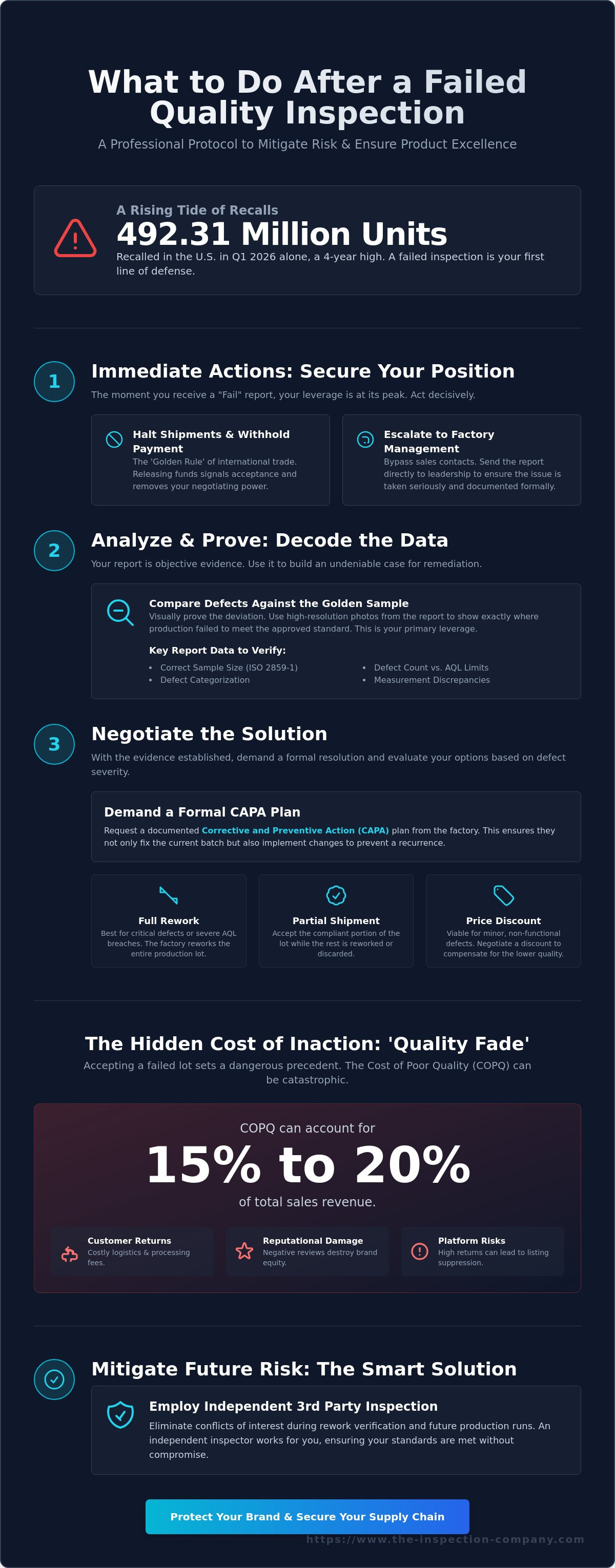
You must follow the 'Golden Rule' of international trade: halt all shipping and withhold final payment until a resolution is fully documented. Releasing funds now removes your leverage and signals that you're willing to accept sub-standard goods. In the regulatory environment of 2026, a failed inspection report serves as a definitive legal safeguard that justifies your refusal to accept non-compliant inventory. It acts as the objective evidence needed to pause the transaction without breaching your purchase agreement.
Don't just email your sales contact. Sales representatives often focus on commissions and may downplay the severity of the defects to keep the shipment on schedule. You must notify factory management directly about the report findings. This ensures the issue is escalated to those with the authority to initiate re-work or production halts. Clear, documented communication at the executive level prevents the factory from claiming the failure was a minor misunderstanding or a subjective preference. Professionalism and directness at this stage are your best tools for risk mitigation.
The Financial Risk of 'Quality Fade'
Accepting a failed lot even once creates a dangerous precedent known as 'quality fade.' When a manufacturer sees that you'll tolerate deviations, they may gradually lower standards to save on material or labor costs. This erosion of quality is difficult to reverse once it begins. Beyond the immediate order, the hidden costs of receiving defective goods are catastrophic for your bottom line. Consider these operational risks:
- Customer Returns: High defect rates lead to a surge in costly return logistics and processing fees.
- Reputational Damage: Negative reviews can destroy a product's ranking and brand equity in a matter of weeks.
- Platform Risks: For e-commerce sellers, high return rates directly threaten Amazon account health and can lead to permanent listing suppression.
Research indicates that the Cost of Poor Quality (COPQ) can account for 15% to 20% of total sales revenue for many manufacturers. Much of this cost is hidden within operational budgets, making a proactive response to a failed inspection a vital financial investment rather than a mere administrative hurdle.
Decoding the Failed Report: AQL Limits and Defect Categorization
A failed report is a technical diagnostic tool, not just a rejection notice. To determine what to do after a failed quality inspection, you must first look past the "Fail" stamp and analyze the statistical data. Did the lot fail because of a single safety hazard, or was it a high volume of minor aesthetic flaws? Your response strategy depends entirely on this distinction. By examining the actual defect count against the allowable AQL threshold, you can identify whether the failure is a systemic production flaw or a series of isolated human errors.
Objective evidence is your only leverage in a dispute. You should immediately reference your Golden Sample to prove the deviation to the manufacturer. High-resolution photo documentation is critical here; it provides visual proof that the factory manager cannot ignore. These photos should show the defect in context, with clear measurements or comparisons to the approved sample. This data forms the objective foundation for any future Corrective and Preventive Actions you demand from the supplier.
Before making a final decision on the lot, verify these seven essential data points in your report:
- Sample size: Ensure the inspector checked enough units to meet the 2026 ISO 2859-1 standards.
- Defect count: Compare the found defects against the "Accept" and "Reject" limits.
- Defect descriptions: Look for technical language that describes the root cause.
- Golden Sample comparison: Note specific variances in color, weight, or dimensions.
- Functional test results: Review on-site tests like drop tests or power-cycle checks.
- Packaging accuracy: Confirm that barcodes and shipping marks are compliant.
- Inspector’s comments: Read the subjective notes regarding the factory’s environment or cooperation.
If you're unsure how to interpret specific findings, consult our technical specialists for a detailed risk assessment.
Categorizing Defects Like a Pro
Defects aren't created equal. Categorizing them correctly allows you to prioritize risks and negotiate effectively. Critical defects involve safety hazards or legal non-compliance, such as RoHS violations or sharp edges. These require an immediate halt. Major defects are functional issues that make the product unsellable or likely to trigger a return. Minor defects are aesthetic flaws that deviate from the Understanding Product Defects guide but don't affect the item’s core utility. A failed lot often contains a mix of all three, necessitating a nuanced remediation plan.
The Remediation Roadmap: Negotiating Reworks and Corrective Actions
Determining what to do after a failed quality inspection requires a methodical approach to remediation. Once the defects are identified, your first step is to request a formal Corrective and Preventive Action (CAPA) plan. This document should detail how the factory will fix the current batch and what changes they'll implement in their Quality Management System to prevent recurrence. Relying on verbal promises isn't enough; you need a written commitment to ensure long-term stability for your supply chain.
You have three primary options for managing the defective lot. A full rework is the most secure path for brand integrity, though it inevitably adds production time. Alternatively, you might accept a partial shipment of verified units while the rest are fixed. For minor aesthetic issues, a price discount may be negotiated, though this is risky for premium brands. Regardless of the path, standard industry practice dictates that the factory pays for the re-inspection. Finalize a strict rework timeline immediately to ensure you don't miss your market window or seasonal deadlines.
Product Sorting: The Professional Solution
When a lot fails due to a high defect rate, product sorting is the most efficient way to salvage your investment. This process involves checking every single unit rather than a statistical sample. You shouldn't let factory staff perform this sorting alone. Their inherent conflict of interest often leads to 'borderline' units being passed to save on scrap costs. Using an independent third party ensures that only units meeting your exact specifications reach your warehouse.
The Final Verdict: Pass, Fail, or Pending
A 'Pending' status in a report often indicates that the inspector found issues that weren't clearly defined in your initial specifications. This requires your expert intervention to decide if the variance is acceptable for your specific market. Document your final decision clearly in a signed letter of authorization. This creates a paper trail that protects your future orders and clarifies your expectations for the manufacturer. If you need immediate assistance managing a rework protocol, contact our regional managers to secure your shipment.
Beyond the Report: Why Professional Inspection Services Outperform DIY Checklists
Relying on a factory to self-correct after a failure is a significant operational risk. When deciding what to do after a failed quality inspection, importers often fall into the trap of trusting the supplier's internal "re-inspection" report. This creates an obvious conflict of interest. The manufacturer's primary incentive is to clear warehouse space and finalize billing, not to meticulously identify their own manufacturing errors. Generic templates or DIY checklists can't replace a physical presence that understands how factories might attempt to conceal defects during a rework.
A professional 3rd party inspection company acts as your technical representative on the ground. Knowing what to do after a failed quality inspection involves more than just reading a PDF; it requires real-time verification of the factory's corrective actions. This includes unannounced visits to the production line, ensuring that defective units aren't simply moved to the back of the lot or hidden in the middle of a pallet. By maintaining this level of scrutiny, you move from reactive crisis management to a proactive quality platform that provides long-term supply chain visibility.
Expertise You Can’t Download
Effective quality management requires more than just technical knowledge. It demands local language skills and cultural fluency to negotiate defect rectifications with factory owners across Asia. When an inspector speaks the local dialect, they can uncover the root cause of a failure that a translated email would miss. Professional firms like The Inspection Company deliver comprehensive reports within 24 hours. This speed is essential in 2026, where supply chain agility determines whether you meet your market window or suffer a total financial loss. Investing in independent oversight isn't just a cost; it's the only way to ensure your remediation plan is actually executed.
Master Your Quality Remediation Strategy
Successfully managing a supply chain crisis requires a transition from panic to protocol. You've learned that halting payments and analyzing AQL data are the first lines of defense. By categorizing defects and demanding a formal CAPA plan, you transform a production failure into a structured improvement process. Understanding exactly what to do after a failed quality inspection ensures that your brand remains associated with excellence rather than operational friction.
Don't leave your reputation in the hands of a factory's self-assessment. Independent oversight is the only way to verify that reworks are genuine and that quality fade doesn't compromise your future shipments. With over 700 inspectors across Asia and European management ensuring global standards, we provide the transparency you need to make informed decisions. We deliver detailed reports within 24 hours so your project stays on track. Protecting your bottom line starts with professional, on-the-ground verification.
Secure your next shipment and resolve quality issues with The Inspection Company.
Frequently Asked Questions
What is the most important section of a quality control report to check after a failure?
The defect summary is the most critical section to analyze immediately after a failure. This section provides a clear breakdown of critical, major, and minor defects found during the sampling process. By reviewing these specific counts against your established AQL limits, you can determine if the failure is a systemic production issue or a series of isolated aesthetic variances. This data is the foundation for deciding what to do after a failed quality inspection.
Can I still ship my products if the inspection report says 'Fail'?
You can technically authorize the shipment, but doing so without a remediation plan is a high-risk decision that often leads to financial loss. A "Fail" status indicates that the lot doesn't meet your quality standards and carries a high probability of customer returns or safety issues. If you choose to ship, you should only do so after signing a formal waiver and acknowledging that you accept the full liability for any defective units that reach the market.
How many photos should be included in a standard failed inspection report?
A comprehensive failed inspection report should contain at least 30 to 50 high-resolution photos documenting specific defects and non-compliance issues. For complex electronics or large consumer goods lots, this number often exceeds 100 images. These photos must show the defect in detail, the product packaging, and a direct comparison against your approved Golden Sample. This visual evidence is your primary tool for proving deviations to the factory management.
What happens if a factory refuses to sign the failed inspection report?
If a factory refuses to sign the report, you must escalate the issue to senior factory management and withhold final payment immediately. A refusal to sign often indicates that the factory is attempting to avoid accountability for rework costs or disagrees with the inspector's findings. However, the independent report remains a valid technical document. You should use this documented evidence to pause the shipping process until a joint re-inspection or a formal resolution is reached.
Who should pay for the re-inspection after a factory fails the first time?
Standard industry practice dictates that the factory pays for all re-inspection costs after an initial failure. You should ensure this specific clause is included in your Purchase Order (PO) to prevent negotiation delays. When the manufacturer is financially responsible for the follow-up check, they're more likely to perform a thorough rework. This is a vital step in knowing what to do after a failed quality inspection to protect your profit margins and ensure long-term supplier accountability.