
What if your greatest supply chain risk isn't the month-long ocean voyage, but the final thirty minutes on the factory loading dock? It's a scenario many importers face; you pay for a full shipment, only to discover missing cartons or moisture damage upon arrival. You've worked hard to ensure product quality, so it's natural to feel anxious about the loading process. A professional container loading inspection eliminates this uncertainty by providing an authoritative presence on the ground when it matters most.
In this guide, you'll discover how to prevent transit damage, confirm total order quantities, and ensure your cargo meets the rigorous 2026 standards set by the Concentrated Inspection Campaign (CIC) on Cargo Securing. We'll outline the essential steps to verify container integrity and explain why photographic evidence is your best defense against customs delays and "5H" holds. From checking ISO 17712 high-security seals to validating the Verified Gross Mass, we'll show you how to secure your investment before it leaves the factory gates.
Key Takeaways
- Learn why verifying your physical carton count at the point of loading is the only way to effectively minimize the risk of short shipments and costly payment disputes.
- Master the 7-point container loading inspection checklist to ensure your shipping unit is weather-tight, structurally sound, and compliant with international safety standards.
- Understand the power of real-time supervisor interventions, such as stopping the loading process during inclement weather or correcting improper handling before the container is sealed.
- Discover how leveraging a network of professional inspectors across 25+ countries acts as a preventative investment, protecting your bottom line from unexpected logistics friction.
Why Container Loading Inspection is Critical for Risk Mitigation
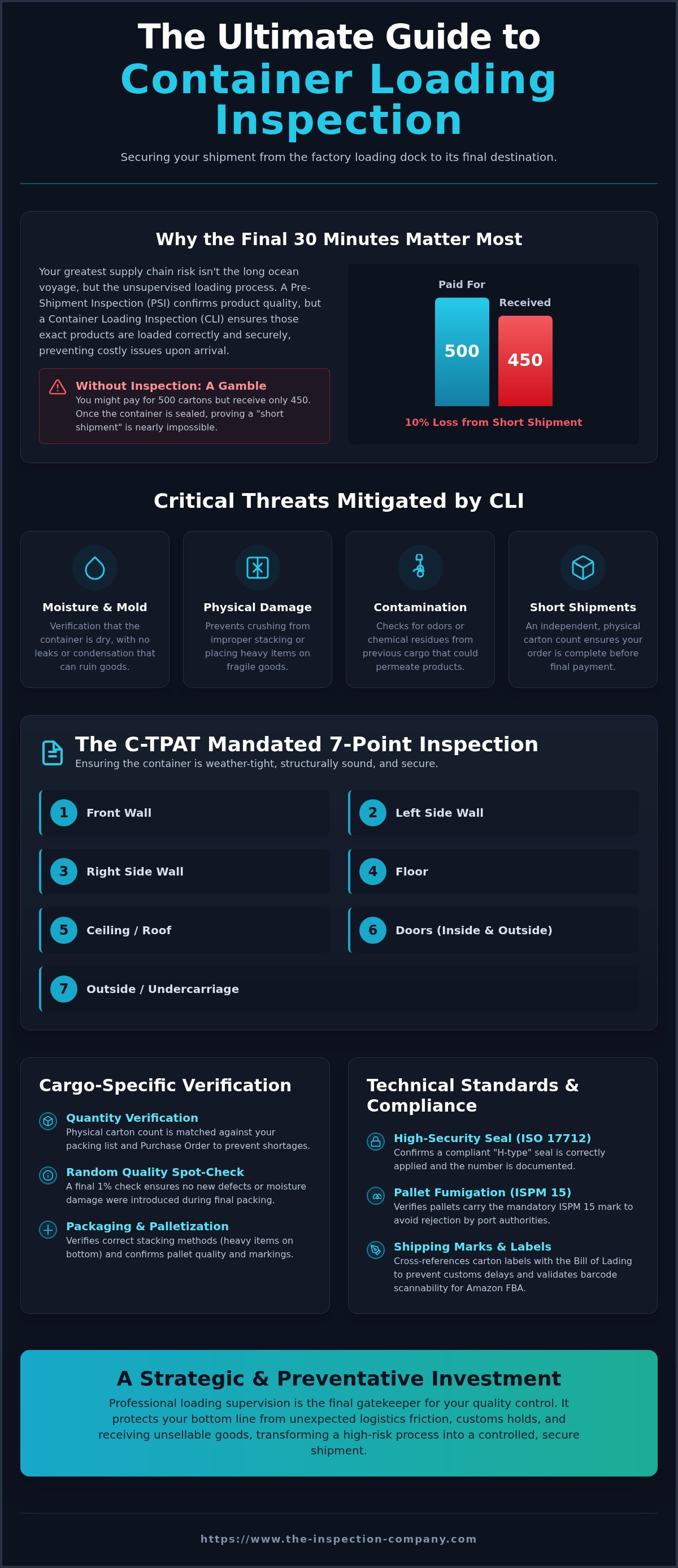
A container loading inspection (CLI) represents the final gatekeeper in your quality control chain. Since the rise of modern containerization, the transition from factory floor to shipping vessel has become a primary source of operational friction. While a Pre-Shipment Inspection (PSI) confirms that your goods meet quality standards, it doesn't guarantee they'll arrive in that condition. CLI ensures that the specific products you approved are the ones actually loaded into a secure, weather-tight container.
The risk of "short shipment" is a constant reality in international trade. Without an independent count, you might pay for 500 cartons but only receive 450. Once the container is sealed and the vessel departs, proving a discrepancy becomes nearly impossible. A professional container loading inspection mitigates several critical threats that can destroy your profit margins:
- Moisture and Mold: Verifying that the container is dry and free of leaks or condensation.
- Physical Damage: Preventing crushing caused by improper stacking or heavy items placed on fragile goods.
- Contamination: Checking for odors or chemical residues from previous cargo that could permeate your products.
The Cost of Skipping Loading Supervision
Receiving unsellable goods is a financial catastrophe. When you're sourcing from Asia, returning defective items is rarely viable. Skipping supervision transforms a controlled shipment into a gamble. We provide a bridge between Western quality expectations and local manufacturing through our European management oversight and 700+ inspectors across 25+ countries. This presence on the dock acts as a preventative investment that forestalls massive losses.
Amazon FBA and Retail Compliance Risks
For modern e-commerce brands, the loading dock is where compliance is won or lost. Incorrect palletization or obscured shipping marks can trigger immediate Amazon FBA rejections or expensive warehouse rework fees. Our inspectors verify that labels are visible and scannable before the doors close. This meticulous check acts as the final gatekeeper for customs compliance, ensuring your shipment flows through international borders without the friction of "5H" holds or documentation discrepancies.
The 7-Point Container Loading Inspection Checklist
A rigorous container loading inspection follows a technical protocol to secure your cargo against environmental and human error. This process begins with the C-TPAT mandated 7-point check of the container's structure. Our inspectors examine the front wall, left side, right side, floor, ceiling, doors, and the outside undercarriage to ensure the unit is weather-tight and structurally sound according to ISO 668:2020 standards.
Once the container's integrity is confirmed, the process moves to cargo-specific verification:
- Quantity Verification: We perform a physical carton count to match your packing list and purchase order. This prevents short shipments before you've made the final payment.
- Random Quality Spot-Check: We conduct a final 1% check to ensure no product defects, such as moisture damage or transit packaging failures, were introduced during the factory's final packing stage.
- Packaging and Palletization: We verify that stacking methods follow your instructions, ensuring heavy items are on the bottom to prevent crushing.
Technical Container Standards
Inspectors verify that locking mechanisms function correctly and that an "H-type" high-security seal (ISO 17712:2013) is applied. We also confirm that pallets carry the ISPM 15 fumigation mark. Missing this detail can lead to immediate rejection by port authorities or expensive quarantine fees. If you're unsure if your current loading process meets these standards, you can request a consultation to review your requirements.
Shipping Marks and Labeling Accuracy
We cross-reference every carton label with the Bill of Lading to ensure seamless customs clearance. Shipping mark verification is the most overlooked part of CLI because minor typographical errors often lead to catastrophic customs delays or warehouse misidentification. For brands utilizing our Amazon FBA inspection services, we specifically validate barcode scannability to avoid expensive warehouse rejections.
Managing the Loading Process: Real-Time Interventions
Passive monitoring is a common failure in third-party logistics. A professional container loading inspection requires an active supervisor who intervenes the moment risks appear. If rain begins to enter the loading bay or workers handle cartons roughly, our inspectors have the authority to stop the process immediately. This real-time oversight prevents moisture damage and structural carton failure before the goods are sealed and shipped.
When a short shipment is identified on the dock, the inspector communicates directly with the factory manager. This immediate intervention allows the factory to locate missing stock or adjust the packing list before the container departs, preventing future payment disputes. We also utilize AQL sampling during the final spot-check to validate the batch's consistency one last time before the doors close.
Comprehensive photographic evidence serves as your final insurance policy. We capture the empty container to prove its condition, the half-full state to verify stacking methods, and the final sealed doors with the ISO seal number clearly visible. This creates an indisputable record for insurance claims and customs clearance, providing the transparency you need for high-stakes international trade.
The TIC 'Stop-Loading' Authority
TIC inspectors are empowered to halt operations if conditions threaten shipment integrity. Our European management oversight ensures that on-the-ground staff remain objective and un-pressured by factory timelines or local relationships. Their only priority is your cargo's security. This management structure provides a level of reliability that remote or unmanaged inspection teams cannot match.
Leveraging the Quality Platform
Clients access all loading data through the TIC Quality Platform. Detailed reports and high-resolution photos are delivered within 24 hours, allowing you to integrate loading data into your broader supplier management dashboard. If you need a partner to act as your eyes on the ground, contact our team to secure your next shipment.
Why Professional CLI is a Strategic Investment
A professional container loading inspection is a high-yield investment. It forestalls massive financial losses associated with damaged goods, short shipments, and customs penalties. By verifying your shipment at the source, you eliminate the friction of returns and insurance disputes that often arise after a container reaches its destination. It's the difference between receiving a profitable shipment and managing a logistical crisis.
This data is essential for mastering the supplier management process. When factories know a third-party expert will count every carton and check every seal, they maintain higher standards of shipping accuracy. The return on investment is clear:
- Significant reduction in transit-related breakage through supervised stacking.
- Elimination of payment disputes through verified quantity counts.
- Guaranteed compliance with international shipping regulations and "5H" hold requirements.
The TIC Difference: European Management in Asia
We provide a localized operational presence across 25+ Asian countries, managed by European standards based in Hong Kong. Our 700+ professional inspectors act as your personal eyes and ears on the factory floor. Unlike remote management services that lack accountability, we deliver detailed reports within 24 hours. This rapid turnaround is critical for fast-moving supply chains where every day of delay impacts your bottom line and market readiness.
Secure Your Next Shipment
To ensure availability, book your container loading inspection at least 7 days before your scheduled loading date. Prepare your loading plan and specific requirements in advance so our inspectors can enforce your exact standards. Don't leave your final mile to chance. Secure your order and book a Container Loading Inspection today to protect your investment and ensure a seamless delivery.
Securing Your Supply Chain for 2026 and Beyond
Your goods have passed production quality checks, but the final thirty minutes on the loading dock determine whether that quality survives the journey. Implementing a professional container loading inspection is the most effective way to minimize the risk of moisture damage, physical crushing, and costly quantity discrepancies. By enforcing the 7-point integrity check and verifying shipping marks, you ensure that your cargo meets the stringent 2026 regulatory standards and arrives ready for retail. It's the ultimate insurance policy for your logistics.
The Inspection Company provides the oversight you need through our network of 700+ certified inspectors across 25+ countries. With European management standards and detailed photographic reports delivered within 24 hours, you gain total transparency into the final stage of the manufacturing process. Don't let a single loading error jeopardize your entire investment. Take control of your logistics today and ensure every shipment leaves the factory exactly as you intended.
Secure Your Shipment: Book a Container Loading Inspection
Frequently Asked Questions
What is the difference between a Pre-Shipment Inspection and a Container Loading Inspection?
Pre-Shipment Inspection focuses on product quality, functionality, and specifications before the goods are packed. In contrast, a container loading inspection validates that those specific goods are safely stowed into a structurally sound unit. While the first service confirms the products meet your requirements, the loading check ensures the quantity is accurate and the container is weather-tight for transit.
Can a container loading inspection prevent theft during transit?
While no service can guarantee 100% theft prevention, our supervision significantly minimizes risk by establishing an indisputable chain of custody. The inspector verifies that an ISO 17712 high-security seal is applied correctly and records the unique seal number in the final report. This photographic evidence discourages tampering at the factory and provides essential documentation for insurance claims if a breach occurs.
How many cartons do inspectors check during a loading supervision?
During a standard loading supervision, the inspector performs a 100% physical count of all cartons entering the container to verify the packing list accuracy. Additionally, we conduct a random 1% spot check of the goods to ensure no damage occurred during the final packing stage. This dual approach confirms you're receiving the exact quantity you paid for while maintaining a final layer of quality oversight.
What happens if the inspector finds a damaged container at the factory?
If our inspector identifies a damaged or unsuitable unit, they have the authority to stop the container loading inspection and halt the process immediately. Common issues include structural holes, light leaks, or lingering chemical odors from previous cargo. We notify you in real-time, allowing you to demand a replacement container from the carrier. This intervention prevents moisture ingress and contamination that would lead to unsellable inventory.
Is a container loading inspection necessary for LCL (Less than Container Load) shipments?
Loading supervision is highly recommended for LCL shipments because they involve higher handling risks at consolidation warehouses. Since your cargo shares space with other shipments, verifying your specific palletization and labeling is critical to prevent loss or misidentification. Our inspectors ensure your goods are protected against the rough handling typical of LCL logistics, providing peace of mind even when you don't control the entire container environment.