

What if the most dangerous threat to your 2026 margins isn't a rising tariff, but the silent drain of uncalculated quality failures? If you think the cost of a defective shipment is just the value of the lost goods, you're ignoring an iceberg that can consume up to 25% of your annual revenue. You're likely already feeling the friction of unpredictable product defects, high Amazon FBA return rates, and the emergency air-freight costs required to replace them. These issues aren't just inconveniences; they're direct failures in import risk management that threaten your brand reputation and financial stability.
This guide provides a professional framework to help you calculate and eliminate the hidden quality risks that drain your margins. You'll learn how to justify a proactive inspection budget and implement a methodical system to improve supplier performance. We'll explore the true cost of poor quality and provide the tools you need to secure your supply chain against the operational friction that stalls growth. This ensures quality control becomes a strategic advantage rather than a cost center.
Key Takeaways
- Understand how the "Iceberg Metaphor" reveals hidden administrative and logistical waste that often exceeds visible scrap costs.
- Learn to categorize quality expenses into Prevention and Appraisal costs to stop defects before they reach your customers.
- Follow a step-by-step framework to quantify direct losses and logistics waste, including duties paid on unsellable goods.
- Discover how shifting your budget toward proactive inspections strengthens your import risk management and protects your long-term profit margins.
Understanding the Financial Impact of the Cost of Poor Quality (COPQ)
In international trade, the Cost of Poor Quality (COPQ) is the total financial loss incurred because a product wasn't manufactured perfectly the first time. It's a critical metric for import risk management. With 2026 labor and material costs in Asia rising, quality errors are more punishing than ever before. Every defective unit represents wasted raw materials and expensive man-hours that can't be recovered.
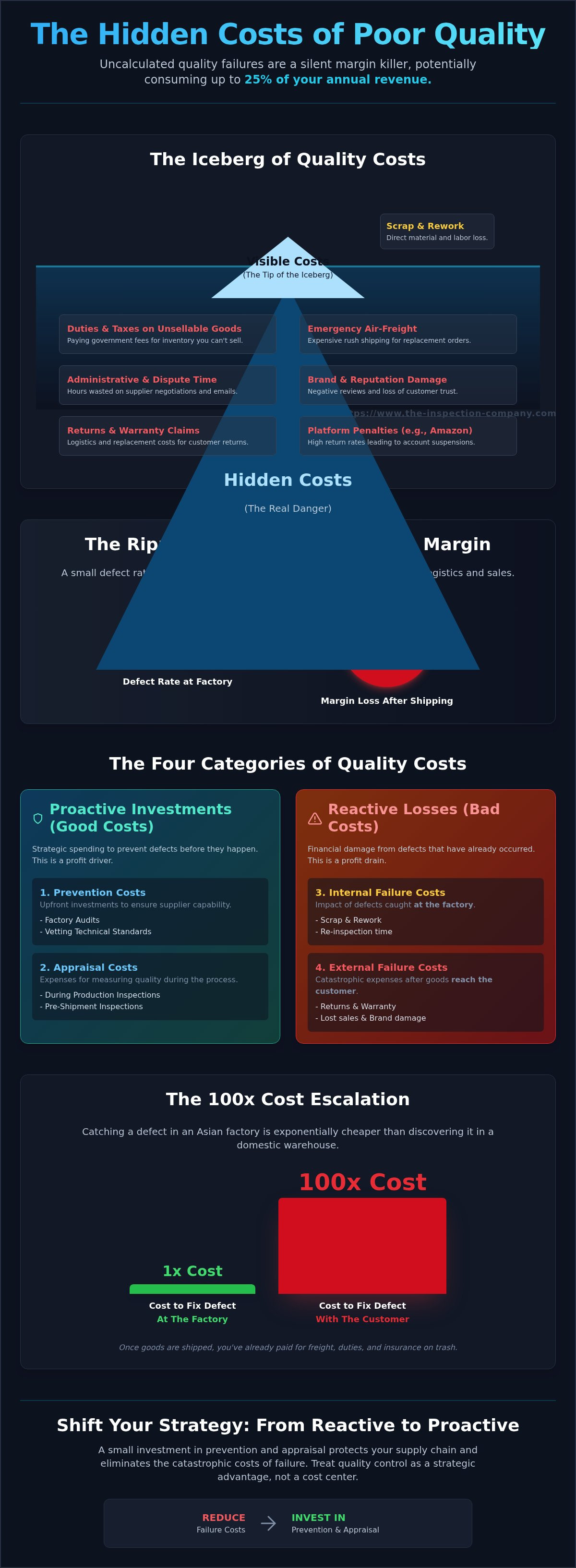
Think of COPQ as an iceberg. Importers often only see the visible tip: scrap and rework. However, the true danger lies in hidden administrative and logistical waste:
- Duties and taxes paid on unsellable inventory
- Administrative time spent on supplier disputes
- Emergency air-freight for replacement parts
By utilizing during production inspection, you transition from reactive damage control to proactive appraisal. Prevention is a profit driver, not a sunk cost.
Why COPQ is the Silent Killer of Import Margins
A 1% defect rate at the factory often translates to a 10% margin loss after shipping and returns. This ripple effect devastates the Total Cost of Ownership (TCO) for Asian-sourced goods. When defects reach your domestic warehouse, you've already paid for freight, insurance, and taxes on trash. High return rates don't just kill the immediate sale; they trigger platform penalties and long-term brand erosion.
The Psychology of Quality Investment
Importers often skip a pre-shipment inspection to save a few hundred dollars, ignoring the thousands at risk. Comprehensive import risk management starts with factory audits to vet supplier capability before production begins. COPQ is a preventative investment that forestalls much larger financial losses rather than an operational expense you can afford to cut.
The Four Categories of Quality Risk in International Trade
Effective import risk management requires a granular understanding of the four categories of quality costs. These are not merely theoretical accounting line items. They represent the concrete difference between a scalable, profitable business and one collapsing under the weight of operational friction and hidden waste.
- Prevention Costs: Upfront investments like Factory Audits to vet a supplier’s capability and technical standards before production begins.
- Appraisal Costs: The expense of measuring quality through During Production Inspection to ensure your specifications are met.
- Internal Failure Costs: The financial impact of scrap, rework, or re-inspection for defects caught at the factory.
- External Failure Costs: The catastrophic expenses incurred once defective goods have been shipped and received by the end user.
Internal vs. External Failures: The Point of No Return
Catching a defect in an Asian factory is often 100x cheaper than discovering it in a domestic warehouse. Once goods are on the water, you've already paid for freight, duties, and inland transport. If they arrive defective, these logistics costs are permanently lost. Utilizing a robust framework for understanding product defects ensures that critical flaws stay at the source rather than reaching your distribution center.
The Escalation of External Failure Costs
External failures trigger a punishing ripple effect. You aren't just losing the product cost; you're paying for returns, warranty claims, and customer service hours. For digital sellers, the "Amazon Factor" is a primary concern. Negative reviews from poor quality can trigger FBA account suspensions that take months to resolve. It's often wise to consult with a specialist to evaluate your current risk exposure before your next shipment.
A Step-by-Step Framework to Calculate Your Import Risk and COPQ
Calculating the true cost of quality requires a methodical approach that moves beyond simple scrap rates. To master import risk management, you must quantify the full spectrum of operational friction. Follow these four steps to build a clear financial picture of your current exposure:
- Step 1: Quantify Direct Losses. Calculate the cost of raw materials and the factory labor hours lost to defective units.
- Step 2: Add Logistics Waste. Account for freight, insurance, and duties paid on unsellable inventory.
- Step 3: Calculate Administrative Overhead. Track the internal time your procurement and QC teams spend managing supplier disputes and rework logistics.
- Step 4: Estimate Intangible Losses. Account for customer churn and the long-term erosion of brand equity caused by negative reviews.
The Hidden Logistics Trap for Importers
Paying for shipping, insurance, and duties on defective products is essentially burning money. Once a defective item crosses a border, your logistics spend becomes unrecoverable. It's a double loss: you've paid to transport trash and lost the space for sellable goods. This is why Container Loading Inspections are vital. They verify that the quantity and quality loaded match the manifest. Integrating Strategic Risk Mitigation practices ensures you aren't paying to ship failures across the ocean.
Opportunity Cost: The Forgotten Metric
Rejected shipments don't just cost money; they cost time. An out-of-stock scenario caused by a failed production run can stall business growth for months. Poor quality ties up working capital in defective inventory that should be fueling new orders. This stagnant capital prevents you from reinvesting in high-performing SKUs. If you're ready to quantify your exposure and secure your margins, contact our experts to discuss a tailored inspection strategy.
Strategic Risk Mitigation: Reducing COPQ through Proactive Quality Control
To master import risk management, you must shift your financial focus. Don't allocate capital just to cover "External Failure" costs like returns and settlements. Instead, redirect those funds toward "Appraisal" and "Prevention." Implementing a multi-stage strategy, such as TIC During Production combined with pre-shipment checks, ensures defects don't leave the factory floor. With digital reports delivered within 24 hours, you maintain the speed-to-market required for 2026 supply chains.
Data secures your margins. The TIC Quality Platform provides real-time analytics to identify recurring defects across different factories. This transparency allows you to refine your supplier management process, rewarding high-performing partners and phasing out those that consistently drain your resources. Transparency builds trust.
Optimizing for Amazon FBA and Retail Standards
For e-commerce brands, platform health is a critical asset. Amazon FBA Inspections act as a final gate against warehouse rejections. These checks verify labeling and packaging compliance, preventing the "non-compliance" fees that retailers often levy for minor barcode errors. It's about ensuring your product is shelf-ready the moment it arrives. This preventative step eliminates the friction of last-mile failures.
Building Long-Term Supplier Accountability
Consistent third-party oversight changes factory culture. When a manufacturer knows an independent expert will verify their work, internal failure rates naturally drop. This creates a cycle of improvement that lowers your overall COPQ year-over-year. It's the difference between a one-time fix and a sustainable quality culture. Protect your margins and secure your supply chain by contacting our team today.
Securing Your Margins Through Strategic Quality Control
Managing the cost of poor quality isn't just about catching a few broken parts. It's about a fundamental shift in your import risk management strategy from reactive firefighting to proactive prevention. By quantifying the hidden logistics waste and opportunity costs that drain your capital, you can transform quality control from an expense into a primary profit driver. You've seen how the iceberg of hidden costs can sink a brand's reputation and financial health. It's time to implement the multi-stage framework necessary to stop defects at the source.
The Inspection Company provides the localized expertise and European management standards required to protect your high-stakes operations. With over 700 certified inspectors across Asian manufacturing hubs and digital reports delivered within 24 hours, we provide the transparency you need to maintain control. Secure your supply chain and reduce COPQ with The Inspection Company. Take the first step toward a more resilient and profitable 2026 by securing your production today.
Frequently Asked Questions
What is a typical percentage of COPQ for manufacturing businesses?
The typical percentage of Cost of Poor Quality (COPQ) for manufacturing businesses often ranges from 5% to 30% of total annual revenue. This variance depends heavily on the complexity of the industry and the maturity of existing quality systems. High-tech electronics or medical devices often sit at the higher end of this spectrum. Ignoring these figures creates a massive blind spot in your financial planning and overall risk mitigation strategy.
How does the cost of poor quality differ from the cost of good quality?
Cost of Poor Quality (COPQ) represents the financial loss incurred from failures, while Cost of Good Quality (COGQ) is the proactive investment in prevention and appraisal. COPQ includes scrap, rework, and customer returns that drain margins. In contrast, COGQ covers activities like factory audits and sample testing. Shifting your focus toward COGQ is a fundamental pillar of effective import risk management, as it prevents the catastrophic expenses of external failures.
Can a Pre-Shipment Inspection (PSI) completely eliminate external failure costs?
A Pre-Shipment Inspection (PSI) significantly reduces the likelihood of external failure costs, but it cannot completely eliminate every risk in isolation. For total security, a PSI should function as one part of a broader quality management system. Combining it with during-production checks and container loading supervision ensures that defects are caught early. This multi-stage approach provides the highest level of protection for your international supply chain and brand reputation.
What are the most common hidden costs in the COPQ iceberg model?
The most common hidden costs within the COPQ iceberg model include administrative time, lost sales, and long-term brand damage. While scrap and rework are visible on the surface, the time your team spends negotiating with suppliers or managing customer complaints is often unquantified. These invisible expenses frequently exceed the direct cost of the defective goods themselves. Addressing these hidden factors is essential for maintaining lean operations and protecting your bottom line.
How does COPQ impact Amazon sellers specifically?
COPQ impacts Amazon sellers through high return rates, negative customer reviews, and potential account suspensions. Poor quality metrics directly affect your Account Health dashboard, which can lead to suppressed listings or a total loss of selling privileges. By implementing rigorous import risk management and FBA-specific inspections, sellers can avoid the death spiral of negative feedback. This proactive stance ensures your inventory is shelf-ready and meets the platform's strict compliance standards.