
The most expensive mistake an importer can make isn't a shipping delay; it's allowing a factory to mass-produce 10,000 units of a defective product before an initial production check catches the error. You likely already understand that once the assembly line starts moving, momentum often overrides accuracy. It's stressful to manage production from thousands of miles away, especially when you're worried about hidden material substitutions or poor workmanship that could lead to a 10% defect rate. Research indicates that these errors often incur 20% to 30% in additional costs due to rework, refunds, and lost time.
This guide will show you how early quality control acts as your frontline defense. You'll learn to identify and rectify manufacturing defects before they compromise your entire order, ensuring your brand reputation remains intact. We'll explore the strategic timing for booking an inspection, how to interpret technical reports, and the specific framework needed to maintain total control over your manufacturing process in 2026. By catching issues when only 0% to 20% of the goods are finished, you can secure your investment and avoid costly shipping delays.
Key Takeaways
- Identify and resolve critical manufacturing errors during the first 5% to 20% of production to prevent mass defects and rework.
- Ensure total compliance by verifying raw materials against your Bill of Materials and auditing machinery calibration before the line accelerates.
- Discover why an initial production check is the most cost-effective investment compared to later-stage quality control measures.
- Master the framework for interpreting inspection reports and issuing immediate Corrective Action Plans to maintain control over your supplier.
What is an Initial Production Check (IPC)?
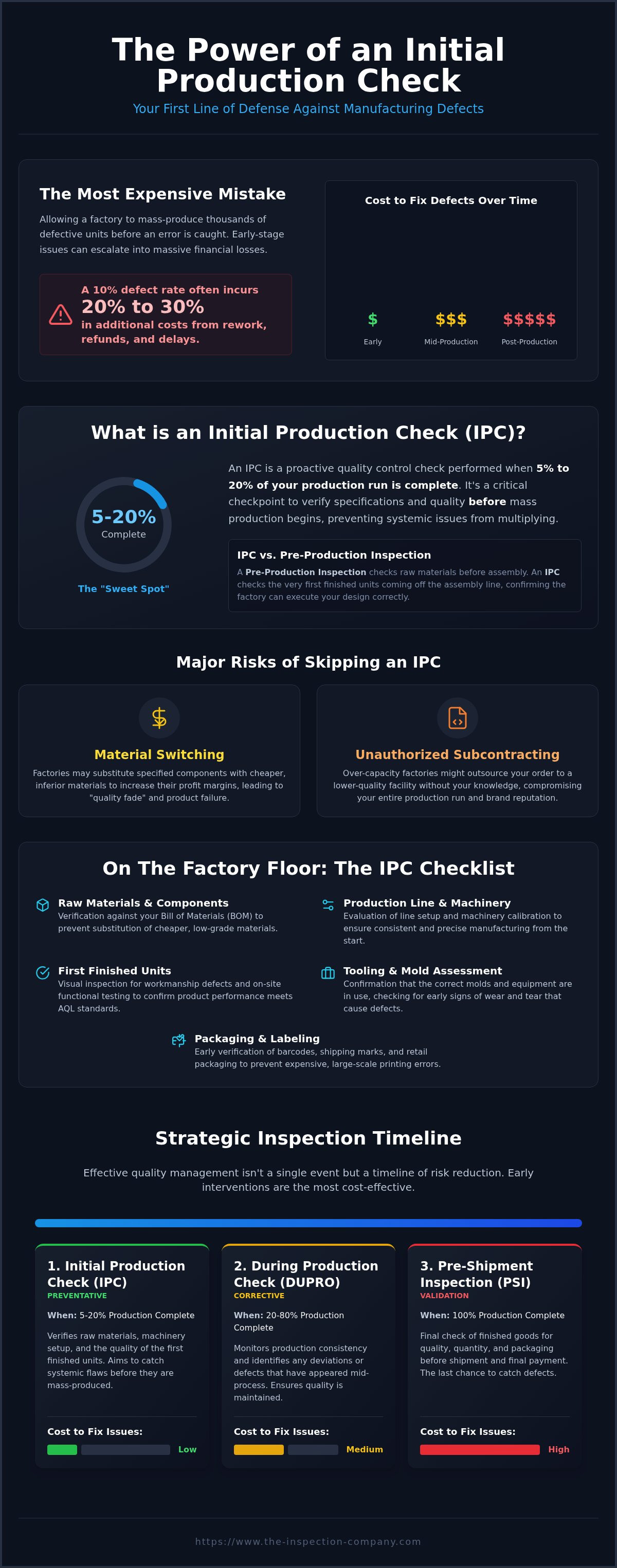
An initial production check is a proactive quality control intervention performed when a factory has completed between 5% and 20% of your production run. This early-stage assessment serves as a critical checkpoint to verify that the manufacturer fully understands your technical specifications before mass production accelerates. By examining the first batch of finished goods, you gain a transparent view of the factory's output quality. An IPC is a preventative investment that forestalls catastrophic financial losses and operational friction during the shipping and distribution stages.
The 20% mark is widely considered the "sweet spot" for catching systemic workmanship issues. At this stage, the production line is fully operational, but the volume of finished goods is small enough that corrective actions remain cost-effective. If an inspector identifies a recurring defect now, the factory can adjust its machinery or retrain staff without the need to scrap a completed order.
IPC vs. Pre-Production Inspection
It's easy to confuse these stages, but they serve distinct roles in risk mitigation. A pre-production inspection focuses on raw materials and components before the assembly lines start moving. The IPC represents the transition from raw materials to the first finished units. It confirms that the factory can successfully execute your design under real-world production conditions, ensuring the final product matches the approved golden sample.
The Risks of Skipping Early Inspection
Skipping this step leaves your supply chain vulnerable to two major threats: material switching and unauthorized subcontracting. Some factories may substitute approved components with cheaper, inferior materials to pad their profit margins. Additionally, if a factory is overcapacity, they might outsource your order to a lower-quality facility without your knowledge. An initial production check ensures your goods are produced with the correct materials at the designated facility, protecting your brand reputation from the start.
The IPC Inspection Checklist: What Happens on the Factory Floor?
An inspector's presence on the factory floor during an initial production check provides oversight that remote management cannot replicate. Utilizing European management standards combined with local expertise, our team verifies raw materials and components against your original Bill of Materials (BOM). This step is vital to ensure the factory hasn't substituted specified high-grade materials for cheaper alternatives. This protects you against "quality fade," where manufacturers slowly degrade component quality to increase their own margins.
Beyond materials, the inspector evaluates the production line setup and machinery calibration. This ensures every unit is manufactured with the same precision before mass production begins. Key checklist items include:
- Visual inspection of the first finished units for workmanship defects and aesthetic deviations.
- On-site functional testing to ensure the product performs according to AQL standards.
- Review of the pilot run's assembly sequence to identify potential bottlenecks.
Packaging and Labeling Verification
Retail packaging and master cartons are often overlooked until the end of a run. However, checking barcodes, shipping marks, and labeling early prevents bulk printing errors that are expensive to fix. Early compliance with shipping standards avoids costly relabeling fees at the destination port or Amazon warehouse. We verify that all packaging materials match the approved samples for both durability and branding accuracy.
Tooling and Machinery Assessment
Inspectors confirm that the factory is utilizing the correct molds and automated equipment for your specific SKU. We look for early signs of "wear and tear" in tooling that often lead to systemic product defects as the run progresses. If you're unsure about your supplier's equipment capacity, you can explore our inspection services to refine your checklist. Our detailed reports are delivered within 24 hours, giving you the "boots on the ground" speed needed for fast decision-making.
Strategic Comparison: IPC vs. DUPRO vs. Pre-Shipment Inspection
Effective quality management is a continuous timeline of risk reduction rather than a single event. While some importers rely solely on a final check, a strategic approach integrates inspections at multiple stages to catch errors before they scale. An initial production check occurs when only 5% to 20% of the order is finished. This contrasts with a During Production Inspection (DUPRO) at the 20% to 50% mark, and a Pre-Shipment Inspection (PSI) when production is 80% to 100% complete.
The cost-benefit ratio of early intervention is undeniable. Fixing a workmanship defect at 10% production typically costs 1/10th of the price of fixing it at 90%. Late-stage corrections often involve expensive rework; scrapped materials and missed shipping deadlines are common consequences of waiting too long. By using findings from the initial production check to refine your PSI checklist, you ensure that specific risks identified early are monitored until the goods leave the factory. Our European management team coordinates these stages across Asian manufacturing hubs, ensuring 700+ inspectors apply consistent standards across your entire supply chain.
When is an IPC Mandatory?
Certain scenarios demand an early-stage check to prevent operational friction. You should prioritize an IPC for new suppliers where a trust history hasn't been established. It's equally vital for complex technical products or high-volume launches where a single error scales exponentially. First-time importers shouldn't skip this step. The cost of a container full of defective goods far outweighs the price of a professional inspection. If you're planning a major production run in 2026, contact our experts today to secure your manufacturing process.
Turning IPC Results into Action: Managing Your Supplier
Receiving your inspection report is the moment of truth. Our detailed reports, delivered within 24 hours, provide a clear status: Pass, Fail, or Pending. A "Pass" allows you to maintain momentum. A "Pending" status indicates that specific technical clarifications are required before proceeding. If the initial production check results in a "Fail," you must act immediately. Don't simply accept a verbal promise to do better. Instead, issue a formal Corrective Action Plan (CAP) that outlines the exact steps the manufacturer must take to rectify defects.
This is where the expertise of 3rd party inspection companies becomes invaluable. We don't just identify problems; we provide the data needed to enforce standards without derailing your entire schedule. Re-verifying corrected units at the 20% mark is far easier than trying to fix thousands of finished goods later. Enforcing these standards early ensures that quality isn't sacrificed for the sake of the production timeline.
Special Considerations for Amazon FBA Sellers
For those selling on marketplaces, the stakes are even higher. Mistakes in FNSKU labeling or packaging durability can lead to suppressed listings or account health warnings. By integrating our Amazon FBA service with an early production check, you can verify Amazon-specific requirements before the entire batch is packed. Catching a barcode error at the 10% stage prevents the nightmare of relabeling an entire shipment at a third-party warehouse.
Building Long-Term Supplier Accountability
Data from an initial production check serves as a powerful benchmark for future factory audits. It allows you to track whether a supplier is improving or if systemic issues persist across multiple orders. Implementing early intervention builds a culture of quality within the factory by signaling to management that your specifications are non-negotiable. This proactive stance transforms the factory from a mere vendor into a disciplined manufacturing partner.
Securing Your Supply Chain for 2026 and Beyond
Proactive quality management isn't just an operational preference; it's a financial necessity in international trade. By implementing an initial production check, you eliminate the anxiety of hidden material substitutions and systemic workmanship errors before they scale. We've explored how catching defects at the 10% mark is significantly more cost-effective than attempting late-stage rework. You now have the framework to interpret technical reports and hold your suppliers accountable through structured Corrective Action Plans.
Our European management team provides the on-site expertise you need across Asian manufacturing hubs. With detailed reports delivered within 24 hours and specialized knowledge in Amazon FBA compliance, we ensure your goods meet every technical requirement. Don't leave your market reputation to chance when you can maintain total control from the first finished unit. Secure your production run by booking an Initial Production Check today. Your brand's growth depends on the reliability of your manufacturing partners, and we're here to guarantee that standard.
Frequently Asked Questions
What is the main difference between an IPC and a First Article Inspection (FAI)?
The main difference lies in timing and scale; an FAI examines a single unit to approve design, whereas an initial production check evaluates the first batch of mass-produced goods. This ensures that the factory can maintain quality standards under full-speed assembly conditions. While FAI confirms the "what," the IPC confirms the "how" of the production process.
How much production should be finished before I book an Initial Production Check?
You should book an inspection when 5% to 20% of the production run is complete. This window allows the inspector to see the finished product coming off the line while leaving enough time to fix systemic errors without scrapping the entire order. Waiting until 50% completion often makes corrective actions too expensive or time-consuming to implement effectively.
Can an IPC prevent unauthorized subcontracting in Asian factories?
Yes, an IPC is a highly effective tool for detecting unauthorized subcontracting. By sending an inspector to the factory at the start of production, you verify that your goods are being manufactured at the agreed-upon facility. If the lines are empty or the machinery doesn't match your SKU's requirements, it's a clear signal that the factory has moved your order elsewhere.
What happens if my supplier fails the Initial Production Check?
If a supplier fails, you must issue a formal Corrective Action Plan (CAP) immediately. This document identifies specific workmanship defects or material deviations and requires the factory to provide a solution before mass production continues. We recommend a follow-up inspection to verify that the factory has implemented these changes. This proactive approach prevents a "Fail" status at the final pre-shipment stage.
Is an IPC necessary if I have a long-term relationship with my factory?
Even with long-term partners, an initial production check remains essential to prevent "quality fade." Manufacturers may change staff, substitute raw materials due to market fluctuations, or use aging machinery that requires recalibration. Consistent oversight signals that your quality standards are non-negotiable. It protects your brand reputation regardless of how many years you've worked with a specific factory.