

A polished vendor catalog and a pristine golden sample will never guarantee reliable mass production. When travel logistics keep you from walking the factory floor yourself, committing financial deposits based purely on overseas claims feels like an expensive gamble with your brand reputation. A rigorous factory audit checklist bridges this visibility gap. It replaces blind trust with verifiable operational data, ensuring that vendor promises match the reality of their machinery, workforce, and daily output.
You understand the devastating cost of shipment delays, defective production runs, and compliance failures that occur when critical red flags go unnoticed. In this guide, you will master the exact standards required to vet overseas facilities, expose systemic risks, and secure consistent product quality before signing purchase orders. We break down a structured, battle-tested framework across machine maintenance, quality control systems, and labor standards, providing actionable scoring criteria to approve, conditionally accept, or reject potential manufacturing partners.
Key Takeaways
- Master a comprehensive factory audit checklist to objectively verify supplier capacity, machinery maintenance, and quality management systems on the ground.
- Discover a systematic four-phase audit methodology that exposes operational discrepancies between a facility's paper documentation and its actual shop-floor execution.
- Learn clear numerical scoring thresholds to confidently categorize vendors into approved, conditional, or rejected status before wiring financial deposits.
- Identify non-negotiable red flags and critical non-conformances that trigger immediate supplier disqualification to protect your supply chain from costly recalls.
What Is a Factory Audit Checklist and Why Importers Need One
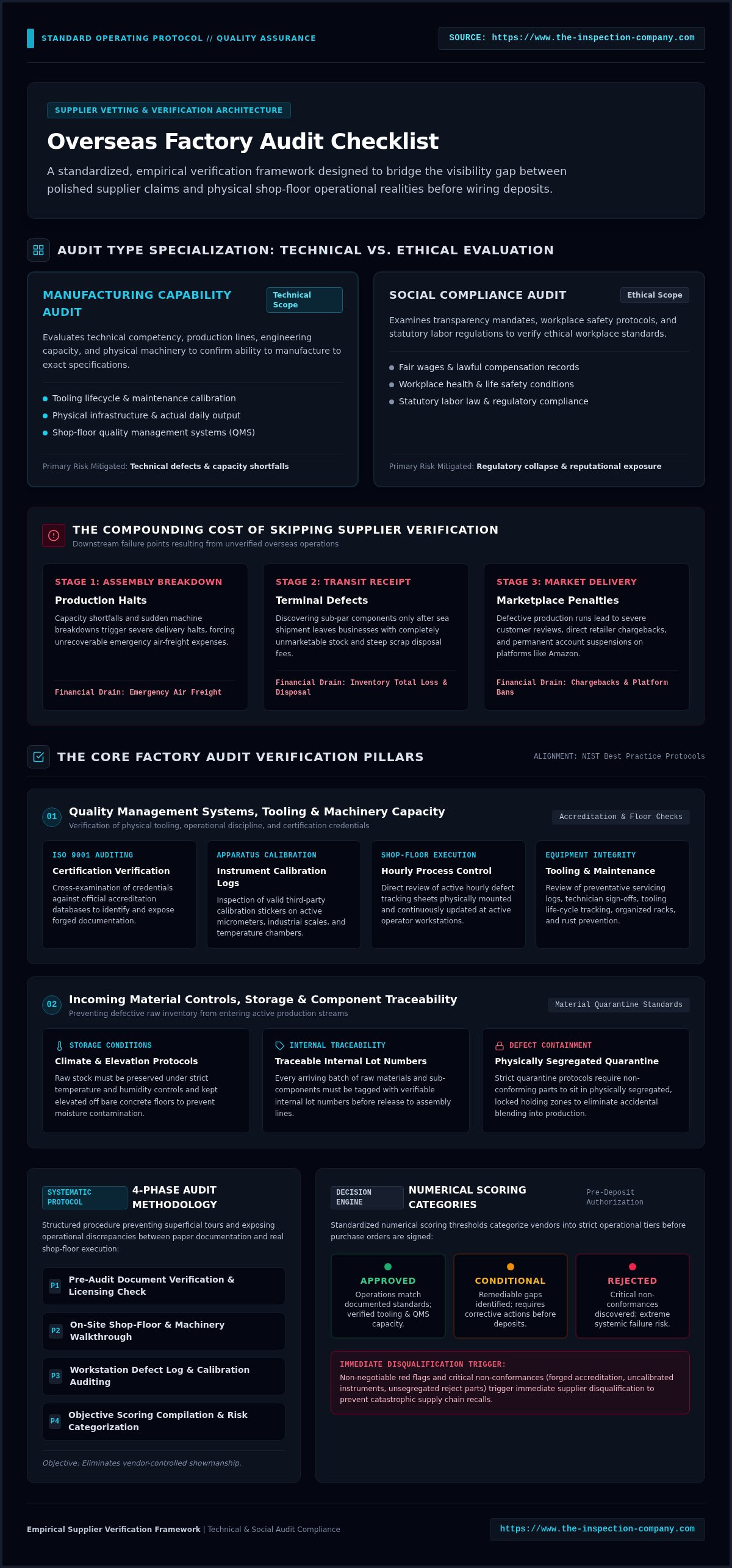
A factory audit checklist is an objective, standardized framework designed to evaluate an overseas manufacturer's physical infrastructure, technical capacity, and operational discipline. Polished showroom presentations and digital vendor profiles often mask severe shop-floor vulnerabilities, including worn machinery, disorganized inventory, and unqualified assembly labor. Grounded in the rigorous methodology of a formal quality audit, this checklist replaces unverified vendor claims with empirical verification. Conducting an on-site audit before production begins protects your investment, preventing catastrophic disruptions before capital changes hands.
Manufacturing Capability Audits vs. Social Compliance Audits
Importers often confuse technical quality assessments with ethical reviews, but both serve distinct functions. Technical assessments examine production lines, engineering capacity, and quality control systems. Deploying specialized factory audit services confirms whether a supplier possesses the operational tooling and technical skill to manufacture your product to specification. In contrast, global supply chain transparency mandates make a complementary social compliance audit vital for verifying fair wages, workplace safety, and labor law compliance. Overlooking either leaves your supply chain exposed to operational or regulatory collapse.
The Hidden Financial Cost of Skipping Supplier Verification
Bypassing supplier vetting creates compounding financial liabilities that quickly erode commercial margins:
- Costly production halts: Capacity shortfalls and machine breakdowns trigger severe delivery delays and unrecoverable air-freight expenses.
- Terminal defects: Discovering sub-par components after sea shipment leaves you with unmarketable stock and steep scrap disposal fees.
- Marketplace penalties: Defective batches lead to negative customer reviews, retailer chargebacks, and damaging account suspensions on platforms like Amazon.
Remediating structural quality failures at your home warehouse costs exponentially more than identifying operational flaws directly at the source.
The Core Factory Audit Checklist: Essential Verification Pillars
An effective factory audit checklist moves beyond checking business licenses; it interrogates whether documented procedures match physical floor reality. Aligning supplier operations with established NIST supply chain best practices requires rigorous, on-site cross-examination of machinery, materials, and measurement tools.
Quality Management Systems, Tooling, and Machinery Capacity
Auditors must verify current ISO 9001 certifications against official accreditation databases to catch forged credentials. On the production floor, inspectors assess actual machine maintenance, tooling wear, and true daily output against vendor promises. Acceptable equipment maintenance records must demonstrate scheduled preventative servicing logs, signed technician sign-offs, and up-to-date third-party calibration certificates for all testing apparatus. Key checkpoints include:
- Calibration logs: Checking valid stickers on micrometers, scales, and temperature chambers.
- Process control: Reviewing hourly defect tracking sheets displayed directly at active workstations.
- Tooling management: Inspecting organized storage racks, rust prevention measures, and tooling life-cycle tracking.
Incoming Material Controls, Storage, and Component Traceability
Defective finished goods often stem from uninspected raw inventory. Floor audits evaluate whether raw stock is stored under appropriate temperature and humidity controls, kept off bare concrete floors, and tagged with traceable internal lot numbers. Strict quarantine protocols represent another critical pillar; non-conforming parts must sit in physically segregated, locked holding zones to prevent accidental blending into active assembly lines. If you want experienced eyes verifying these operational pillars on-site across Asia, you can speak with an audit specialist to coordinate targeted facility assessments.
How to Execute an On-Site Factory Audit Step-by-Step
Executing an on-site evaluation requires a disciplined, four-phase methodology. Skipping structured protocols turns an inspection into a superficial tour, allowing vendors to conceal operational bottlenecks. A systematic factory audit checklist provides the structure needed to uncover operational vulnerabilities before they derail your production timeline.
Pre-Audit Preparation and Scope Customization
Preparation begins well before entering the plant gates. Never rely on a generic checklist; customize inspection criteria around your product specifications, raw material requirements, and critical dimensional tolerances. Integrating this verification into your broader supplier quality management framework ensures complete transparency across your supply pipeline. Importers should request business registrations, export licenses, and quality manual indices beforehand. This desktop review allows auditors to enter the facility with targeted inquiries regarding previously identified operational gaps.
Floor Inspection, Worker Verification, and Closing Protocols
Execution on the ground follows three strict operational checkpoints:
- Opening meeting: Convene with the general manager, chief engineer, and quality head to confirm audit scope, floor access rights, and testing requirements.
- Unscripted floor walkthrough: Move directly along active assembly lines. Cross-reference documented work instructions against live operator technique, and pull random in-process parts directly from workstations to check defect rates.
- Closing debrief: Present documented non-conformances with photographic evidence to plant leadership, establishing immediate alignment on required Corrective and Preventive Action (CAPA) timelines.
Documenting operational reality requires impartial eyes on the ground across Asian manufacturing hubs. Importers looking to secure production quality and eliminate overseas travel expenses can schedule an on-site factory audit with qualified field inspectors to receive comprehensive findings within 24 hours.
Translating Audit Checklist Results into Sourcing Decisions
Raw operational data gathered from an inspection only delivers value when paired with a clear procurement decision matrix. Translating your factory audit checklist findings into objective numerical scores eliminates emotional bias, protecting your capital before you issue upfront production deposits.
Scoring Supplier Risk: Pass, Conditional Approval, and Disqualification
Establish strict sourcing thresholds based on weighted non-conformances:
- Approved (85-100%): Minor deviations only. The manufacturer demonstrates robust quality management, documented machine maintenance, and disciplined floor execution.
- Conditional Approval (70-84%): Multiple major non-conformances identified, such as expired calibration stickers or improper raw material storage. Buyers issue a formal CAPA roadmap requiring verified remediation within a strict 30-day window before releasing production deposits.
- Immediate Disqualification (Below 70% or Critical Zero-Tolerance): Serious infractions trigger instant rejection. Zero-tolerance red flags include forged ISO certifications, structural labor safety violations, and unauthorized shadow subcontracting.
Deploying Professional Third-Party Audits Across Asian Hubs
Executing an on-site factory audit checklist across Asian manufacturing centers poses steep logistics hurdles, cultural barriers, and significant travel expenses. Working with independent, on-the-ground verification teams removes these friction points while eliminating internal vendor bias.
Backed by European management in Hong Kong and an expansive network of over 700 qualified inspectors across Asian manufacturing centers, The Inspection Company delivers detailed audit reports with high-resolution photographic evidence within 24 hours of completion. Once your vendor meets baseline compliance, maintain quality oversight by scheduling follow-up in-process and pre-shipment inspections. You can schedule a thorough on-site factory audit to protect your supply chain before committing financial deposits.
Secure Your Supply Chain Before Production Begins
Relying on supplier promises introduces needless vulnerability into your overseas procurement. A systematic factory audit checklist transforms subjective vendor selection into an objective, data-backed process. By auditing machinery condition, component traceability, and quality management systems directly on the factory floor, you identify operational risks before transferring production deposits. Preventative verification remains your most reliable defense against shipment delays, defective stock, and brand damage.
You don't need to coordinate expensive international travel to verify overseas operations. Backed by European management standards in Hong Kong, The Inspection Company deploys a network of over 700 qualified inspectors across major Asian manufacturing hubs to deliver detailed photographic reports within 24 hours of inspection completion. Take control of your production pipeline today. Book a professional on-site factory audit to protect your investment and scale your business with complete confidence.
Frequently Asked Questions
What is the difference between a factory audit and a pre-shipment product inspection?
A factory audit evaluates a manufacturer's facility, machinery, and management systems before production starts, whereas a pre-shipment inspection inspects finished goods after manufacturing is complete. Auditing assesses organizational capacity and risk prevention to verify whether a plant can make your product. Product inspection verifies finished batch quality, packaging, and quantities against approved specifications before cargo departs overseas. Both services work together to protect your capital.
Can a prospective supplier refuse specific checkpoints on our factory audit checklist?
Suppliers can reasonably restrict access to proprietary technology or unrelated client production lines, but resisting standard operational checkpoints is a major red flag. Legitimate manufacturers welcome transparency across raw storage, machine maintenance, calibration records, and quality stations. If a prospective vendor denies access to assembly lines or refuses to share basic calibration logs on your factory audit checklist, treat the evasiveness as an unacceptable risk and reconsider the partnership.
How long does a comprehensive on-site factory audit typically take to complete?
A standard technical factory audit typically takes one full working day for a medium-sized facility. Larger production campuses, multi-building sites, or plants requiring simultaneous social compliance assessments may require two or more auditor-days. Following the on-site walkthrough and management closing meeting, professional inspection teams synthesize their findings, calibration checks, and photographic evidence into a comprehensive report delivered to the importer within 24 hours.
What are considered critical zero-tolerance failures during a factory audit?
Critical zero-tolerance failures represent non-negotiable operational or legal violations that prompt instant supplier disqualification. These include falsified business licenses, forged ISO certificates, severe structural safety hazards, and confirmed child or forced labor. Unapproved subcontracting also triggers an automatic failure, as it indicates the vendor secretly redirects your purchase orders to unvetted third-party workshops without quality oversight or legal accountability.
How often should an importer re-audit an existing overseas manufacturing partner?
Importers should re-evaluate active overseas manufacturing partners annually to confirm ongoing operational discipline. Factory conditions, floor staff, and machine maintenance degrade over time without regular oversight. You should also conduct a targeted re-audit whenever an established vendor relocates, introduces major production lines, changes ownership, or exhibits unexplained spikes in defective goods during routine production inspections. Regular audits ensure standards remain consistent year over year.