

Did you know that fixing a product defect at the consumer level costs 100 times more than catching it during pre-production? According to the 1-10-100 rule, an error that costs $1 to prevent can balloon into a $100 disaster once it reaches your customers. You likely already feel the sting of high return rates eating your margins or the anxiety of an Amazon account health warning. It's frustrating to pay for rework and logistics for items that should've been perfect, but finding strategic quality control cost savings can stop these financial leaks before they start.
Many brands view inspections as a burdensome overhead, but they're actually your most effective tool for margin protection in 2026. This guide will show you how to transition from reactive troubleshooting to a high-yield investment strategy that safeguards your brand reputation. We'll break down a clear framework to justify your QC spending, lower your total cost of goods sold, and create predictable outcomes across your entire supply chain by leveraging professional oversight.
Key Takeaways
- Learn how to implement quality control cost savings by shifting from reactive failure management to proactive appraisal investments that protect your bottom line.
- Identify the hidden financial drains of international sourcing, including reverse logistics and disposal fees, that never appear on a factory invoice.
- Master the use of Acceptable Quality Limits (AQL) to optimize your inspection depth and match specific quality checks to the correct production stage.
- Discover how utilizing professional oversight with German-level precision ensures predictable supply chain outcomes and prevents costly shipping delays.
The Economics of Quality Control: Why Inspection is a Profit Driver
In 2026, global trade margins are thinner than ever. Importers simply cannot afford to treat quality as a variable. The "Cost of Quality" (COQ) framework distinguishes between proactive investments and reactive losses. By prioritizing appraisal, you achieve significant quality control cost savings. Catching a defect early isn't just about standards; it's about financial survival.
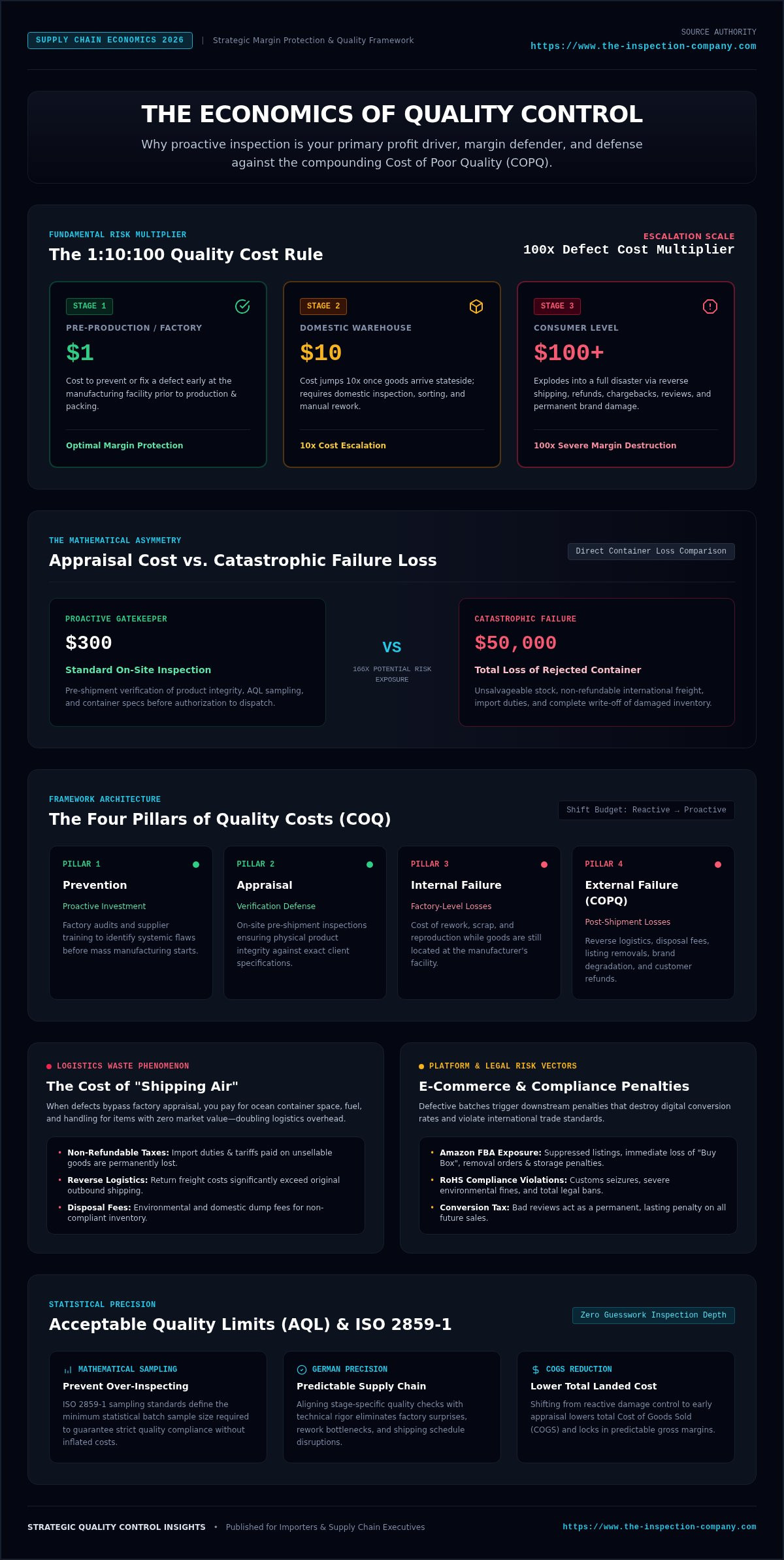
Manufacturing experts use the 1:10:100 rule to illustrate financial risk. A defect caught at the factory costs $1 to fix. If it reaches your warehouse, that cost jumps to $10. Once it hits a customer's hands, the cost explodes to $100 or more due to shipping, returns, and brand damage. A Pre-Shipment Inspection serves as the final gatekeeper for your margins, ensuring you never pay to ship defective stock.
The Four Pillars of Quality Costs
To manage your budget, you must understand where money is spent. Effective management focuses on minimizing the Cost of Poor Quality (COPQ) by shifting spending toward the first two pillars:
- Prevention: Investments like training and factory audits that stop defects before production begins.
- Appraisal: On-site inspections to verify product integrity against your specific requirements.
- Internal Failure: The cost of rework or scrap while the goods are still at the factory.
By investing in appraisal, you prevent internal failures from becoming external catastrophes.
The Multiplier Effect of Defective Goods
Shipping defective products is essentially "shipping air." You pay for container space, fuel, and labor for items that have zero market value. This doubles your logistics waste. Additionally, you've already paid import duties and taxes on non-sellable inventory. These sunk costs are non-refundable. Strategic quality control cost savings are found by identifying these errors before they enter the expensive logistics pipeline.
Decoding the Cost of Poor Quality (COPQ) in International Sourcing
The true price of manufacturing isn't found on your factory invoice. It's buried in the Cost of Poor Quality (COPQ). When defects slip through, you aren't just losing the initial product cost. You're paying for ocean freight, import duties, reverse logistics, and disposal fees. By applying ASQ's Cost of Quality framework, it's clear that appraisal costs are a fraction of failure expenses. Consider the math: a $300 on-site inspection is a minor expense compared to the total loss of a rejected $50,000 container.
Compliance serves as a critical financial safeguard. Ensuring RoHS compliance isn't simply a box to tick. It's a strategy to avoid legal fines, customs seizures, and environmental penalties that can destroy your margins. These proactive steps are the foundation of sustainable quality control cost savings.
Amazon FBA and Platform-Specific Financial Risks
For e-commerce sellers, quality issues are catastrophic. High defect rates trigger suppressed listings and the immediate loss of "Buy Box" revenue. You'll face expensive Amazon removal orders, storage penalties, and re-labeling fees just to salvage stock. Protecting your account health requires specialized Amazon FBA Inspection to catch platform-specific errors before they reach the fulfillment center.
Brand Reputation and Market Share Erosion
Negative reviews act as a permanent tax on your future conversion rates. One bad batch can erode years of market share. In the competitive global market, quality and savings are inseparable for brand longevity. If you want to identify hidden leaks in your supply chain, you can consult with our technical experts to secure your next shipment.
Strategy: Balancing Quality Control Costs with Maximum ROI
Maximizing your ROI requires moving beyond "check the box" inspections. You must align your oversight intensity with your specific risk profile. A key tool here is AQL (Acceptable Quality Limit). AQL is the statistical tool that prevents over-inspecting while maintaining safety. By following ISO 2859-1 AQL sampling standards, you can mathematically determine the minimum number of units to check to ensure the batch meets your standards. This approach creates immediate quality control cost savings by reducing unnecessary labor while protecting your margins.
Calculating your break-even point is straightforward. Compare the cost of a single man-day against the total value of the goods at risk. If you're shipping $20,000 worth of electronics, a few hundred dollars to prevent a total loss isn't an expense; it's a hedge. You should also match the inspection type to the production stage. While a Pre-Shipment Inspection is standard, a During Production Inspection catches errors when they're still fixable. This prevents the scrap costs that occur when a defect is only found at the end of the line.
Selecting the Right Inspection Stage for Your Budget
Early intervention is often the most cost-effective. Investing in a Factory Audit helps you avoid long-term supplier fraud or operational incompetence before you send a deposit. Similarly, the ROI of Container Loading Inspections is found in preventing transit damage and ensuring the factory doesn't short-ship your order. These targeted checks ensure every dollar spent on QC reduces a specific financial threat.
Leveraging Technology for Cost Transparency
Time is money in logistics. Our 24-hour digital reporting eliminates wait time costs that stall your supply chain. By using data from our Quality Platform, you can track performance trends and identify recurring supplier issues. This transparency allows for smarter quality control cost savings by focusing resources where they're needed most. Schedule a strategy session today to optimize your 2026 inspection plan.
Implementing a Risk-Free Framework with The Inspection Company
Achieving sustainable quality control cost savings requires a partner that understands both international trade risks and local factory dynamics. The Inspection Company (TIC) bridges this gap. Our European management team applies German-level precision to every on-site visit across Asia. Since we're ISO 9001:2015 certified, our processes meet the highest global standards for reliability and transparency. With a network of over 700 professional inspectors, we maintain a permanent presence in all major manufacturing hubs. This localized footprint eliminates the hidden travel fees that often inflate QC budgets. Integrating TIC into your Supplier Management Process ensures your 2026 sourcing strategy is built on a foundation of verified data rather than hope.
Getting Started: The 24-Hour Quality Turnaround
Speed is essential for protecting your cash flow. TIC’s operational model is designed for rapid deployment. You can book an inspection and receive a detailed digital report, complete with high-resolution photos and video evidence, within 24 hours of the inspector leaving the factory. This efficiency prevents shipping delays that lead to retailer chargebacks or missed sales windows. More importantly, these reports give you the leverage to negotiate reworks or discounts with suppliers before you release the final payment. You stop being a passive recipient of goods and become an active manager of your supply chain.
Your Next Step Toward Supply Chain Security
Waiting for a defect to arrive at your customer's door is the most expensive mistake an importer can make. By that stage, the failure costs have already decimated your profits. Professional QC serves as the ultimate tool for "calidad y ahorro"-the perfect balance of quality and savings. Don't leave your reputation to chance. Contact The Inspection Company today to secure your next shipment and protect your margins from unexpected failure costs.
Securing Your 2026 Profit Margins Through Strategic Oversight
We've explored how identifying defects at the source prevents the 100x cost multiplier associated with customer returns and brand erosion. By balancing statistical AQL standards with targeted production checkpoints, you transform quality from a line-item expense into a robust margin protector. You don't have to accept hidden failure costs as an inevitable part of international sourcing. Instead, you can treat every inspection as a high-yield investment in your brand's future.
Realizing long-term quality control cost savings requires a partner with a localized presence and rigorous international standards. With over 700 professional inspectors across Asian manufacturing hubs and ISO 9001:2015 certified management, TIC delivers detailed reports within 24 hours of inspection. This rapid turnaround ensures your shipping schedules remain on track while eliminating the risk of sub-standard inventory reaching your warehouse. Our European leadership ensures that every check meets German-level precision standards.
Protect your margins and secure your production. Contact The Inspection Company for a quote. It's time to take control of your supply chain and turn your quality management into a sustainable competitive advantage.
Frequently Asked Questions
How much can quality control services actually save my business?
Quality control services save your business significant capital by preventing external failures that typically cost five to twenty times more than the inspection itself. You avoid the financial drain of cross-border returns, ocean freight for defective units, and retailer chargebacks. By catching issues on the factory floor, you ensure every dollar spent on logistics moves sellable inventory. This proactive approach turns a perceived expense into a high-yield margin protector.
Is the cost of third-party inspection worth it for small Amazon sellers?
Third-party inspection is essential for small Amazon sellers because a single quality complaint can trigger listing suppression or account suspension. Our specialized Amazon FBA Service ensures your products meet strict labeling and packaging requirements before they reach the fulfillment center. This prevents the high cost of removal orders and protects your Buy Box eligibility. Investing in professional oversight is the most reliable way to secure your platform-specific revenue.
How does quality management decrease overhead costs in the long run?
Quality management decreases overhead by minimizing the administrative labor required to process returns and manage supplier disputes. It creates sustainable quality control cost savings by streamlining your supply chain and reducing the need for emergency rework. You'll spend less time on crisis management and more on growth. Eliminating the waste of paying duties and shipping fees on non-sellable goods directly lowers your total cost of goods sold.
What is the difference between the cost of quality and the cost of poor quality?
The Cost of Quality refers to the total investment in prevention and appraisal to ensure products meet standards. In contrast, the Cost of Poor Quality represents the financial losses incurred when defects reach the customer. While the former is a controlled investment, the latter is a reactive loss that erodes margins. Optimizing this balance is the primary driver for quality control cost savings in international trade.
Can factory audits help reduce sourcing costs over time?
Factory audits reduce sourcing costs by verifying a supplier's capabilities and quality systems before you issue a deposit. This prevents the massive expense of switching partners mid-production or dealing with systemic manufacturing failures. By selecting a reliable factory through on-site evaluation, you ensure predictable lead times and consistent output. This long-term strategy minimizes the operational friction and unexpected costs associated with unverified or underperforming suppliers.