

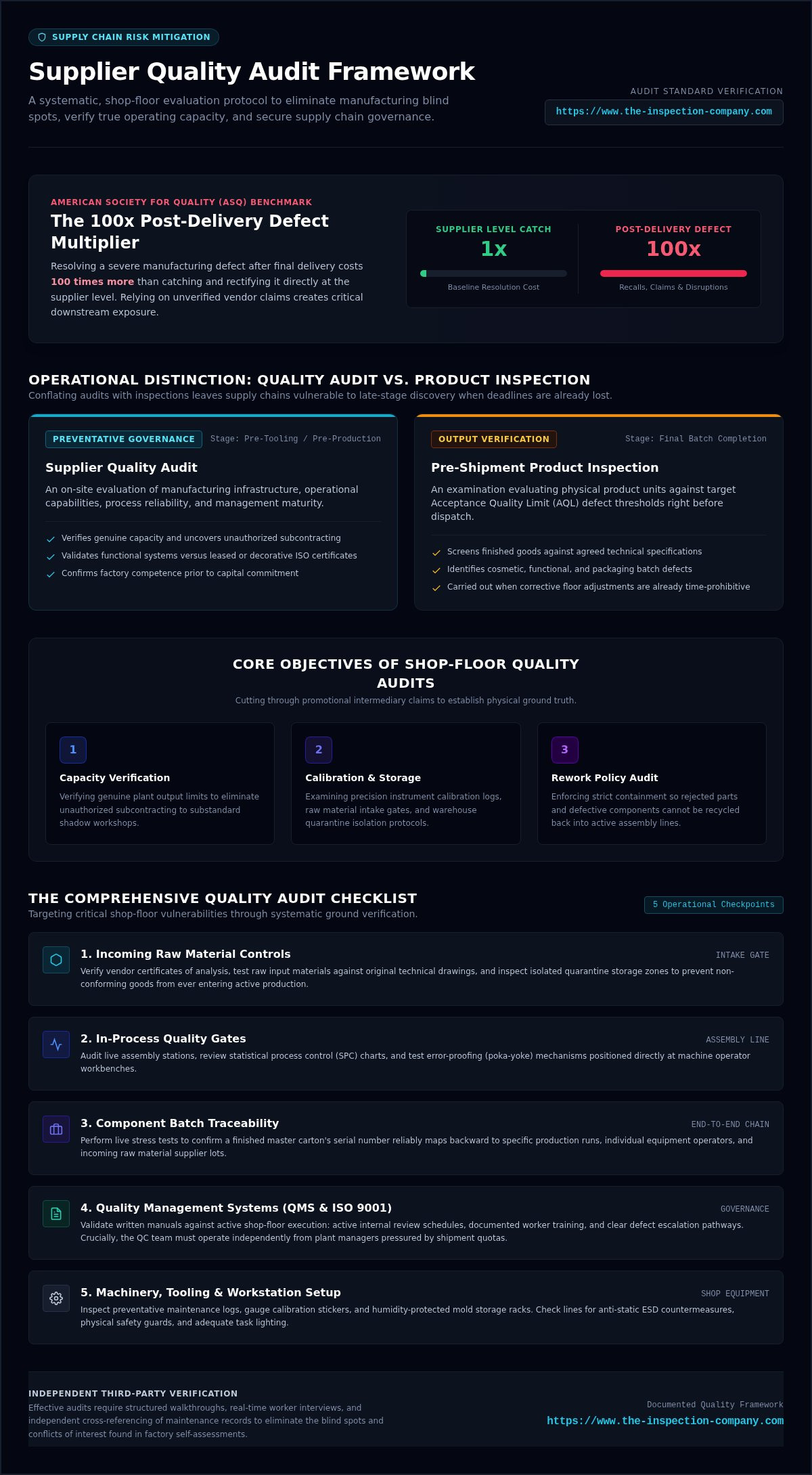
According to the American Society for Quality, resolving a severe defect after delivery costs 100 times more than catching it at the supplier level. For sourcing teams managing remote facilities, that financial multiplier represents an ongoing vulnerability. You shouldn't have to wonder whether an overseas partner secretly outsources your order to substandard workshops, or if their posted ISO certifications are merely decorative paperwork. Deploying a comprehensive supplier quality audit eliminates these blind spots, verifying actual floor operations before valuable capital leaves your account.
When you can't be on the factory floor yourself, dependable verification is your strongest commercial safeguard. In this guide, you'll discover how a rigorous audit protocol validates manufacturing capacity, flags compliance failures early, and prevents catastrophic shipment defects before containers leave port. We examine the essential 2026 auditing framework you need to maintain operational visibility, protect your brand equity, and scale supplier partnerships with complete confidence.
Key Takeaways
- A comprehensive supplier quality audit serves as a critical preventative investment, validating manufacturing capabilities and preventing costly production failures before orders ship.
- Core audit checklists rigorously inspect incoming raw materials, operational storage controls, and active quality management systems to expose hidden shop-floor bottlenecks.
- Effective audit execution demands a systematic walkthrough, real-time worker interviews, and independent cross-referencing of maintenance and calibration logs.
- Deploying qualified third-party auditors with localized ground networks eliminates the operational blind spots and inherent conflicts of interest found in factory self-assessments.
What Is a Supplier Quality Audit and Why Is It Critical?
A supplier quality audit is an independent, on-site evaluation of a manufacturer's production capabilities, operational infrastructure, and process controls. While overseas vendors readily supply digital ISO certificates, paper credentials are often outdated, doctored, or leased from third-party entities. Relying on unverified desktop documentation leaves buyers vulnerable. Systemic factory evaluations establish proactive quality governance, shielding your procurement operations against catastrophic downstream financial losses, extended shipment delays, and crippling product recalls long before production commences.
Core Objectives of Auditing Factory Quality Systems
Sales intermediaries routinely inflate shop-floor capacity to secure high-value contracts. An on-site audit cuts through promotional claims to establish physical ground truth. Key objectives include:
- Verifying genuine production capacity to eliminate unauthorized subcontracting risks.
- Inspecting instrument calibration records, raw material incoming controls, and warehouse quarantine protocols.
- Auditing rework policies to ensure defective components aren't recycled into active assembly lines.
This scrutiny confirms whether a facility maintains functional quality systems or merely projects an illusion of compliance.
Supplier Quality Audit vs. Product Inspection: The Key Differences
Many importers conflate audits with product inspections, creating severe supply chain vulnerabilities. A supplier quality audit assesses manufacturing infrastructure, management maturity, and process reliability before tooling and assembly begin. In contrast, a pre-shipment inspection evaluates completed product batches against target AQL defect thresholds right before dispatch. Auditing is a preventative investment that guarantees factory competence; inspection verifies batch output. Relying solely on final inspections means discovering defects when it's already too late to avoid missed retail deadlines.
The Comprehensive Supplier Quality Audit Checklist
A rigorous supplier quality audit translates high-level standards into concrete shop-floor checkpoints. When auditing overseas facilities, theoretical compliance manuals mean little without physical proof. Inspectors must systematically verify incoming material controls, production line setups, and end-to-end component traceability to guarantee reliable manufacturing execution.
Thorough checklists target three operational vulnerabilities on the factory floor:
- Incoming raw material controls: Verifying vendor certificates of analysis, testing raw inputs against technical drawings, and inspecting isolated quarantine storage to stop non-conforming goods from reaching production.
- In-process quality gates: Auditing active assembly stations, statistical process control charts, and error-proofing mechanisms directly at machine operator benches.
- Component batch traceability: Testing whether a finished carton's serial number links back to specific production runs, machine operators, and raw material lots.
Quality Management Systems and ISO 9001 Verification
Auditors must validate written quality manuals against daily floor records. A compliant facility demonstrates active internal review schedules, documented staff training, and unambiguous defect escalation pathways. Critically, the quality control team must operate independently from plant managers who face strict shipping quotas. When production volume overrides quality controls, defective goods invariably slip through.
Machinery, Tooling Maintenance, and Workstation Ergonomics
Precision manufacturing depends on well-maintained equipment. Inspectors examine preventative maintenance logs, gauge calibration stickers, and dedicated mold-storage racks protected from humidity. Line setups require clear anti-static ESD countermeasures, safety guards, and proper task lighting. Responsible brands often pair technical evaluations with a social audit to verify ethical labor practices alongside machinery safety. To safeguard your next production run against latent factory defects, consult with our technical team to review tailored audit criteria.
How to Conduct a Factory Quality Audit: Step-by-Step
Executing an effective supplier quality audit requires systematic discipline. Without clear benchmarks, evaluations turn into superficial plant walk-throughs that fail to uncover operational vulnerabilities. A structured assessment follows a repeatable four-stage pathway:
- Protocol definition: Aligning on quality acceptance thresholds, production milestones, and mandatory floor access rights before auditors arrive.
- Physical investigation: Cross-referencing paperwork against operational lines, testing equipment calibration, and interviewing station operators.
- Evidence documentation: Assembling findings into a scored, photographically verified report within 24 hours.
- Remediation management: Enforcing a binding Corrective Action Plan (CAP) to fix identified non-conformances before mass assembly.
Pre-Audit Alignment and Setting Evaluation Criteria
Surprise audits rarely work in overseas manufacturing. Give factory management advance notice of evaluation dates, target assembly workshops, and required paperwork. Clear communication eliminates stalling tactics during on-site inspections. Establish measurable pass, conditional pass, and fail scoring criteria tied directly to commercial purchase contracts. When factories understand that order releases depend on audit results, they treat quality requirements seriously.
Executing Corrective Action Plans and Follow-Up Protocols
An audit without structured follow-up is an incomplete risk management exercise. Audit reports categorize discoveries into critical, major, and minor non-conformances. Critical failures, like missing calibration logs or unsegregated scrap bins, halt production immediately.
Impose firm 14-day windows for factory leadership to submit formal root-cause analyses using 8D or 5-Why frameworks. Require concrete proof of preventive adjustments, such as re-machined jigs or updated work instructions, before authorizing initial production runs. Follow up by scheduling a during production inspection to verify these corrections on the live production floor. If you need immediate ground verification across Asian manufacturing centers, book a factory audit today.
Selecting a Professional Third-Party Auditing Partner
Relying on supplier self-assessments creates an immediate conflict of interest. Overseas vendors won't voluntarily disclose uncalibrated machinery, chronic assembly bottlenecks, or unauthorized subcontracting. An impartial, professional supplier quality audit provides the ground truth required to safeguard procurement capital and maintain operational control over distant supply chains.
Key Criteria: Geographical Footprint, Governance, and Reporting Speed
Selecting an auditing partner demands strict scrutiny. The wrong agency leaves your supply lines exposed to the very risks you sought to eliminate. Essential evaluation criteria include:
- Dedicated ground staff: Avoid agencies that rely on unvetted freelance networks. Auditing requires permanent, technically trained personnel who adhere to strict anti-bribery policies.
- Rapid turnaround: In fast-moving procurement cycles, waiting days for data paralyzes decision-making. Insist on comprehensive reports delivered within 24 hours, backed by timestamped, high-resolution photographic evidence.
- Systemic evaluation protocols: Choose standardized assessment frameworks through structured factory audit solutions that systematically probe physical equipment, documentation, and operator competency.
The Inspection Company Advantage for Global Importers
The Inspection Company bridges international quality benchmarks with deep operational presence across Asian industrial centers. By combining European management oversight with over 700 qualified on-site inspectors active across Asia, we enforce rigorous international standards directly on the shop floor. Our detailed evaluations cut through intermediary claims, providing the transparency needed to protect your brand equity. To secure your supply chain across every production stage, explore our comprehensive suite of on-site quality control and inspection services.
Secure Your Supply Lines with Independent On-Site Verification
Sourcing across global networks shouldn't mean gambling with product integrity. Digital certificates and sales promises can't substitute for physical verification. By implementing an uncompromising supplier quality audit before releasing production purchase orders, you eliminate unauthorized subcontracting, isolate manufacturing bottlenecks, and protect your brand equity from catastrophic downstream recalls.
Real supply chain resilience requires impartial boots on the ground. The Inspection Company pairs European management standards with over 700 on-the-ground technical inspectors across Asia, delivering actionable, photo-rich supplier audit reports within 24 hours of inspection. You gain the objective operational clarity needed to enforce corrective action plans and scale offshore partnerships securely. Book a comprehensive factory audit to secure your supply chain today and protect your procurement investments from day one.
Frequently Asked Questions
What is the difference between a supplier quality audit and a product inspection?
A supplier quality audit evaluates a factory's overall systems, machinery maintenance, and organizational capability before production begins. In contrast, a product inspection examines the physical goods themselves at specific stages, such as pre-shipment, to catch cosmetic or functional defects against defined acceptance limits. While an audit verifies whether the facility can manufacture reliably, an inspection verifies whether a specific finished batch meets your specifications.
How long does an on-site supplier quality audit take to complete?
A standard on-site factory audit typically takes one full working day for small to medium-sized facilities. Larger manufacturing complexes with multiple specialized workshops or complex assembly lines may require two or more man-days. Technical inspectors spend this time reviewing paperwork, walking production floors, and testing machinery calibration. Detailed findings and photographic evidence are compiled into an actionable audit report delivered within 24 hours of site departure.
Can a supplier fail a quality audit and still become an approved vendor?
Yes, depending on the severity of the findings. If an audit uncovers major non-conformances rather than systemic fraud or critical safety violations, buyers often issue a conditional pass. The factory must then implement a structured Corrective Action Plan (CAP) within a set timeframe, usually 14 to 30 days. Approval is finalized only after follow-up verification confirms the factory corrected those root-cause issues before production begins.
How often should an importer conduct a supplier quality audit on existing factories?
Most global importers schedule a supplier quality audit annually for core manufacturing partners to maintain standard compliance and detect operational drift. However, you should trigger an immediate re-audit if defect rates spike unexpectedly, if the factory relocates production lines, or when introducing complex new product designs. Routine auditing reinforces quality standards and prevents suppliers from quietly altering processes or shifting orders to unvetted subcontractors over time.
What documents does an auditor examine during a manufacturing facility audit?
Auditors examine valid business licenses, export documentation, and official quality management certificates like ISO 9001. On the operational side, they scrutinize raw material inspection logs, equipment maintenance schedules, instrument calibration certificates, and station-level work instructions. They also review documented staff training records, non-conformance quarantine procedures, and internal audit reports to confirm the facility actively tracks and resolves production defects rather than hiding them.