
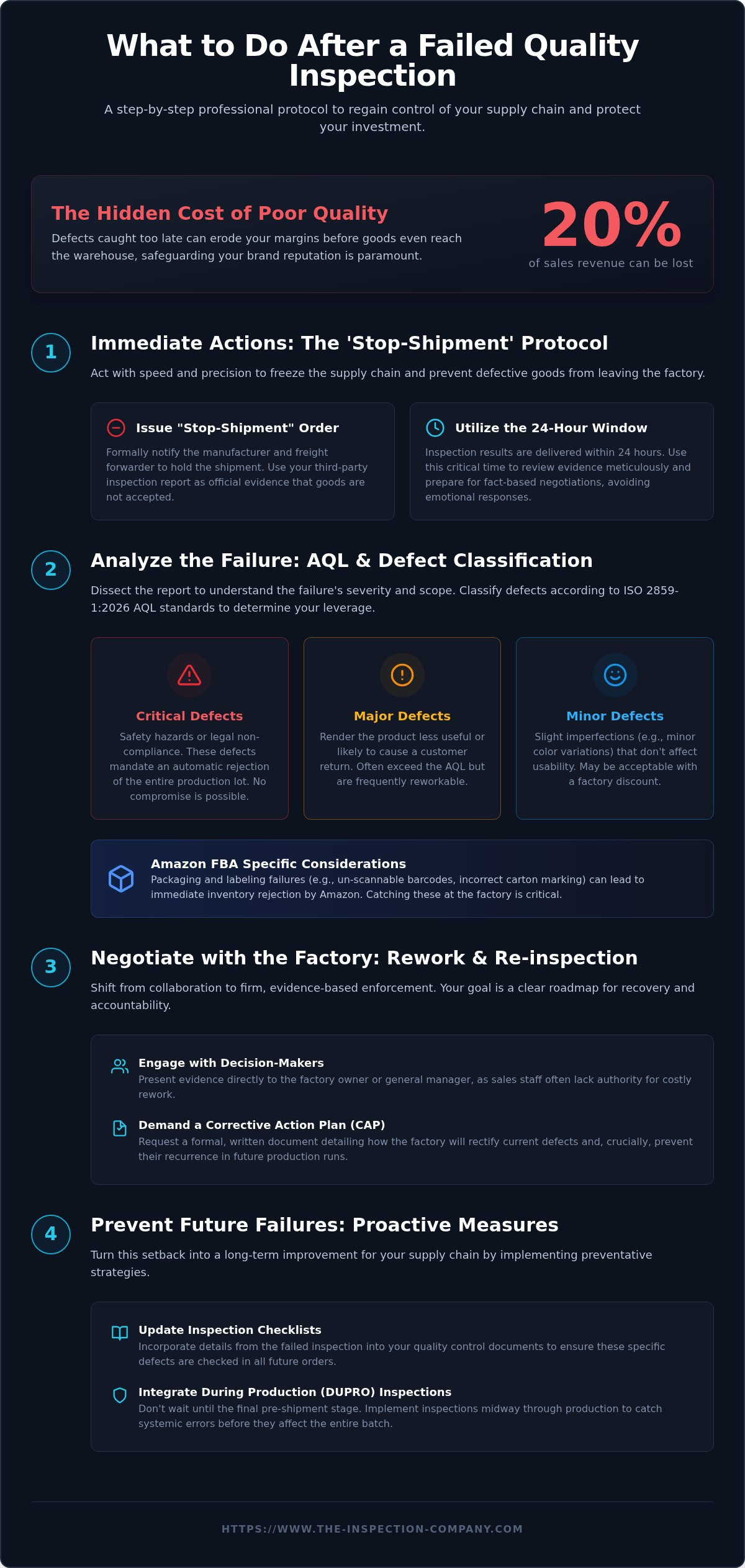
A failed quality inspection isn't a failure of your procurement process; it's your risk management system working exactly as intended to prevent a much larger financial disaster. While the initial report might trigger anxiety over factory disputes or the risk of an Amazon account suspension, catching defects at the source is the only way to safeguard your brand reputation. You've likely spent months developing your product. The last thing you need is the cost of poor quality, which can reach as high as 20% of total sales revenue, eroding your margins before the goods even reach the warehouse.
We understand the uncertainty surrounding re-inspection costs and the pressure of shipping deadlines. That's why this guide provides the exact professional protocol you need to follow to regain control of your supply chain. You'll learn how to leverage the current ISO 2859-1:2026 standards to negotiate repairs and protect your investment. We will walk you through a methodical recovery plan that ensures your goods meet every requirement before they leave the factory floor, turning a potential operational setback into a verified success.
Key Takeaways
- Secure your supply chain by immediately issuing a "Stop-Shipment" order to prevent defective goods from leaving the factory and reaching your customers.
- Decipher your failed quality inspection by classifying critical, major, and minor defects according to the latest ISO 2859-1:2026 AQL statistical standards.
- Negotiate evidence-based solutions directly with factory management to ensure they commit to a structured Corrective Action Plan (CAP) and mandatory rework.
- Prevent future operational friction by updating your inspection checklists and integrating During Production Inspections (DUPRO) to catch errors before they become terminal.
Immediate Actions: The 'Stop-Shipment' Protocol
What is the first step when you receive a failed quality inspection report? You must act with speed and precision to freeze the supply chain. A failure isn't just a paperwork error; it's a legal and financial barrier between your capital and a potentially disastrous shipment. Your primary goal is to prevent the transfer of risk from the factory to your warehouse.
Securing the Shipment
Why is immediate action critical? Without a formal hold, factories may attempt to ship the goods regardless of the result to meet their own production schedules. You need to issue an immediate "Hold" order to both the manufacturer and your freight forwarder. Use your Pre-Shipment Inspection report as the primary evidence for this hold. This objective, third-party document serves as a formal notification that the goods are not accepted. Contact your logistics partner to pause container loading immediately. Once the container is sealed and leaves the gate, your leverage for rework or refunds vanishes.
The 24-Hour Review Window
Time is your most valuable asset. Professional inspection services deliver detailed results within 24 hours, giving you a narrow window to decide on the next steps. Start by distinguishing between a "Pending" result, which may require more data, and a "Fail" result based on established AQL Standards. Review the photographic evidence meticulously to confirm the severity of the issues. Do the visual defects align with your original specification sheet or golden sample? Avoid making emotional or accusatory statements to the factory manager in these early hours. Focus on the facts presented in the report to maintain a professional high ground during the upcoming negotiations. Clear, evidence-based communication is the only way to resolve a failed quality inspection without escalating into a permanent dispute.
Analyzing the Failure: AQL Standards and Defect Classification
Once the shipment is held, you must dissect the data with clinical precision. A failed quality inspection report isn't just a "no" from the inspector; it's a diagnostic tool. You need to determine if the failure stems from workmanship, functional defects, or quantity discrepancies. Is the issue systemic, indicating a fundamental flaw in the production line, or isolated to a specific batch? Understanding this distinction is vital for deciding whether to scrap the lot or invest in sorting.
Critical vs. Major Defects: The Decision Matrix
The severity of the failure dictates your negotiation leverage. Critical defects, which include safety hazards or legal non-compliance, result in an automatic rejection of the entire lot. There's no room for compromise here. Major defects are those that render the product less useful or likely to result in a customer return. While these often exceed the Acceptable Quality Limit (AQL), they are frequently reworkable. Following official quality assurance protocols helps you categorize these risks objectively. Minor defects, such as slight color variations, might be acceptable if the factory offers a significant discount, provided they don't damage your brand equity.
Amazon FBA Specific Considerations
For e-commerce brands, packaging and labeling failures carry a unique weight. Amazon's fulfillment centers are unforgiving. A failure in barcode scannability or carton marking can lead to immediate inventory rejection and potential account suspension. This is where a targeted Amazon FBA Inspection becomes a critical safeguard. Catching a packaging "Fail" at the source is far more cost-effective than managing a removal order from an FBA warehouse. If you're struggling to interpret a complex report, it's wise to reach out to a quality consultant to review the findings before you respond to the factory.
Negotiating with the Factory: Rework and Re-inspection
A failed quality inspection requires a shift from collaboration to firm enforcement. Present your evidence directly to the factory owner or general manager. Sales representatives often lack the authority to approve costly rework or financial concessions. Demand a formal Corrective Action Plan (CAP) that outlines how the manufacturer will rectify current defects and prevent their recurrence. This document serves as your roadmap for recovery and accountability.
Handling Factory Pushback
Expect resistance. Manufacturers may claim the inspection standard was too stringent or that defects are "normal variations." Use the data from your 3rd party inspection company as an objective truth to shut down these excuses. Managing the fallout of a failed quality inspection effectively requires staying focused on the contract specifications. Negotiating with the Factory involves identifying shared interests but never compromising on agreed-upon quality levels. If rework is impossible, you might negotiate a discount for "B-grade" goods, but only if they don't damage your brand reputation or safety standards.
The Rework and Sorting Process
Never settle for a "spot check" of the repairs. Insist on 100% Product Sorting to isolate every defective unit. The factory must bear the cost of this labor and the subsequent re-inspection fees. Monitor the process closely; rushed rework can often cause secondary damage to previously "good" units. Only schedule the re-inspection once the factory confirms 100% completion in writing. Do not release the final payment balance until you hold a "Pass" report in your hands. This is your only real leverage in international trade. If you're facing resistance from a supplier after a failure, contact our technical team to help mediate the resolution.
Preventing Future Failures: Root Cause and Process Audits
A failed quality inspection shouldn't just be an isolated crisis. It must be a catalyst for systemic change in your supply chain. To prevent a recurrence, you must first update your inspection checklist to include the specific defects discovered during the failure. This ensures future inspectors focus on known vulnerabilities. You should also verify that the factory's "Golden Sample" matches your specifications exactly. If the reference point is flawed, the production will be too.
Moving Upstream in the Quality Cycle
Catching errors at the end of the line is expensive. To mitigate risk, move your oversight earlier in the production cycle. For your next order, schedule a During Production Inspection (DUPRO) to identify workmanship issues when only 20% of the lot is finished. For new product launches, Pre-Production Inspections are essential to verify raw materials. If the failure was material-based, integrate Sample Testing into your QA strategy to ensure compliance before mass assembly begins.
Strengthening Supplier Relationships
Use the failed quality inspection as a professional teaching moment for the factory's internal QC team. Clear feedback builds a more reliable partner. When suppliers consistently deliver "Pass" results, reward them with larger orders or improved payment terms. However, if a Factory Audit reveals a quality management system that is fundamentally broken, you must be prepared to walk away. Protecting your investment requires a supplier capable of meeting international standards. Consistent failure is a signal that your capital is at risk, and it's time to find a partner who values transparency as much as you do.
Securing Your Supply Chain for Long-Term Success
A failed quality inspection isn't the end of your project; it's a pivot point that protects your brand from terminal financial loss. By freezing the shipment, applying clinical AQL standards, and demanding a formal Corrective Action Plan, you transform a potential disaster into a controlled recovery. This methodical approach ensures that only goods meeting your exact specifications reach your warehouse. Managing international quality standards requires a partner who acts as your objective eyes and ears on the ground.
With expert inspectors in every major Asian hub and European management standards, we provide the transparency essential for high-stakes trade. Our detailed 24-hour reporting ensures you never lose momentum when making critical procurement decisions. Secure your next shipment with a professional Pre-Shipment Inspection and regain total control over your production quality. You now have the professional protocol required to protect your investment and build a more resilient, reliable supply chain.
Frequently Asked Questions
Who pays for the re-inspection if the first one failed?
The factory typically pays for the re-inspection costs if the initial lot failed to meet the agreed standards. You should ensure this clause is explicitly stated in your purchase contract or proforma invoice. When a failed quality inspection occurs, the supplier is responsible for correcting the defects and covering the fees for the third-party inspector to return. Don't pay the final balance until the follow-up report confirms a "Pass" result.
Can I ship my products if they only failed on minor defects?
You can choose to ship products with minor defects, but you must evaluate the impact on your brand reputation. Minor issues, such as small cosmetic blemishes, don't typically affect product function or safety. However, if the number of minor defects exceeds the AQL limit, it indicates a lack of process control. You might negotiate a discount with the factory rather than demanding a full rework for these non-critical discrepancies.
How long does a typical rework and re-inspection process take?
The timeline for rework and re-inspection generally ranges from seven to fourteen days, depending on the severity of the defects and the lot size. Simple packaging corrections might take only a few days, while functional repairs for an entire shipment require more time. Once the factory confirms 100% completion of the Corrective Action Plan, a professional inspector can usually deliver a follow-up report within 24 hours of the site visit.
What should I do if the factory refuses to acknowledge the failed inspection report?
You should immediately escalate the issue to the factory's general manager or owner if the sales team refuses to acknowledge the findings. Use the photographic evidence and objective data from your failed quality inspection report as your primary leverage. If the supplier remains uncooperative, remind them that the final payment is contingent on a successful inspection. Objective third-party reports are difficult to dispute when they are based on internationally recognized AQL standards.
Is it possible to perform a remote inspection if I can't visit the factory?
Yes, third-party inspection services act as your objective "eyes and ears" on the factory floor so you don't have to travel. Our team of over 700 inspectors across Asian manufacturing hubs provides full transparency through detailed digital reports and high-resolution photos delivered within 24 hours. While you aren't physically present, these professional services provide a level of oversight that is far more rigorous than a simple video call or factory-provided photos.