
Why do factories wait until 100% of your order is finished to reveal that production is three weeks behind schedule? It is a recurring failure that results in missed retail windows and damaging platform penalties. You have likely experienced the high-stakes anxiety of a silent production line suddenly requiring a massive rework cycle just as your vessel is set to depart. Mastering how during production inspection prevents delays is no longer just a quality preference; it's a critical logistics strategy for importers managing the complexities of 2026 customs enforcement and stricter bonding requirements.
We understand that factory transparency is the only way to mitigate operational risk and maintain customer trust. This guide explains how During Production Inspection (DUPRO) acts as a strategic firewall to eliminate excuses and secure your shipping deadlines. You'll learn how the 1-10-100 rule stops late-stage rework and provides the verifiable data you need to maintain predictable shipping dates. We will also preview how real-time transparency into factory speed allows you to pivot before a minor production hiccup turns into a total stockout.
Key Takeaways
- Avoid the "rework trap" by identifying systemic defects early, preventing the total production restarts that lead to missed retail windows and platform penalties.
- Discover how during production inspection prevents delays by validating raw material compliance and verifying the factory's actual daily output against their reported claims.
- Master the 20% to 60% production window to implement a signed Corrective Action Plan (CAP) while there is still time to remediate quality issues.
- Leverage real-time production data to secure vessel bookings with confidence and eliminate the late-stage surprises that lead to costly logistics friction and stockouts.
The High Cost of Late-Stage Discovery: Why Waiting for PSI Causes Delays
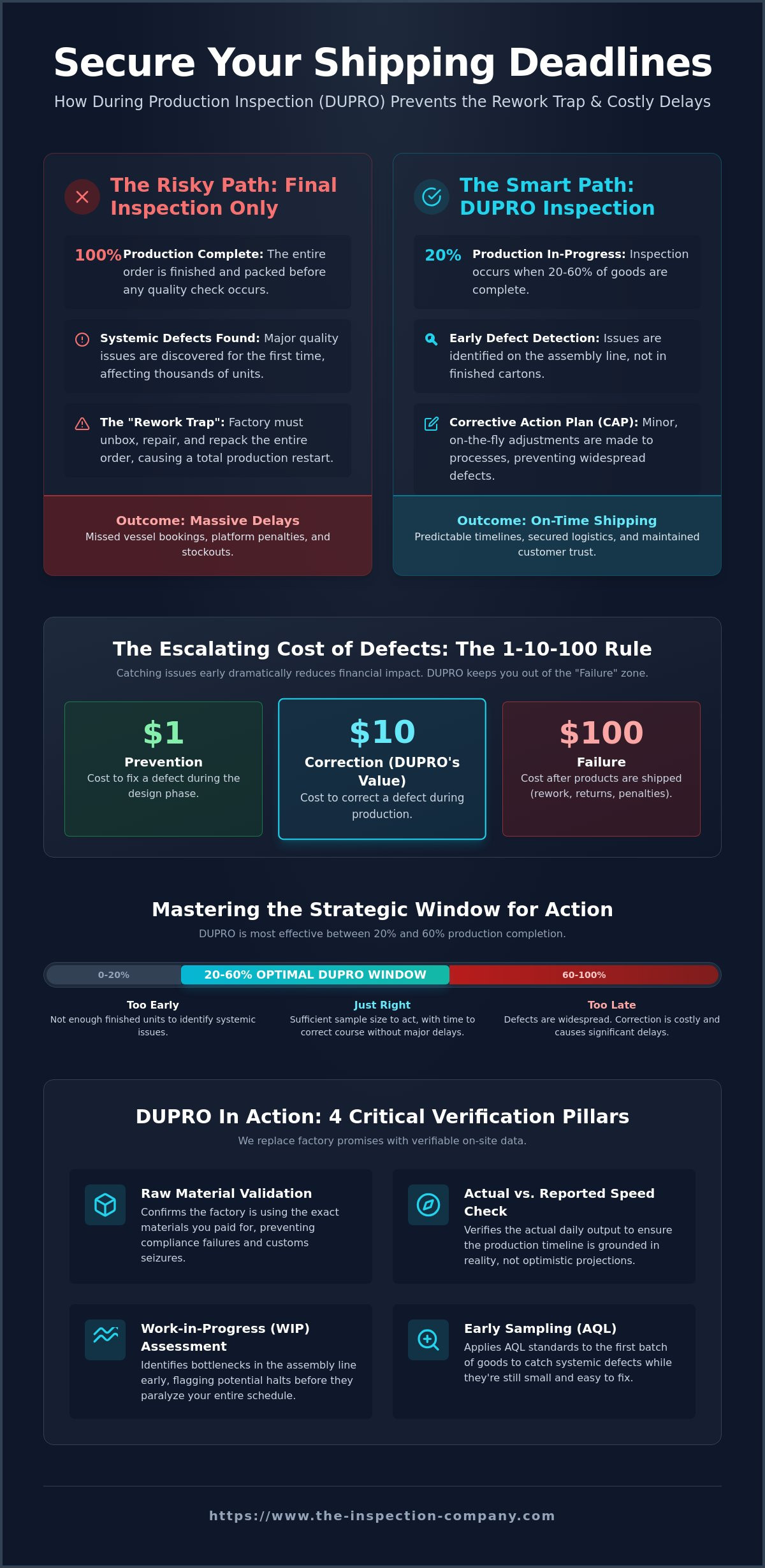
Many importers rely solely on a final Pre-Shipment Inspection (PSI) as their primary quality gate. This is a strategic error that often leads to the "Rework Trap." When defects are discovered only after 100% of the goods are finished and packed, the factory is forced to unbox, repair, and repack every unit. This doesn't just cost money; it triggers a total production restart that can push your shipping date back by weeks. Understanding how during production inspection prevents delays is essential for avoiding the catastrophic domino effect of a missed vessel.
The financial impact of these delays is severe in 2026. Retailers operate on "Just-in-Time" inventory models, and missing a retail window can result in heavy chargebacks or canceled contracts. For e-commerce brands, an Amazon "out of stock" status leads to immediate ranking drops and platform penalties that take months to recover from. A DUPRO serves as a "Logistics Firewall," identifying systemic errors while the goods are still on the assembly line and easily correctable. While standard Inspection in manufacturing often focuses on the final result, proactive importers use mid-production checks to secure their bottom line.
The 'Surprise' Defect: A 2026 Supply Chain Killer
Factories often hide production issues until the final hour, hoping the pressure of a looming shipping deadline will force you to accept sub-par goods "as-is." This psychological leverage is a common tactic. If you discover a major flaw three days before the ship sails, you face a lose-lose choice: ship defective products or face a massive delay. Early intervention removes this leverage and keeps your schedule on track.
Why ISO 9001:2026 Standards Mandate Early Intervention
The upcoming publication of ISO 9001:2026 in September signals a major shift toward digital transformation and supply chain resilience. These new standards emphasize proactive risk mitigation rather than reactive troubleshooting. When sourcing from Asia, mid-production transparency is the only way to satisfy these modern requirements. By verifying quality at the 20% to 60% completion stage, you align your operations with international best practices and ensure your factory remains accountable to your specific quality standards.
The Mechanics of Prevention: How During Production Inspection Verifies Reality
Understanding how during production inspection prevents delays begins with a fundamental shift from trusting factory reports to verifying floor-level reality. A During Production Inspection (DUPRO) provides a granular look at the assembly line while there's still time to course-correct. This process is a vital component of any modern strategy to De-Risk Supply Chains in an increasingly volatile global market. By placing an expert on the ground, you replace vague promises with verifiable data.
The mechanics of a mid-production check focus on four critical pillars:
- Raw Material Validation: We confirm the factory is using the specific RoHS compliant materials you paid for. This prevents late-stage compliance failures that could result in customs seizures or total product rejections.
- Actual vs. Reported Speed Check: Factories often report production percentages based on optimistic projections. Our inspectors verify the actual daily output to ensure the timeline is grounded in reality.
- Work-in-Progress (WIP) Assessment: By identifying bottlenecks in the assembly line early, we flag potential halts before they paralyze your entire production schedule.
- Early Sampling: We apply AQL standards to the first 20% of finished goods to catch systemic defects while they're still easy to fix.
Verifying Production Capacity and Momentum
Inspectors calculate the "True Lead Time" by auditing current manpower and machinery usage. This prevents the common trap of "Phantom Production," where a factory claims to be halfway finished but hasn't actually started final assembly. If you're concerned about your current order's progress, you can request a site visit to verify the status in person. This transparency ensures you aren't surprised by a sudden delay notice just days before your shipping date.
Technical Specifications and First Article Alignment
A critical component of a DUPRO is ensuring the mass production run aligns perfectly with the First Article Inspection (FAI) approved sample. This prevents "quality fade," where a factory might swap high-grade components for cheaper alternatives as the run progresses. Catching these discrepancies at the 20% mark ensures the remaining 80% of your order meets your exact specifications without requiring a total restart.
Strategic Timing: Mastering the 20-60% Window for Corrective Action
Timing is the most critical variable in quality management. Identifying a systemic defect at the 20% completion mark is often referred to as the "Goldilocks Zone." At this stage, enough units have been produced to reveal consistent workmanship or material issues, yet the factory still has 80% of the production run ahead of them to implement corrections. This is fundamentally how during production inspection prevents delays; it allows for real-time adjustments that stop a minor error from becoming a terminal failure for the entire lot. Adhering to quality control best practices means intervening when the cost of correction is still minimal and the shipping schedule is still intact.
The CAP Framework: Forcing Factory Accountability
When our inspectors identify a major defect mid-line, we don't just report the problem. We initiate a Corrective Action Plan (CAP) to ensure the factory takes immediate responsibility. This framework follows three disciplined steps:
- Step 1: Defect Identification: Pinpointing the exact nature and frequency of the quality lapse.
- Step 2: Root Cause Analysis: Determining if the issue stems from faulty machinery, untrained labor, or sub-par raw materials.
- Step 3: Implementation of Fixes: Executing a specific remedy that the factory manager must sign and commit to.
A signed CAP serves as vital legal and commercial leverage, providing you with a documented admission of fault and a formal roadmap for remediation. If you need to secure this level of accountability on your factory floor, contact our regional management team to schedule an intervention.
Maintaining Production Flow During Fixes
The goal of a DUPRO isn't to halt production but to refine it. By "fixing while finishing," factories can often remediate the first 20% of goods while simultaneously applying the corrected process to the remaining 80%. If the initial batch requires intensive correction, we may recommend a specialized Product Sorting & Rework service. This allows the main assembly line to continue moving forward while a dedicated team handles the defective units, ensuring your vessel booking remains viable and your retail windows stay protected.
Securing Your Bottom Line: Integrating DUPRO into Your Logistics Strategy
Quality data is the most valuable currency in international trade. Integrating a mid-production check into your broader logistics strategy transforms quality control from a cost center into a profit-protection tool. Understanding how during production inspection prevents delays allows you to make informed decisions about your cargo long before it leaves the factory floor. By leveraging The Inspection Company's Quality Platform, you gain real-time visibility across multiple factories. This ensures that your entire 2026 supply chain remains synchronized and transparent.
The return on investment for a DUPRO is undeniable. Compare the modest expense of a professional inspection to the $10,000 cost of an emergency air-freight shipment required to save a late order. Catching a production bottleneck at 40% completion allows you to adjust your schedule proactively. It's far better to manage a timeline shift early than to react to a crisis after the goods are packed and have already failed a final check.
From Inspection Report to Vessel Booking
A DUPRO report provides a verified "Estimated Completion Date" (ECD) that is far more reliable than a factory's verbal promise. You can use this data to secure lower freight rates by booking vessel space with confidence weeks in advance. This precision also prevents "Less than Container Load" (LCL) fees. By verifying the exact final quantity early, you ensure you aren't paying for empty space or scrambling to find extra room at the last minute. This level of foresight is essential for reducing "Container Loading" surprises at the dock.
The Competitive Advantage of a Transparent Supply Chain
Top-tier Amazon sellers and major retailers use mid-production data to maintain their "In-Stock" status during high-stakes peak seasons. In a market governed by stricter 2026 customs enforcement and bonding requirements, transparency is your greatest defense against operational friction. Book your During Production Inspection today to secure your 2026 shipping dates and eliminate factory excuses once and for all.
Secure Your Supply Chain Continuity for 2026
The transition to ISO 9001:2026 standards and the tightening of customs enforcement leave no room for factory excuses or late-stage rework cycles. By mastering the 20% to 60% production window, you shift from reactive troubleshooting to proactive logistics management. This strategic oversight is exactly how during production inspection prevents delays; it provides the verifiable data needed to confirm vessel bookings and protect your retail reputation. You don't have to wait for a failed final inspection to discover your schedule is in jeopardy.
The Inspection Company offers the meticulous oversight required for high-stakes international trade. With over 700 inspectors across all major Asian hubs and reports delivered within 24 hours, you gain the transparency necessary for fast, confident decision-making. Our European management ensures that international quality standards are maintained at every stage of the assembly line, forestalling financial losses before they snowball. Don't let hidden production issues derail your shipping schedule or lead to costly stockouts.
Secure your 2026 shipping dates with a professional DUPRO inspection today. We're ready to act as your eyes and ears on the factory floor, ensuring your cargo arrives exactly when it's needed.
Frequently Asked Questions
How does a During Production Inspection (DUPRO) specifically prevent delays?
A DUPRO acts as an early warning system to catch systemic defects while the factory still has the time and raw materials to correct them. By identifying errors at the 20% completion mark, you avoid the "Rework Trap" that occurs when 100% of an order must be unboxed and fixed at the final stage. This is essentially how during production inspection prevents delays; it turns potential terminal failures into manageable mid-line adjustments that don't compromise your shipping schedule.
What is the ideal time to schedule a DUPRO during the manufacturing cycle?
The most effective window is when 20% to 60% of the production run is finished. This specific timeframe provides enough finished product to evaluate consistent quality while leaving the majority of the order open for process improvements. Scheduling within this "Goldilocks Zone" ensures that any required Corrective Action Plan (CAP) can be implemented without halting the entire assembly line or missing your confirmed vessel booking.
Can a DUPRO inspection actually cause a delay if the inspector finds issues?
No, a DUPRO is a strategic tool for identifying existing problems that would inevitably cause much longer delays during a final Pre-Shipment Inspection. While implementing a fix might take a few days mid-production, it prevents the weeks-long delay of a total production restart or a massive sorting project at the port. It's a preventative investment that trades a minor, controlled adjustment for the avoidance of a catastrophic supply chain failure.
Is a During Production Inspection necessary if I already perform a Pre-Shipment Inspection?
Yes, because a Pre-Shipment Inspection is reactive while a DUPRO is proactive. Relying solely on a final check means you only find out about critical defects after it's too late to fix them without missing your retail window. Understanding how during production inspection prevents delays helps you see that mid-production checks offer the transparency needed to manage factory output in real-time. This creates a comprehensive quality firewall that aligns with ISO 9001:2026 standards.
What happens if the factory fails the During Production Inspection?
We immediately issue a formal Corrective Action Plan (CAP) that the factory management must sign and implement. Our inspectors work to identify the root cause of the failure, whether it's faulty raw materials, machinery issues, or incorrect assembly techniques. This allows the factory to remediate the current batch and adjust their process for the remaining 80% of the order, ensuring the final shipment meets your specifications without a total restart.