

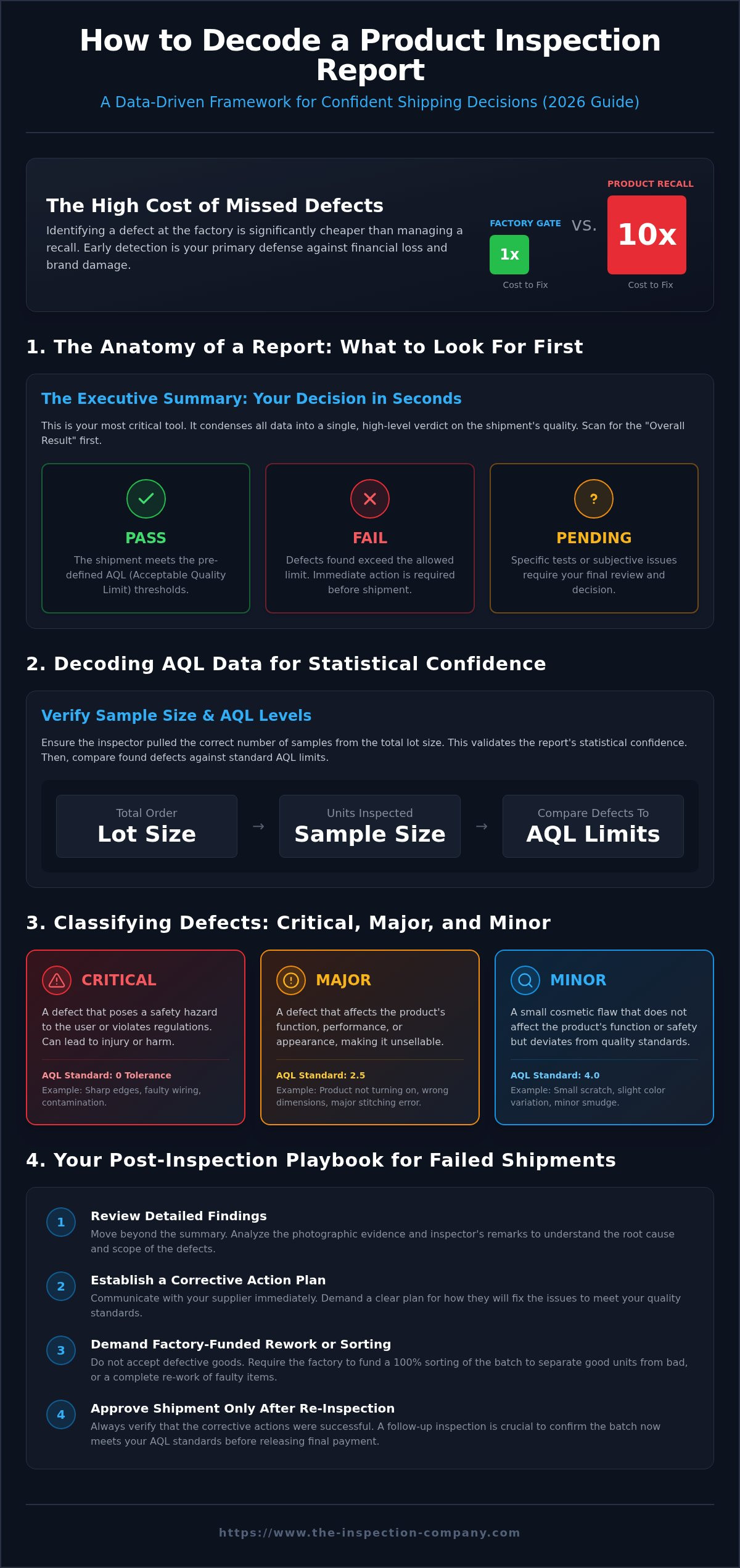
Identifying a defect at the factory gate costs ten times less than managing a product recall in Europe or the United States. Despite this, many importers feel a sense of dread when a technical PDF lands in their inbox, often because they aren't sure how to read a product inspection report with total accuracy. It's common to feel overwhelmed by complex sampling levels or anxious about factory manipulation of samples. You need more than a simple "pass" result; you need the statistical confidence to ensure your shipment won't lead to financial loss or operational friction.
This 2026 guide provides the framework to decode quality data and make confident shipping decisions. We'll explain the ISO 2859-1:2026 skip-lot procedures, the impact of the new EU Product Liability Directive, and how to spot subtle supplier red flags. You'll gain a clear understanding of batch quality and the technical expertise to approve or reject shipments based on hard evidence. This methodical approach will help you reduce return rates and protect your brand in a strictly regulated global market.
Key Takeaways
- Identify the executive summary as your primary decision-making tool to determine a shipment's status in seconds.
- Master how to read a product inspection report by verifying that the sample size pulled by the inspector provides sufficient statistical confidence.
- Differentiate between critical, major, and minor defects to prevent safety hazards and reduce high return rates from functional failures.
- Establish a clear post-inspection protocol to demand factory-funded re-works or sorting services when quality standards aren't met.
The Anatomy of a Product Inspection Report: What to Look for First
A product inspection report serves as the final gatekeeper in your sourcing from Asia strategy. It's a data-driven document that validates if a shipment meets your specific quality standards before it leaves the factory floor. Without this verification, you risk importing defective goods that lead to financial loss and brand damage. A professional Inspection provides the transparency needed to maintain control over your supply chain.
Begin by verifying the General Information section. You must confirm the factory location, the inspection date, and the 3rd party inspection company credentials. Discrepancies here are immediate red flags for factory manipulation or unauthorized subcontracting. Ensuring these logistical details align with your purchase order is the first step in learning how to read a product inspection report effectively. Expert partners deliver these detailed reports within 24 hours, giving you the speed required for fast-moving logistics.
Executive Summary vs. Detailed Findings
The Executive Summary is your most critical decision-making tool. It condenses hundreds of data points into a single page, allowing you to quickly scan for the "Overall Result." This result typically falls into three categories:
- Pass: The batch meets the predefined AQL threshold.
- Fail: Defects exceed the allowed limit, requiring immediate action.
- Pending: Specific tests or on-site conditions require your final review.
Don't ignore the "Remarks" section. This area highlights recurring production issues that might not trigger a "Fail" result but suggest long-term quality drift. While the summary provides the verdict, the detailed findings offer the evidence. Learning how to read a product inspection report requires balancing this high-level verdict with the photographic proof found in the later pages. This dual-layered review ensures you don't miss subtle warning signs that could lead to operational friction.
Decoding AQL Data: Understanding Pass, Fail, and Pending Results
Decoding the statistical tables is essential to mastering how to read a product inspection report. You must first verify the "Lot Size" against the "Sample Size" to confirm the data's validity. If the inspector failed to pull the correct number of units, the entire report loses its statistical confidence. Most professional inspections follow the standard AQL levels of 0 Critical, 2.5 Major, and 4.0 Minor. Once these are set, you compare the found defects against the "Accept" (Ac) and "Reject" (Re) points.
This systematic process ensures your goods align with U.S. import inspection regulations and your own internal quality benchmarks. If the number of defects reaches the "Re" point, the shipment is technically a failure. For a deeper dive into the underlying mathematics of these tables, see our comprehensive guide on AQL explained. Understanding these limits helps you avoid the operational friction of receiving unsellable inventory.
The 'Pending' Result: Why the Decision Rests with You
Inspectors issue a "Pending" result when defects fall into a subjective gray area or when specific on-site tests couldn't be completed. It's not an automatic rejection, but it signals that the risk remains on your shoulders. You should use these detailed findings to negotiate with your supplier. You might demand a partial re-work or a price credit to offset the potential for increased customer returns before you release the final payment.
Amazon FBA Standards: Avoiding Warehouse Rejections
Amazon sellers face unique pressures that require specialized oversight. An Amazon FBA inspection typically requires tighter AQL thresholds because the platform has zero tolerance for functional failures. Your report must confirm that FNSKU labeling and carton markings are 100% accurate. A single misplaced barcode can lead to inventory being stranded or rejected at the fulfillment center. If you're struggling to interpret your latest data, you can reach out for a professional review to safeguard your seller health.
Classifying Defects: Critical, Major, and Minor Issues Explained
The true value of knowing how to read a product inspection report lies in understanding the "so what" behind the numbers. Defect counts only matter if you can weigh their impact on your bottom line. Professional reports categorize issues into three distinct levels of severity. Critical Defects are the most dangerous, involving safety hazards or legal non-compliance. For instance, failures in RoHS compliant meaning tests require an immediate rejection to avoid heavy fines or product seizures at customs.
Major Defects represent functional failures that make a product unsellable or likely to trigger a high return rate. These are unacceptable departures from your quality standards. Minor Defects are typically aesthetic issues, such as small scratches or slight color variations. While these don't affect function, they still represent a deviation from your understanding of product defects. You must review every piece of visual evidence, including high-resolution photos and videos, to validate these findings yourself.
Spotting Factory Red Flags: What the Report Might Be Hiding
Even a professional report can be compromised if the "Independence Gap" isn't respected. The inspector must pull samples from the batch personally. If factory staff select the units, you're likely facing a "cherry-picked" sample that doesn't represent the true quality of the lot. Watch for sample sizes that seem too perfect or defect lists that are suspiciously empty. A robust pre-shipment inspection acts as a preventative investment, ensuring the data you're reading is accurate and untainted by factory interference. If you suspect your current reporting lacks this level of transparency, contact our experts to secure an independent audit of your next shipment.
How to Manage Your Supplier After Inspection
Once you understand how to read a product inspection report, the next step is decisive action. If the data confirms the risk is within your tolerance, you can authorize the shipment with confidence. However, if the report reveals a "Fail" result, you must hold the factory accountable. Use the detailed defect list to demand a product sorting service. This ensures the supplier removes all defective units at their own expense before you release the final balance. It's a proactive way to maintain control over your inventory quality and mitigate potential losses.
Speed is your greatest asset in international trade. Receiving your report within 24 hours is vital for meeting tight shipping deadlines and avoiding costly port storage fees. In 2026, where freight rates for a 40-foot High Cube container from Southeast Asia to Europe average $5,800, every day counts. Integrating these findings into your long-term supplier management process allows you to track performance trends over time. This data-driven approach helps you identify which partners are consistently reliable and which represent a recurring financial risk. Mastering how to read a product inspection report turns raw data into a powerful negotiation tool for future contracts.
The Role of Container Loading Inspection (CLI)
A "Pass" on your report doesn't guarantee the right goods reach the port. A container loading check is the final safeguard to ensure the specific units inspected are the ones actually loaded. This prevents "bait and switch" tactics where factories might substitute quality batches with inferior stock after the inspector leaves. It also verifies that your goods are packed securely to prevent damage during transit. Don't leave your shipment to chance. To protect your investment and ensure total transparency, book your next inspection with TIC to secure your supply chain from factory to warehouse.
Securing Your Supply Chain with Data-Driven Decisions
Mastering how to read a product inspection report is the difference between a profitable shipment and a costly operational disaster. By correctly interpreting AQL data and prioritizing critical defect classifications, you move from uncertainty to total control. You now have the tools to demand factory accountability through sorting services or re-works before any goods leave the floor. This proactive approach ensures that your quality standards are met without compromise.
The Inspection Company (TIC) maintains European management standards across Asia to forestall financial loss before it reaches your warehouse. We provide ISO 2859-1 compliant sampling and deliver detailed reports within 24 hours, ensuring you never miss a shipping window. Don't leave your brand's reputation to chance. Secure Your Shipment—Contact Our Expert Team Today to implement a robust quality gatekeeper for your next production run. You've built your business on excellence; let's ensure your suppliers deliver nothing less.
Frequently Asked Questions
What is the most common reason for an inspection report to fail?
The primary reason for failure is exceeding the Acceptable Quality Limit (AQL) for major defects. This occurs when functional failures, like poor assembly or incorrect dimensions, exceed the predetermined "Reject" point. Catching these errors early prevents the financial loss of importing unsellable goods. Learning how to read a product inspection report allows you to identify these specific failures and address them with the factory before you release the final payment.
Can I approve a shipment if it has a 'Pending' result?
You have the authority to approve a "Pending" shipment, but doing so means you accept all quality risks. Inspectors use this classification when defects fall into subjective areas or when specific tests couldn't be completed on-site. It's a clear signal to examine the detailed findings and photos with extra care. You should negotiate a price credit or a partial re-work with your supplier before providing final shipping authorization.
How many photos should a professional product inspection report contain?
A professional report generally includes 40 to 100 high-resolution images to provide total transparency. These photos must document the factory conditions, the random sampling process, and every defect identified. Reliable firms deliver these detailed reports within 24 hours of the site visit. Reviewing this visual evidence is a critical step in knowing how to read a product inspection report, as it provides objective proof that validates the inspector's statistical findings.
What should I do if the factory refuses to re-work a failed shipment?
If a factory refuses a re-work, you should immediately withhold the final balance payment and reference your purchase order's quality requirements. Remind them that the independent report confirms the batch failed the agreed AQL standards. You can propose a product sorting service where the factory covers the cost of a third party to filter out defective units. This firm approach protects your brand from the damage caused by substandard goods.
Why is the sample size in my report different from the total order quantity?
Reports use statistical sampling based on the ISO 2859-1 standard to balance cost and accuracy. Checking every unit is often too expensive and time-consuming for most importers. Instead, the inspector pulls a random, representative sample that provides a high level of confidence in the overall batch quality. This mathematical approach allows you to assess the risk of the entire shipment without the need for a 100% inspection of every single unit.