Your choice of Incoterm is not just a logistics preference; it's the legal boundary that determines whether you pay for a container of defective goods or receive the high-quality inventory you ordered. Most importers recognize that importing from China risks include more than just simple shipping delays. You've likely felt the anxiety of realizing your cargo is already on the water while you're still uncertain exactly when the factory's liability ended and yours began. This confusion often leads to unexpected insurance gaps or paying for products that fail to meet your standards.
This guide will help you master the 11 Incoterms rules for 2026 to eliminate hidden costs and protect your business from financial loss. You'll learn how to choose the right framework to maintain control over your supply chain and lower your insurance expenses. We'll examine how to align your quality control strategy with your shipping terms so you can verify product integrity before the risk transfers to your balance sheet.
Key Takeaways
- Master the 11 standardized ICC rules to clarify cost allocation and pinpoint the exact moment legal responsibility for your cargo shifts.
- Identify how strategic term selection helps manage importing from China risks by preventing hidden logistics fees and uninsured damage.
- Discover why popular terms like DDP can create blind spots for Amazon FBA sellers and how to regain control over your supply chain.
- Align your quality control strategy with your shipping terms to ensure inspections happen before you've legally accepted substandard goods.
What are Incoterms and Why Do They Matter for Your Bottom Line?
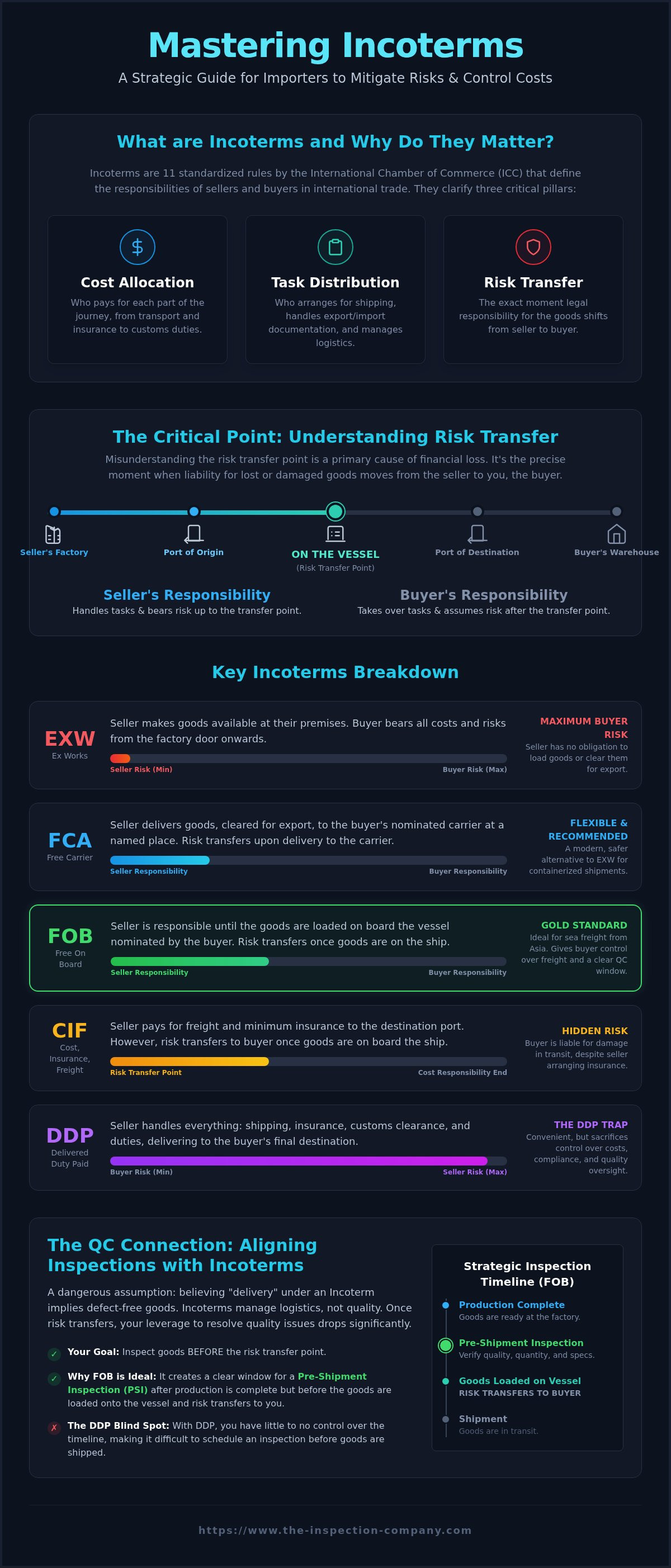
Incoterms are the 11 standardized rules published by the International Chamber of Commerce (ICC). They define the "who, what, and where" of international trade. For businesses today, understanding these rules is vital because they establish three critical pillars: the allocation of costs, the distribution of operational tasks, and the transfer of risk.
You cannot rely on "standard" factory terms in 2026 without understanding your hidden liabilities. One of the greatest importing from China risks is assuming your supplier's preferred terms protect your interests. They often don't. A common mistake is failing to realize that Incoterms do not cover quality specifications. Ensuring your goods meet requirements requires a pre-shipment inspection.
The Difference Between Cost and Risk
Paying for freight doesn't mean you're responsible for damage during transit. Conversely, just because a supplier pays for shipping doesn't mean they're liable if the ship sinks. The transfer of risk point is the exact moment legal responsibility for the cargo shifts from the factory to the buyer. Misunderstanding this point leads to unrecoverable financial losses when cargo is damaged or lost.
The Limitations of Incoterms in Quality Disputes
Many importers believe "delivery" under an Incoterm implies the goods are defect-free. This is a dangerous assumption. Incoterms only manage the logistics and physical movement. They offer zero protection against manufacturing errors or substandard materials. You need a robust strategy to handle quality because once risk transfers, your leverage to demand a refund or replacement drops significantly. Verifying product integrity before this transfer is essential for mitigating importing from China risks.
The 11 Incoterms 2020 Rules: A Comprehensive Breakdown for Importers
The Incoterms 2020 framework consists of eleven distinct rules. These are divided into two groups: seven rules applicable to any mode of transport and four specifically for sea and inland waterway transport. To manage importing from China risks effectively, you must identify the "Critical Point" where the seller’s responsibility for the cargo ends and yours begins. You can Know Your Incoterms better by understanding how these categories dictate your operational control and financial liability.
Common 'Any Mode' Terms: EXW, FCA, and DDP
EXW (Ex Works) represents the maximum risk for the buyer. The factory simply makes the goods available at their premises. Most Chinese factories prefer this because it absolves them of all export formalities. FCA (Free Carrier) is a modern, safer alternative. It requires the seller to deliver the goods to your chosen carrier, making it ideal for containerized shipments. DDP (Delivered Duty Paid) is the "hands-off" choice where the seller handles everything. While convenient, it conceals dangers like lack of transparency in customs compliance and quality oversight, significantly increasing your importing from China risks if the factory cuts corners on documentation.
Sea Freight Essentials: FOB and CIF
FOB (Free On Board) is the gold standard for importers sourcing from Asia. The seller is responsible until the goods are loaded onto the vessel. This provides a clear window for pre-shipment inspections before the goods leave the country of origin. CIF (Cost, Insurance, and Freight) requires the seller to pay for freight and minimum insurance. However, the risk transfers to you the moment the goods are on the ship. This means you're still liable for transit damage despite the seller's insurance obligation. If you're unsure which rule fits your specific supply chain, contact our regional experts to discuss a tailored risk-mitigation strategy.
Strategic Selection: Which Incoterms Best Protect Importers in 2026?
FOB (Free on Board) remains the most effective choice for sourcing in Asia. It balances cost-control with risk-mitigation. By choosing FOB, you control the freight forwarder and the insurance, ensuring transparency that isn't available when the seller manages the logistics. This clarity is essential to manage importing from China risks, as it allows you to precisely schedule your QC checks before the goods are loaded onto the vessel.
Many Amazon sellers fall into the "DDP Trap" by choosing Delivered Duty Paid for its perceived simplicity. However, DDP often leads to a loss of oversight. If you don't have a boots-on-the-ground partner, you might not realize a product defect exists until the goods reach an FBA warehouse. At that point, returning the cargo is financially impossible. Referencing the official Incoterms® 2020 rules can help you understand the heavy reliance on seller integrity that DDP requires.
Special Considerations for Amazon FBA Sellers
Direct-to-FBA shipping often mandates DDP to ensure duties are prepaid. This complicates third-party quality checks because the factory handles the entire journey. You can bridge this gap by scheduling an Amazon FBA inspection. This ensures your inventory meets Amazon’s strict labeling and packaging requirements before it leaves the factory floor, mitigating the most common importing from China risks for e-commerce brands.
Negotiate these terms early in your relationship. Use your initial factory audit to confirm the supplier's capability to handle your preferred Incoterm. If a supplier refuses FOB, it's often a red flag regarding their logistics transparency. Contact our experts today to secure your supply chain.
The QC Connection: How Incoterms Dictate Your Inspection Strategy
Your legal right to inspect goods is inextricably linked to the "Point of Delivery" defined by your chosen Incoterm. If you wait until the goods arrive at your destination to check for defects, you've likely already legally accepted them. This timing gap is one of the most overlooked importing from China risks. You must align your quality control milestones with the moment risk transfers to avoid paying for unsellable inventory.
Under FOB or FCA terms, the delivery point occurs at the port or carrier handover. You should schedule a pre-shipment inspection before the cargo crosses the ship's rail. Once that physical boundary is crossed, the risk transfers to you. Your legal leverage to hold the factory accountable for manufacturing errors effectively vanishes once the bill of lading is issued and the vessel departs.
If you operate under EXW terms, you lack control over the logistics chain. In this high-risk scenario, during production inspections are essential to catch structural errors before they're finalized. You also need container loading inspections to verify that the quantity and packaging match your invoice exactly before the truck leaves the supplier's gate. This prevents "short-shipping" errors that are difficult to prove later.
When to Book Your Inspection Based on Your Terms
Timing determines your financial security. Follow the "24-hour rule" by ensuring your inspection provider delivers detailed reports within one day of the site visit. This speed allows you to halt shipping or withhold final payment before the Transfer of Risk occurs. Always include clear inspection clauses in your Proforma Invoice that link the QC result to the chosen Incoterm. The Point of Inspection is the last moment of buyer leverage. Failing to verify quality before this point turns a manageable operational issue into a permanent financial loss.
Securing Your Supply Chain for 2026
Mastering Incoterms is the first step in neutralizing the financial danger of international trade. By selecting the right framework, you move beyond logistics and create a legal shield for your capital. It's vital to remember that the transfer of risk is your final opportunity to verify product integrity. Waiting until cargo arrives at your warehouse to identify defects is a mistake that often results in unrecoverable losses. Effectively managing importing from China risks requires a proactive approach where you align your shipping terms with rigorous on-site verification.
The Inspection Company provides the practical enforcement your contracts need. With over 700 full-time inspectors across Asia and European management standards, we deliver the transparency required for high-stakes operations. You'll receive detailed inspection reports within 24 hours, giving you the data needed to make informed decisions before your goods leave the factory floor. Protect your investment-book a professional inspection before your goods ship. Secure your inventory today and trade with total confidence.
Frequently Asked Questions
Do Incoterms cover the transfer of ownership (title) of the goods?
No, Incoterms don't cover the transfer of ownership or title of the goods. They only define the allocation of costs, tasks, and the transfer of risk between the buyer and seller. Property rights and payment terms are separate legal matters usually handled in your contract of sale. You shouldn't confuse "delivery" under an Incoterm with the legal transfer of title or ownership.
Which Incoterm is best for a first-time importer sourcing from China?
FOB is generally the best choice for first-time importers. It provides a balanced approach to managing importing from China risks by giving you control over the freight forwarder and insurance. This transparency prevents hidden charges often found in CIF. Most importantly, it creates a clear window for pre-shipment inspections before the goods leave the country of origin, protecting your capital from defective inventory.
Can I use Incoterms 2010 instead of the 2020 version in 2026?
Yes, you can use Incoterms 2010 if you clearly specify it in your contract. However, the ICC 2020 version remains the global standard for 2026 and includes updated language for security and insurance requirements. Using older versions can lead to confusion or legal friction. It's best to adopt the latest standards to ensure all parties have a clear, modern understanding of their liabilities.
Does DDP include the cost of unloading the goods at my warehouse?
No, DDP doesn't include the cost of unloading the goods at your warehouse. Under DDP rules, the seller is responsible for bringing the goods to the named place of destination, but the buyer is responsible for the physical unloading. This distinction is important for budgeting your local labor costs. Misunderstanding this can lead to operational friction and unexpected fees once the truck arrives at your facility.
Who is responsible for cargo insurance under FOB terms?
The buyer is responsible for cargo insurance under FOB terms. Since the risk transfers from the factory to you the moment the goods are loaded onto the vessel, you must secure your own coverage for the sea voyage. This is a critical step in mitigating importing from China risks. Managing your own insurance allows you to ensure the policy actually covers the full value of your specific cargo.