
With over 940 million units recalled in the U.S. during the first half of 2026 alone, the financial risks of international importing have reached a critical tipping point. You've likely felt that familiar anxiety after releasing a final payment, wondering if the thousands of items currently inside a shipping container actually match the "golden sample" you approved months ago. It's a valid concern; the gap between a handcrafted prototype and a mass-produced shipment is where most brands lose their reputation and their capital.
This guide provides a professional roadmap to securing your supply chain through rigorous product sample testing and independent lab verification. You'll learn how to navigate new 2026 compliance mandates, such as the mandatory CPSC eFiling requirements, while preventing the common pitfalls of quality fade. We'll examine why random sample selection is your best defense against defective goods and how to obtain the verified certificates required by modern marketplaces. By the end of this article, you'll have a clear strategy to ensure every shipment meets your standards before it leaves the factory floor.
Key Takeaways
- Distinguish between your initial "golden sample" and actual production units to ensure mass manufacturing matches your approved prototype.
- Implement a systematic product sample testing protocol that relies on random on-site collection rather than factory-selected items.
- Eliminate the risk of "quality fade" by establishing a transparent testing schedule that holds suppliers accountable throughout the production cycle.
- Protect your capital and ensure compliance with 2026 regulations by treating lab verification as a critical preventative investment.
What is Product Sample Testing in Manufacturing?
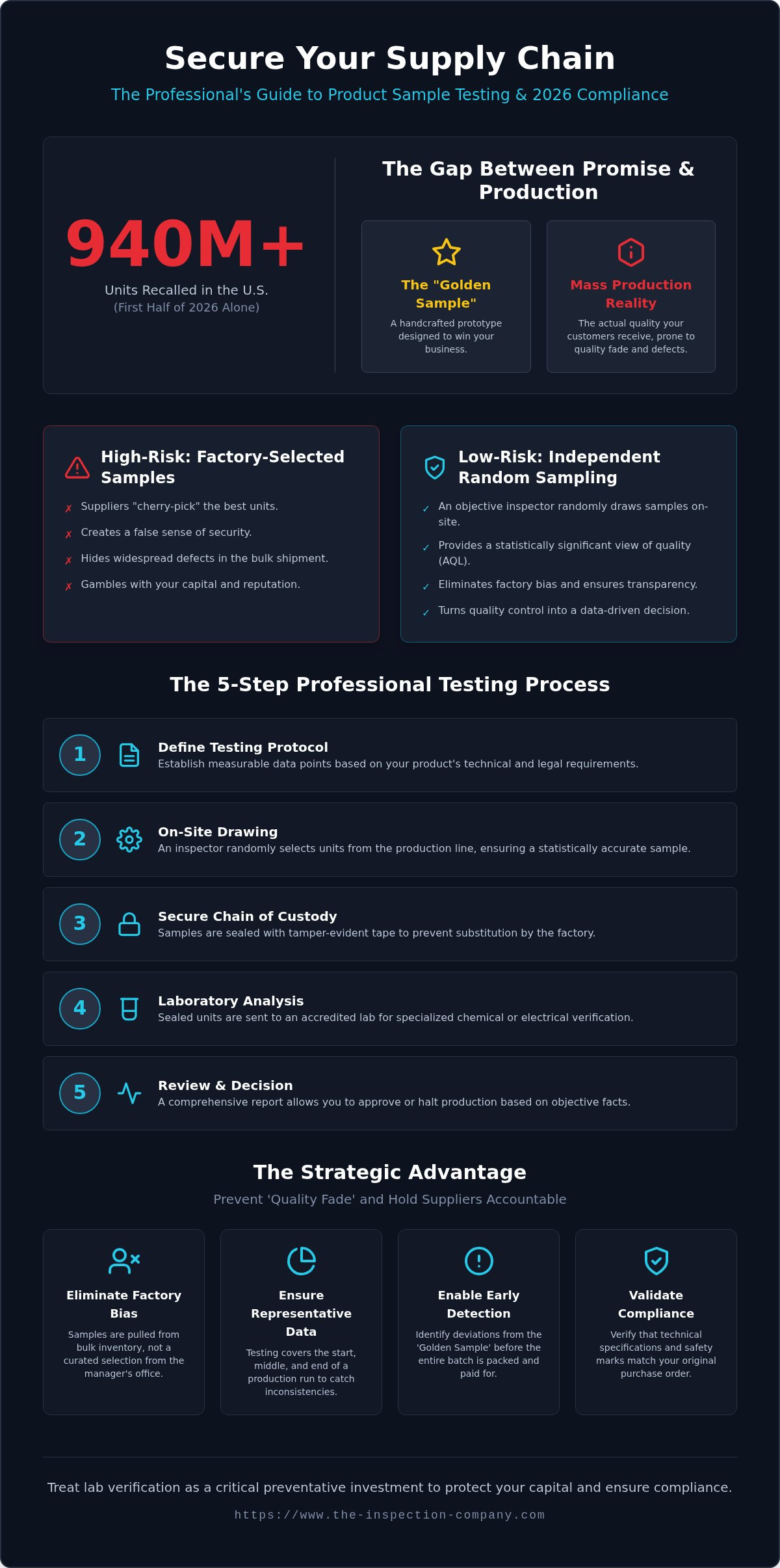
Product sample testing is the methodical process of selecting and verifying specific production units against your technical specifications and safety standards. It's vital to distinguish between a 'Golden Sample' and a production sample. While the former is a handcrafted prototype designed to win your business, the latter represents the actual quality your customers will receive. Product testing ensures that the high standards set by your prototype are maintained throughout the manufacturing cycle. Without this verification, you're essentially gambling on the factory's internal quality control.
Relying on samples sent directly by the factory is a high-risk strategy. Suppliers often 'cherry-pick' the best items from a batch, or worse, manufacture a small set of perfect units specifically for your review. This creates a false sense of security while the rest of the shipment may contain significant defects. You need an objective eye on the factory floor to ensure that what you see is what you actually get. This transparency is the only way to prevent costly returns and marketplace bans.
The Strategic Importance of Third-Party Selection
Independent inspectors provide the objectivity required to maintain supply chain integrity. During a During Production Inspection, our team draws samples randomly from the line. This ensures the product sample testing results reflect the true state of the entire batch, not just a curated selection. We utilize the AQL (Acceptable Quality Limit) methodology to determine sample sizes, providing a statistically significant view of your order's quality. This methodical approach transforms quality control from a guessing game into a data-driven business decision.
- Eliminates factory bias: Inspectors choose samples from the bulk inventory, not from the manager's office.
- Representative cross-sections: Testing covers the start, middle, and end of a production run to catch inconsistencies.
- Early detection: Identifying deviations from the 'Golden Sample' before the entire batch is packed and paid for.
- Compliance validation: Verifying that technical specifications and safety marks match your original purchase order.
The 5-Step Product Sample Testing Process
Securing your supply chain requires a methodical approach that leaves nothing to chance. A structured product sample testing workflow ensures that every unit matches your technical requirements and safety obligations. This process begins by defining a testing protocol tailored to your product category and target market's legal mandates. It's the only way to transform vague quality expectations into measurable data points.
Once the protocol is set, the execution follows these critical stages:
- On-site drawing: An inspector selects units randomly during a During Production Inspection, adhering to industry sampling standards to ensure statistical accuracy.
- Chain of custody: Samples are securely sealed with tamper-evident tape and signed by the inspector. This prevents the factory from substituting "perfect" units after the inspector leaves the premises.
- Laboratory analysis: The sealed units are dispatched to an accredited facility for specialized chemical, mechanical, or electrical verification.
- Review: All data is consolidated into a comprehensive report, allowing you to approve or halt production based on objective facts rather than factory promises.
On-Site vs. Laboratory Testing
Understanding the distinction between on-site checks and lab verification is essential for risk management. On-site testing focuses on visual defects, dimensions, and basic functionality. It's your first line of defense against obvious manufacturing errors. However, complex safety requirements, such as RoHS or CE compliance, require the controlled environment of a laboratory to detect heavy metals or electrical instability.
Determining which tests are mandatory depends on your specific product category and where you intend to sell. If you're unsure about the requirements for your next shipment, you can request a consultation with our quality experts to build a compliant testing plan. This proactive investment prevents customs seizures and costly marketplace removals.
Preventing 'Quality Fade' Through Systematic Testing
Quality fade is a silent profit killer in international sourcing. It describes the gradual degradation of product quality as a factory substitutes cheaper materials or simplifies processes after the initial "Golden Sample" is approved. For instance, a factory might replace high-grade, food-safe silicone with a cheaper industrial alternative to save on overhead. Systematic product sample testing during the Pre-Shipment Inspection phase is your only reliable defense against this calculated erosion of your brand's standards.
Establishing a consistent testing protocol also has a profound psychological impact on your supplier. When a factory manager understands that every batch is subject to third-party verification, the incentive to cut corners disappears. This creates a culture of accountability where the factory prioritizes your specifications over their own margin-padding tactics. Proactive oversight ensures that the thousandth unit off the line matches the quality of the first. Accountability becomes the standard.
A recent case involving a kitchenware importer highlights the value of this approach. During a routine check, lab analysis revealed that the manufacturer had switched to a non-compliant coating that didn't meet safety regulations. Catching this error before the final payment saved the seller from a catastrophic product recall, a critical move considering U.S. recalled units are on track to exceed one billion in 2026. If you want to secure your next production run, you can book a consultation with our technical team today.
Amazon FBA and Marketplace Specifics
Amazon's 2026 enforcement landscape is increasingly unforgiving. With the U.S. CPSC's mandatory eFiling for imported consumer products now in effect as of July 8, 2026, sellers must have verified compliance data ready for every shipment. If your listing is flagged for a safety appeal, you'll need documented Amazon FBA inspection reports to prove your goods meet regulatory standards. Failing to provide these verified records can lead to permanent account suspension and the destruction of your inventory.
Maximizing ROI: Why Sample Testing is a Preventative Investment
Professional product sample testing isn't an expense; it's a strategic insurance policy for your balance sheet. When calculating the ROI of quality assurance, you must look beyond the testing fee to the catastrophic costs of a failed shipment. A single container of defective goods represents a total loss of manufacturing capital, non-refundable ocean freight, and import duties. These financial hits are often compounded by the long-term damage to your brand's reputation and the loss of marketplace rankings that take years to build.
Implementing a rigorous verification program significantly reduces the risk of sourcing from Asia by bridging the geographical gap between your office and the factory floor. Beyond immediate quality control, these inspection reports serve as powerful legal evidence during supplier disputes. It's much harder for a factory to deflect responsibility when presented with objective, third-party data. For your 2026 procurement strategy, professional sampling should be a mandatory gatekeeper before any final wire transfer is authorized.
Choosing the Right Testing Partner
The effectiveness of your quality program depends entirely on the boots you have on the ground. A localized presence in major Asian manufacturing hubs is non-negotiable for maintaining real-time oversight and preventing factory-led delays. You need a partner who combines international management standards with deep local expertise to navigate complex manufacturing environments. Speed is equally critical for your supply chain's agility. Our commitment to delivering detailed reports within 24 hours ensures you can make informed decisions without stalling your production timeline.
Don't leave your next shipment to chance. Book your professional sample testing today to secure your supply chain and protect your investment from avoidable quality failures.
Securing Your 2026 Supply Chain Strategy
International trade in 2026 demands more than just trust; it requires verified data. Relying on factory-sent samples is no longer a viable business strategy when the risk of quality fade and regulatory non-compliance can result in total inventory loss. By implementing a systematic product sample testing protocol, you move from a position of vulnerability to one of control. This proactive oversight ensures your mass production matches your approved prototype while meeting the latest safety standards for global marketplaces.
The Inspection Company provides the high-stakes security your brand needs. With over 700 professional inspectors across Asia and European management standards, we bridge the gap between your expectations and local manufacturing realities. We deliver detailed reports within 24 hours, giving you the transparency required to release payments with total confidence. Don't let a single defective shipment jeopardize your reputation or your capital.
Secure Your Quality: Get a Professional Sample Testing Quote
Take the first step toward a more resilient and profitable supply chain today.
Frequently Asked Questions
Is product sample testing mandatory for all imports?
While not every product has a blanket mandate, 2026 regulations make compliance documentation essential. The U.S. CPSC now requires electronic filing of certificates for regulated consumer goods as of July 8, 2026. Beyond legal requirements, marketplaces like Amazon demand verified safety data to prevent account suspensions. Professional product sample testing is the only way to generate the evidence needed to clear customs and maintain your selling privileges in these strict environments.
What is the difference between a prototype and a production sample?
A prototype is a "Golden Sample" used to prove a design concept, while a production sample reflects the reality of mass manufacturing. Suppliers often put extra effort into prototypes to secure your order. In contrast, production samples are pulled from the actual assembly line to catch quality fade or unauthorized material substitutions. Testing these units ensures that the items your customers receive match the high standards of your original, approved prototype.
How many samples should be tested from a large production run?
The number of units tested depends on your specific risk profile and the AQL standards used for your inspection. For product sample testing that involves destructive lab analysis, you typically select a small, statistically relevant number of units to keep costs manageable. For on-site functional checks, the sample size scales with your total order volume. This methodical approach ensures your quality data is representative of the entire batch rather than a few outliers.
Can the factory conduct the testing themselves?
Suppliers often provide internal reports, but these lack the objectivity required for high-stakes importing. Factories have a vested interest in passing their own products, which often leads to "cherry-picking" or falsified data. To mitigate risk, an independent third party must draw samples randomly from the production line. This ensures that the testing results reflect the true state of your inventory rather than a curated selection of perfect units.
What happens if a sample fails the laboratory test?
A failed test result should trigger an immediate halt to production and a suspension of final payments. You must require the factory to provide a formal corrective action plan to address the non-compliance or defects. After the factory implements these changes, you should conduct a re-test to verify the issues are resolved. Using independent reports as evidence gives you the necessary leverage to demand these improvements before the goods leave the factory.