

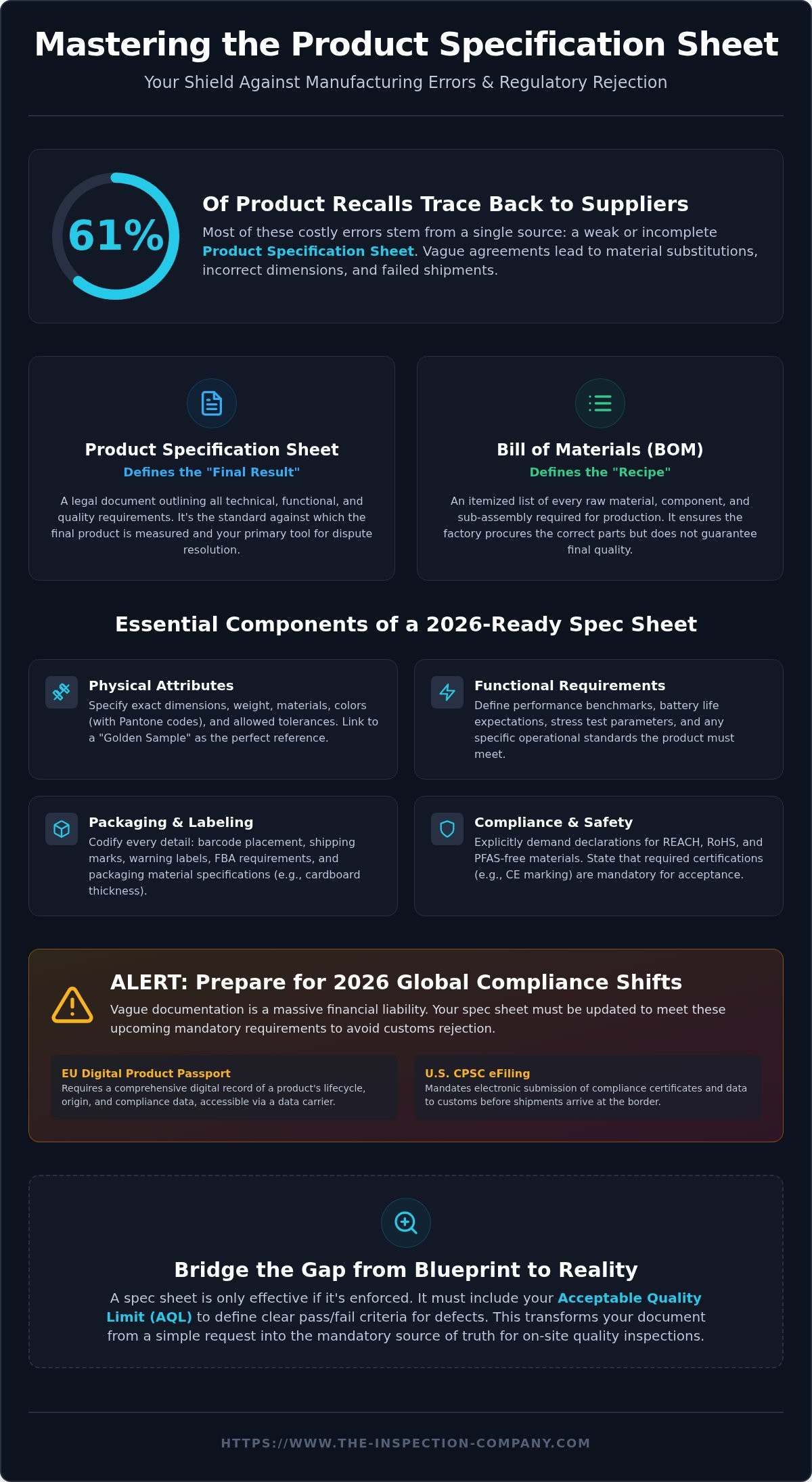
Did you know that 61% of product recalls are traced directly back to supplier-related quality issues? For global importers, the anxiety of opening a container only to find materials substituted or dimensions altered is a costly reality. Most of these errors stem from a weak or incomplete product specification sheet. You've likely felt the frustration of receiving a shipment that bears little resemblance to your approved sample. It's a risk that threatens your bottom line and your reputation with every order placed in Asia.
We understand that a vague agreement isn't enough to protect your investment. This guide will teach you how to master technical documentation to eliminate manufacturing errors and ensure total regulatory compliance. By the end of this article, you'll know how to create a foolproof document that provides legal protection during supplier disputes and slashes your defect rates. We'll preview the critical 2026 updates, including the EU Digital Product Passport registry and new U.S. CPSC eFiling requirements, so your shipments never face a customs rejection again.
Key Takeaways
- Learn why a detailed product specification sheet is your primary legal shield against factory material substitution and regulatory rejections in 2026.
- Transition from vague descriptive language to precise technical metrics that leave zero room for supplier misinterpretation.
- Prepare your documentation for the latest global compliance shifts, including the EU’s Digital Product Passport and U.S. CPSC electronic filing requirements.
- Bridge the gap between digital blueprints and physical reality by using your specifications as the mandatory source of truth for on-site quality inspections.
Product Spec Sheets: Your Primary Risk Shield
A product specification sheet is far more than a simple design blueprint. It's a comprehensive technical document that outlines every physical, functional, and legal requirement of your product. In 2026, the manufacturing landscape has shifted. With the launch of the EU Digital Product Passport registry and mandatory U.S. CPSC eFiling, vague orders have become a massive financial liability. If your documentation lacks explicit compliance data, your shipment risks immediate rejection at the border.
Your spec sheet serves as the legal backbone of your purchase order. It functions as a contract that defines your right to reject a shipment. Without these specifics, you've got no objective basis for a dispute when a factory delivers sub-par goods. Clear specifications allow you to move from hoping for quality to enforcing it. You can see the consequences of failing to define these standards in our guide to Understanding Product Defects.
The Difference Between a Spec Sheet and a Bill of Materials (BOM)
New importers often confuse these two critical documents. A Bill of Materials (BOM) is essentially the product's recipe. It lists every raw material, component, and sub-assembly required for production. Conversely, the product specification sheet defines the final result. It details the dimensions, weight tolerances, and performance benchmarks the finished item must meet. It's the standard against which the final output is measured.
Successful supplier management requires both. While the BOM ensures the factory procures the correct parts, the spec sheet ensures they assemble them to your standard. If a supplier substitutes high-grade components for cheaper alternatives to save costs, your spec sheet is the only tool that allows an inspector to identify the deviation. It transforms your expectations into verifiable facts.
Essential Components of a 2026 Product Spec Sheet
A modern product specification sheet must provide granular detail to prevent costly misunderstandings during production. Start with the physical attributes: exact dimensions, weight, and allowed tolerances. Don't just list numbers; link them to "Golden Sample" references that the factory must match perfectly. Functional requirements are equally critical. You need to define battery life, stress test parameters, and specific performance benchmarks that the product must achieve during operation. If these aren't documented, a factory might use cheaper internal components that fail after minimal use.
Packaging and labelling often represent a high-risk area for customs rejections or warehouse delays. Your document should specify barcode placement, shipping marks, and exact Amazon FBA requirements to avoid expensive relabelling fees. Every detail, from the thickness of the corrugated cardboard to the ink used on the warning labels, should be codified. If you're unsure about the technical requirements for your specific category, it's wise to consult with a quality expert to finalize your documentation before production begins.
Compliance and Safety Fields
In 2026, compliance is non-negotiable. Your sheet must explicitly demand REACH, RoHS, and PFAS-free declarations to navigate increasingly strict market access rules. Never assume a factory understands your market's legal requirements. You must state that CE markings or other certifications are mandatory requirements for acceptance. To understand the chemical restrictions involved in these standards, review our guide on RoHS compliant meaning.
AQL and Inspection Criteria
Your document is only effective if it defines the threshold for rejection. Explicitly state your Acceptable Quality Limit (AQL) within the product specification sheet. This sets clear boundaries for major, minor, and critical defects. By defining these standards upfront, you give your inspector the objective data needed to fail a shipment that doesn't meet your safety or aesthetic standards. This prevents the "paperwork fallacy" where a document exists but has no teeth for enforcement.
How to Create a Spec Sheet That Prevents Manufacturing Errors
Creating a product specification sheet requires a methodical approach to eliminate ambiguity. You must first define the user persona and environment. A product designed for high-humidity tropical climates requires different material tolerances than one sold in dry, temperate zones. Next, detail every technical requirement using specific metrics like millimeters, kilograms, and volts. Adjectives like "strong" or "lightweight" have no place here. They invite supplier discretion, which remains the primary cause of manufacturing friction and unexpected costs.
Visual references are your next priority. High-resolution photos, CAD drawings, and Pantone color codes provide a universal language that transcends borders. Benchmarks define exactly what tests the product must pass during a Pre-Shipment Inspection. Finally, review and translate the document. Ensure your factory manager in China or Vietnam understands every line. If you need help verifying that your factory can meet these standards, contact our regional experts for a factory audit.
Avoiding Vague Terminology
Vague language is a financial risk. Replace "high quality" with specific ISO standards or quantifiable durability metrics. When you leave details to supplier discretion, you're allowing the factory to choose the cheapest possible path. Every material choice must be yours to maintain control over your supply chain and protect your brand reputation.
Special Considerations for Amazon FBA Sellers
Amazon sellers should include platform-specific requirements in their product specification sheet. Integrate Amazon FBA Inspection criteria directly into your document. This includes precise carton dimensions, weight limits, and labeling orientations. Codifying these rules prevents "stranded inventory" caused by warehouse rejections and ensures your products are ready for immediate sale.
The Critical Link: Why Your Spec Sheet Needs Physical Verification
A common mistake among global importers is the "Paperwork Fallacy." This is the dangerous belief that a perfect product specification sheet automatically results in a perfect product. In reality, a document is only as effective as your ability to enforce it on the factory floor. Without physical verification, your technical requirements remain mere suggestions to a factory facing its own margin pressures and operational friction.
Material substitution is a persistent risk in international trade. When raw material costs spike or specific components become scarce, factories often deviate from your specs to maintain their profits. These substitutions are frequently invisible until the product fails in the consumer's hands, leading to costly recalls and brand damage. To prevent this, you must use Sample Testing to verify the "First Article" before mass production begins. This creates a physical benchmark that matches your digital data.
Relying on factory-provided photos is not a quality control strategy. You need an independent China Inspection Service to act as your eyes and ears on-site. Only a third-party expert can confirm that the physical goods in the container actually align with the standards defined in your product specification sheet.
The Role of the Pre-Shipment Inspection (PSI)
During a Pre-Shipment Inspection, TIC inspectors use your spec sheet as their definitive checklist. They don't just look at what the factory presents; they perform independent sample picking from the entire lot to ensure the factory hasn't "cherry-picked" the best units for review. This ensures the data reflects the true quality of the shipment. A comprehensive PSI report validates spec sheet compliance and is delivered within 24 hours to facilitate fast, confident decision-making.
Secure Your Supply Chain with Technical Precision
A detailed product specification sheet is your primary defense against the financial risks of international trade. By codifying every technical and compliance requirement, you move from a position of uncertainty to one of total operational control. However, even the most meticulous document requires enforcement on the factory floor to prevent material substitution and quality fade. An inspection is only as effective as the standards it enforces.
Our team of 700+ inspectors across major Asian hubs operates under strict European management standards to ensure your requirements are met. We provide detailed reports within 24 hours, giving you the transparency needed to approve or reject shipments with confidence. Protecting your bottom line starts with a clear plan and ends with verified results. We're here to help you bridge that gap and secure your investment.
Secure your manufacturing run. Contact our experts for a professional inspection today.
Frequently Asked Questions
What is the difference between a product spec sheet and a data sheet?
A data sheet is often a public summary of a product's capabilities used for engineering or marketing. In contrast, a product specification sheet is a private manufacturing document. While a data sheet describes what the finished product does, the spec sheet dictates exactly how it must be built. It covers every technical detail, material standard, and compliance requirement needed for production and rigorous quality control.
Does a product specification sheet have legal standing in China?
A spec sheet has legal standing when you integrate it into a signed Purchase Order or contract. In China, courts rely on written evidence to resolve disputes. Without a clear product specification sheet, it's nearly impossible to prove a factory breached its obligations. Attaching the document to your contract ensures that quality expectations are legally binding and enforceable during on-site inspections or legal proceedings.
How detailed should my product spec sheet be for a new supplier?
Documentation should be extremely granular for new suppliers to prevent misinterpretation. You shouldn't leave room for "supplier discretion," as factories often cut costs by substituting cheaper materials. Include specific metrics for dimensions, weight, and tolerances alongside high-resolution photos. A detailed document makes it easier for an independent inspector to identify deviations before the goods leave the factory, protecting your bottom line from unexpected defects.
Can I use a spec sheet template for different types of products?
You can use a standardized framework, but every product requires unique technical requirements. A template ensures you don't forget critical fields like compliance markings or packaging standards. However, the specific functional tests and material grades must be tailored to the individual item. A generic document won't protect you from category-specific risks like chemical restrictions or electrical safety standards that vary significantly between different products.
Who is responsible for updating the product spec sheet during production?
The importer is ultimately responsible for maintaining and updating the document. If any changes occur during mass production, such as a component substitution or a design tweak, you must document it immediately. You should then share the revised version with the factory manager and your third-party inspection team. This ensures that every party works from the same "source of truth" to avoid costly manufacturing errors.