

A single shipment of defective goods can erase months of profit and damage your brand's reputation beyond immediate repair. If you're relying on a vague or incomplete quality control inspection report template, you're essentially leaving your capital to chance. You likely understand the frustration of navigating communication barriers with overseas factories or struggling with inconsistent data from different suppliers. These gaps lead to financial loss and operational friction that could have been prevented with a more rigorous framework.
We'll help you master the essential components of a professional QC report to mitigate these risks and ensure product excellence before your goods ever leave the factory floor. By the end of this guide, you'll have a clear roadmap for standardizing your reporting and establishing firm criteria for approving or rejecting shipments. We'll examine the specific sections every report needs to translate raw factory data into the actionable business decisions required for your 2026 supply chain strategy.
Key Takeaways
- Learn why a robust quality control inspection report template acts as your final gatekeeper to prevent defective goods from leaving the factory.
- Understand the technical requirements of ISO 2859-1 sampling plans to ensure your inspection results are statistically valid and actionable.
- Discover how to adapt inspection criteria for different product categories, from functional safety tests in hardlines to measurement accuracy in textiles.
- Identify the critical risks associated with manual reporting and why factory self-inspections create a dangerous conflict of interest.
- Learn how professional reporting reduces operational friction and accelerates the approval process for high-stakes shipments.
What is a Quality Control Inspection Report and Why Is It Critical?
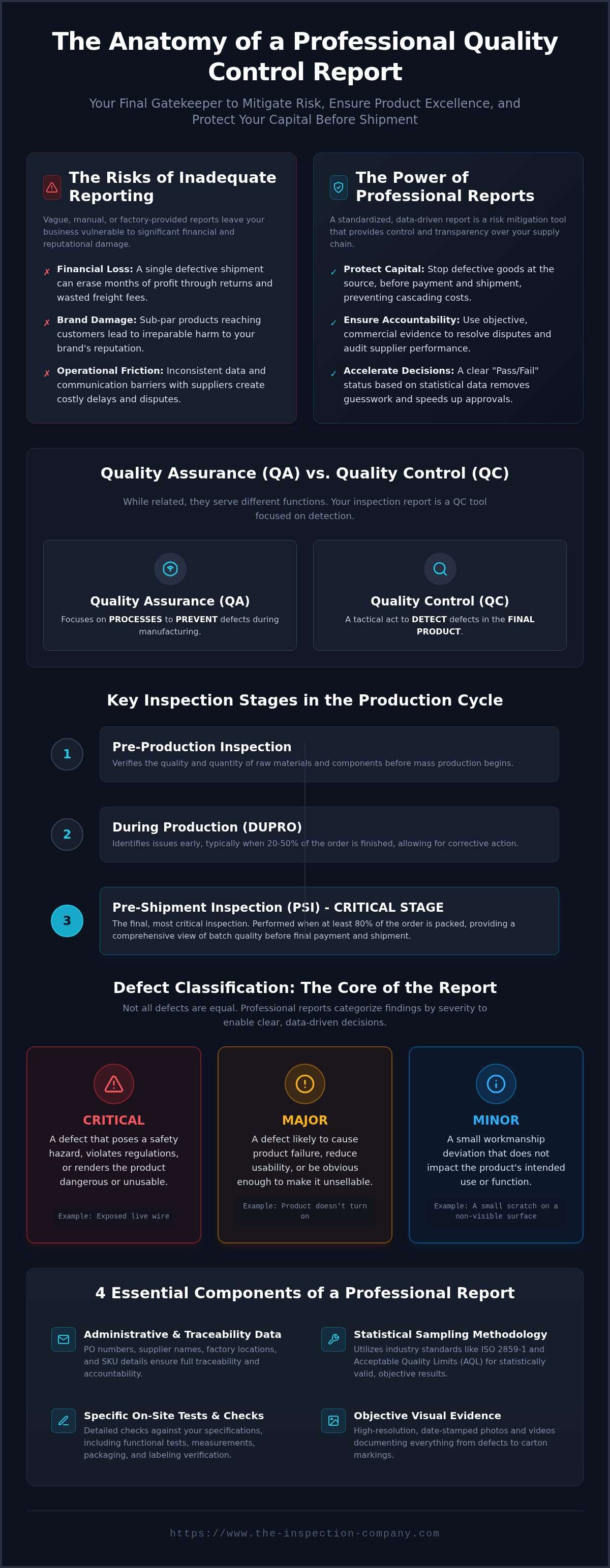
A What is a Quality Control Inspection Report is a structured document that captures the findings of an on-site product examination against your pre-defined specifications. It acts as the physical evidence of your product's condition before ownership transfers from the factory to your warehouse. Utilizing a standardized quality control inspection report template ensures that every inspector, regardless of the factory's location, evaluates the same criteria and measures against the same tolerances.
Think of this report as your final gatekeeper. Once goods leave the factory floor and clear customs, your leverage with the supplier effectively vanishes. Stopping defective goods at the source prevents the cascading costs of international returns, wasted freight fees, and the irreparable damage to your brand reputation that occurs when customers receive sub-par items. It isn't just a checklist; it's a professional risk mitigation tool designed to protect your capital.
Beyond simple defect tracking, professional reports provide the transparency needed for accountability. If a dispute arises regarding shipment quality, this document serves as objective commercial evidence. It replaces "he-said, she-said" arguments with data-driven facts. This level of detail is essential for maintaining control over high-stakes international trade operations where communication barriers often lead to expensive misunderstandings.
Quality Control vs. Quality Assurance: Understanding the Difference
Quality Assurance (QA) focuses on the processes used to prevent defects during manufacturing. In contrast, Quality Control (QC) is the tactical act of detecting those defects. Your quality control inspection report template is a QC tool. While you want a factory with robust processes, your reporting must focus on detecting issues that have already occurred. It's the difference between hoping for a good outcome and verifying it through empirical data.
When to Deploy an Inspection Report
Importers deploy these reports at various stages to maintain visibility over the production cycle:
- Pre-Production: Verifying raw materials and initial components.
- During Production (DUPRO): Identifying issues when 20% to 50% of the order is finished.
- Pre-Shipment Inspections (PSI): The most critical stage, performed when at least 80% of the order is packed and ready for transport.
The PSI report is the industry standard for final shipment approval. It provides the most comprehensive view of the total batch quality before the container is sealed and the balance payment is issued.
Essential Components of a Professional QC Report Template
Every professional quality control inspection report template begins with rigorous administrative data. Purchase order (PO) numbers, supplier names, and specific factory locations ensure full traceability across your supply chain. Without these details, your data becomes impossible to aggregate for long-term supplier performance auditing. This section sets the foundation for accountability before the technical examination even begins.
The core of the document is the inspection methodology. Professional agencies typically utilize the ISO 2859-1 sampling plan. This statistical model determines the exact number of units to pull from a batch based on the total order size. The resulting Acceptable Quality Limit (AQL) data then dictates a "Pass," "Fail," or "Pending" status. This objective framework removes the guesswork from shipment approvals and provides a clear mathematical basis for your business decisions.
Defects are rarely equal in impact. A professional template categorizes findings into three distinct levels:
- Critical: Safety hazards or legal non-compliance that render the product dangerous.
- Major: Functional failures or significant aesthetic issues that make the product unsellable.
- Minor: Small workmanship deviations that don't impact the product's intended use.
Visual Evidence: The Role of Photos and Video
Visuals provide the transparency required for remote supply chain management. High-resolution photos must document everything from the shipping marks on the master carton to the internal wiring of an electronic device. Crucially, professional inspectors use date and time stamps on all on-site media. This prevents factories from attempting to hide current production failures by providing "stock" images from previous successful runs.
Product Specific Tests and Checklists
Generic checklists often miss the nuances of specialized manufacturing. Electronics require functional tests like "hi-pot" or grounding verification. Garments need pull-tests for buttons and seam strength measurements. Every report must also include a carton drop test to ensure your packaging can survive the rigors of international logistics. You can find more detail on categorizing these issues in our Understanding Product Defects guide.
How to Customise Your Template for Different Product Categories
A generic quality control inspection report template serves as a foundation, but it cannot account for the unique risks inherent in different manufacturing sectors. Hardline goods like electronics or furniture require technical scrutiny that goes far beyond visual checks. For electrical items, your template must prioritize functional safety and RoHS compliance to ensure the product meets international environmental and safety standards. Failure to include these specific tests can lead to legal liability and total shipment rejections at the border.
Softline goods, such as apparel and textiles, demand a different focus. Here, the report must emphasize precise measurements, stitching integrity, and fabric consistency. A single centimeter of deviation in a sleeve length can render a high-fashion garment unsellable. By tailoring your reporting to these specific physical properties, you ensure that the data collected is actually relevant to the product's market value.
The Amazon FBA Inspection Checklist
Selling on Amazon introduces a layer of regulatory complexity that standard templates often overlook. Amazon's fulfillment centers are notorious for rejecting shipments due to minor labeling errors or incorrect carton dimensions. Your inspection must verify:
- FNSKU labeling accuracy and scannable placement on every unit.
- Carton weight and dimension limits to ensure they align with Amazon's strict policies.
- Suffocation warnings on polybags and correct "Sold as Set" stickers where applicable.
To eliminate the risk of expensive warehouse rejections, consider utilizing specialized Amazon FBA Inspection services to handle these granular checks.
Defining Your 'Pass/Fail' Thresholds
Setting your AQL levels is a strategic decision based on your brand's tolerance for risk. High-end luxury brands typically demand tighter AQL limits than discount retailers. Regardless of the product, your template must clearly define what constitutes a failure. A critical defect is any condition that could result in hazardous or unsafe conditions for the user. These findings should trigger an immediate "Fail" result, regardless of how few are found in the sample. If you need help calibrating these thresholds for your specific category, consult with our quality engineers to build a custom framework.
Why Manual Templates Fail (and the Professional Solution)
While a quality control inspection report template is a vital starting point, its effectiveness depends entirely on the person executing the examination. Many importers fall into the "conflict of interest" trap by allowing factories to use a template for self-inspection. This is a fundamental operational risk. A manufacturer's primary objective is to ship goods and secure payment. They have no incentive to highlight their own production failures or functional defects.
Excel-based reporting is similarly riddled with risks. Manual data entry frequently leads to human error in AQL calculations and missing visual evidence. These inaccuracies create a false sense of security that disappears only when the defective container arrives at your warehouse. Leading quality inspection services operate with a 24-hour turnaround because speed is essential for maintaining your shipping schedule. Static PDFs are no longer enough. Modern supply chain managers utilize a digital Quality Platform to transform individual reports into long-term supplier benchmarking data.
Leveraging Professional 3rd Party Inspections
The Inspection Company (TIC) eliminates the friction of manual reporting by providing a professional, ready-made report within 24 hours of the site visit. Our European management team oversees operations across Asian manufacturing hubs, ensuring that international quality standards are strictly enforced on the ground. With over 700 inspectors available, we provide the scale and technical expertise required to validate your production without the bias of factory self-reporting.
Next Steps: From Template to Shipment Approval
A professional report summary allows you to make an immediate "Ship" or "Re-work" decision based on objective data. You don't need to spend hours deciphering raw factory notes when the AQL results provide a clear pass or fail status. This clarity reduces operational stress and protects your bottom line. To move beyond generic checklists and secure your supply chain, book a Pre-Shipment Inspection and receive your first comprehensive, data-driven report.
Protect Your Capital with Data-Driven Shipment Approvals
Implementing a robust quality control inspection report template is the first step toward total supply chain visibility. By moving away from manual Excel sheets and factory self-reporting, you eliminate the conflict of interest that often leads to costly defects reaching your customers. Professional reporting provides the transparency needed to make objective "Ship" or "Re-work" decisions before your goods ever leave the factory floor. This proactive approach transforms quality management from an administrative hurdle into a strategic competitive advantage.
The Inspection Company (TIC) offers a localized operational presence across Asia backed by European-managed quality standards. With over 700 certified inspectors on the ground, we deliver the technical expertise required to validate your production against strict global benchmarks. Our detailed reports are delivered within 24 hours of the site visit, ensuring your supply chain remains agile and efficient.
Secure Your Quality: Get a Professional Inspection Report Today and take full control of your manufacturing outcomes. We're here to ensure your goods meet your standards every time.
Frequently Asked Questions
What is the most important part of a quality control report?
The overall result summary is the most critical section, as it provides an immediate "Pass," "Fail," or "Pending" status based on your AQL limits. This snapshot allows you to make rapid commercial decisions without sifting through hundreds of individual data points. It serves as the definitive evidence required to either authorize a shipment or halt a payment due to non-compliance.
How do I choose the right AQL level for my report template?
You should select AQL levels based on your product's retail price point and your brand's tolerance for risk. While the industry standard often defaults to 0 for Critical, 2.5 for Major, and 4.0 for Minor defects, luxury goods or medical devices require much stricter thresholds. Integrating these specific limits into your quality control inspection report template ensures the inspector evaluates the batch against your exact brand standards.
Can I use an Excel-based template for my inspections?
While Excel is a common starting point, it's often a source of operational friction and data entry errors. Manual templates lack real-time validation, which means an inspector might miscalculate the AQL result or fail to attach necessary time-stamped visual evidence. Professional importers are shifting toward digital platforms that automate these calculations and provide a more secure, standardized way to manage multi-supplier quality data.
What should I do if my inspection report shows a 'Fail' result?
You must immediately halt the balance payment and notify the factory that the shipment is rejected until corrective actions are taken. Demand a formal root-cause analysis and require the factory to perform a 100% re-work of the affected batch. Once the factory claims the issues are resolved, schedule a re-inspection to verify the defects are eliminated before allowing the goods to leave the floor.
How long does it take to receive a professional inspection report?
You should expect to receive a professional report within 24 hours of the inspector finishing their site visit. This speed is essential for maintaining your shipping schedule and avoiding expensive port congestion fees. A fast turnaround ensures you have the data needed to approve the shipment while the goods are still physically accessible at the factory for any necessary re-work or sorting.