
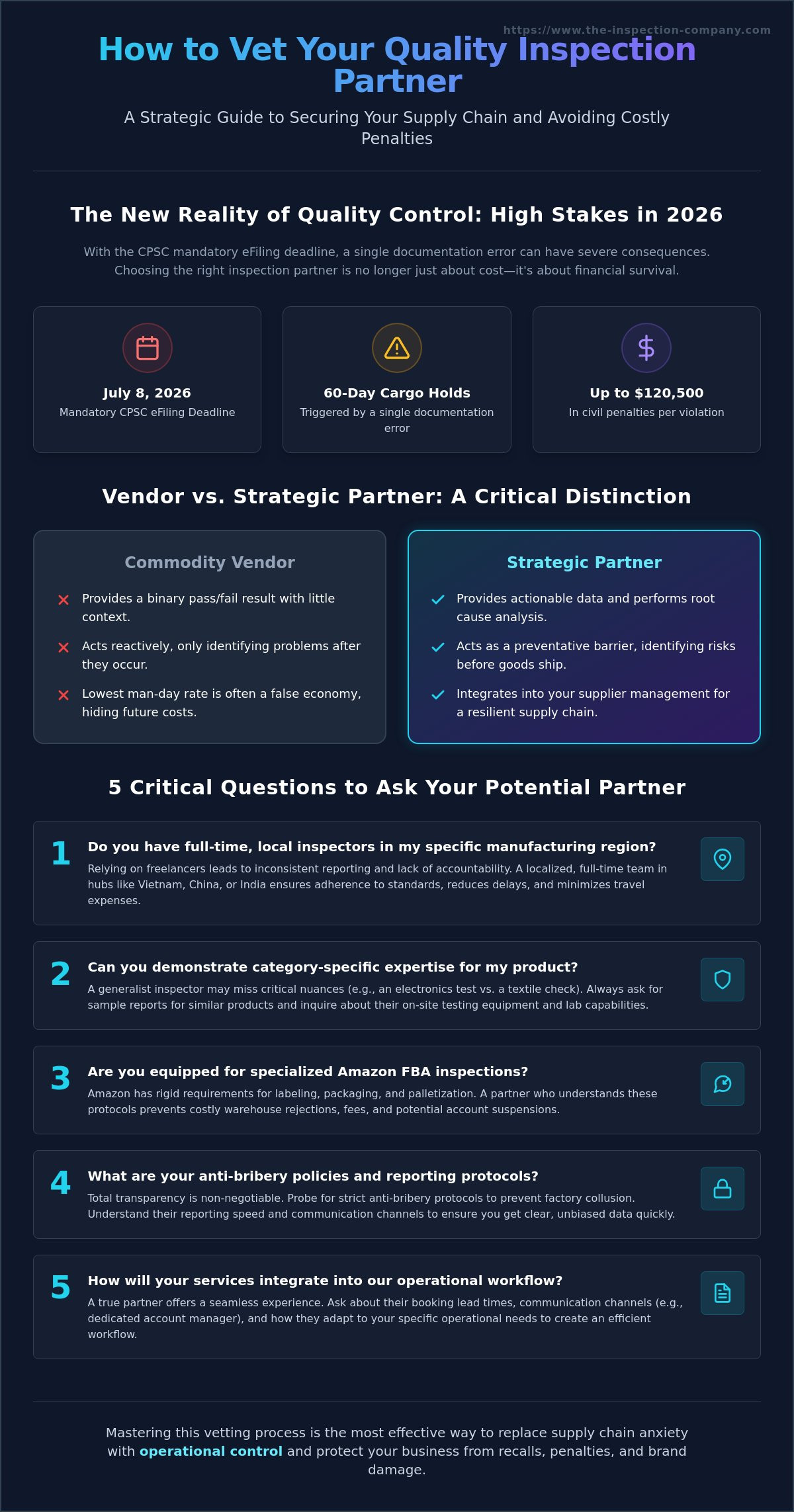
With the July 8, 2026, CPSC mandatory eFiling deadline now in effect, a single documentation error can trigger a 60-day cargo hold or civil penalties reaching $120,500. You've likely felt the pressure of these new regulations while worrying if your current quality control is actually catching defects or just checking boxes. It's a common anxiety; nobody wants to open a container only to find a season's worth of inventory is unsellable or violates Amazon's strict compliance standards. To secure your supply chain, you must know the exact questions to ask a potential inspection partner before you sign a contract.
This guide provides a meticulous framework to vet agencies and ensure they possess the technical expertise your specific product category requires. You'll learn how to probe for anti-bribery protocols and digital transparency to prevent factory collusion. We'll show you how to identify a partner that acts as a preventative investment, shielding your business from costly recalls and protecting your importer risk score from permanent damage. Mastering this vetting process is the most effective way to replace supply chain anxiety with operational control.
Key Takeaways
- Understand why viewing quality control as a strategic investment rather than a commodity is essential for preventing costly recalls and Amazon account suspensions.
- Learn how to verify an agency's technical expertise and geographic reach to ensure they have full-time inspectors on the ground in your specific manufacturing hub.
- Discover the critical questions to ask a potential inspection partner regarding their anti-bribery policies and reporting speed to ensure total transparency in your supply chain.
- Establish a seamless workflow by identifying a partner that offers clear communication channels and manageable lead times for booking factory audits and inspections.
Why Your Choice of Inspection Partner is a Strategic Financial Decision
In the high-stakes environment of international trade, viewing quality control as a mere line-item expense is a dangerous oversight. A reliable quality inspection partner functions as a preventative barrier between your capital and supply chain failure. When you evaluate the questions to ask a potential inspection partner, you aren't just hiring a service; you're securing your company's financial health. An expert partner identifies risks before goods leave the factory floor, preventing the catastrophic costs associated with defective inventory.
Poor quality control carries heavy penalties. US manufacturers lose approximately $50 billion annually due to poor quality, according to industry estimates. These losses manifest in several ways:
- Delayed shipments that miss critical seasonal sales windows.
- Costly product recalls, disposal fees, and freight costs for returns.
- Permanent brand damage and the risk of Amazon account suspensions.
The landscape in 2026 has shifted from simply checking products to proactively managing supplier risk. With the implementation of mandatory CPSC eFiling, an error in product safety data can result in civil penalties of up to $120,500 per violation. Price-shopping for the lowest man-day rate is often a false economy. If an agency lacks the technical depth to catch a critical safety defect, the "savings" on the inspection fee will be dwarfed by the subsequent legal and operational costs.
The Difference Between a Vendor and a Strategic Partner
A standard vendor provides a binary pass or fail result. In contrast, a strategic partner integrates into your supplier management process by providing actionable data. They don't just report a defect; they perform root cause analysis to prevent the error from recurring. This distinction is vital when determining the questions to ask a potential inspection partner, as it ensures you're building a resilient supply chain rather than just reacting to failures. A true partner provides the transparency needed to make informed decisions about your manufacturing future.
5 Critical Questions to Ask About Technical and Geographic Capability
Identifying the right technical fit requires precision. When compiling your list of questions to ask a potential inspection partner, focus first on their physical infrastructure. You need to know if they have full-time inspectors in your specific manufacturing region. Relying on an agency that lacks a localized presence in hubs like Vietnam, China, or India often leads to scheduling delays and increased travel expenses.
Verifying Geographic Reach and Inspector Status
A critical distinction exists between full-time employees and freelance inspectors. Freelancers are often hired on a per-job basis; this frequently results in inconsistent reporting and a lack of accountability. You should ask if their team consists of full-time staff trained to uphold European quality standards. This ensures the person on the factory floor is directly answerable to the agency's management, not just a temporary contractor. If you're expanding into new territories, you can discuss your specific regional requirements with an expert to see how local coverage impacts your timeline.
Category-Specific Expertise
Generalist inspectors often miss the nuances of complex products. If you're importing electronics, an inspector with a background in textiles won't understand the necessary functional tests. Ask for sample reports for products similar to yours. These reports should demonstrate a deep understanding of your category's specific failure points. Inquire about their on-site testing equipment and their capacity for specialized sample testing in a laboratory setting. This depth of knowledge is what separates a basic check from a professional risk assessment.
Finally, for e-commerce brands, ask if the agency can perform specialized Amazon FBA inspections. Amazon has rigid requirements for labeling, packaging, and palletization. A partner who doesn't understand these specific protocols puts you at risk of costly warehouse rejections or account suspensions. These questions to ask a potential inspection partner will reveal if they truly understand the operational hurdles of 2026's global marketplace.
Evaluating Transparency: Questions on Reporting and Ethical Standards
Transparency is the foundation of any successful quality control strategy. When finalizing your list of questions to ask a potential inspection partner, you must move beyond technical specs and probe their reporting speed and ethical safeguards. A delay in information isn't just an inconvenience; it's a window for risk to enter your supply chain. If a report takes several days to reach your desk, you lose the ability to halt a shipment or demand immediate corrective action.
The 24-Hour Rule in Quality Control
Ask specifically: what is your exact turnaround time for a pre-shipment inspection report? In the fast-paced trade environment of 2026, 24-hour reporting is non-negotiable. Digital reporting prevents factory-inspector collusion by ensuring data is uploaded and timestamped directly from the factory floor. This immediate flow of information is also critical for meeting new regulatory deadlines, such as the CPSC eFiling requirements. If an agency cannot provide a 24-hour turnaround, they are likely using manual processes that are prone to manipulation or human error.
Ethics and Integrity in Asian Sourcing
Bribery and factory collusion remain significant anxieties for importers sourcing from Asia. You need to know what specific anti-bribery and ethical policies are in place for on-site inspectors. A professional agency should have a strict Code of Ethics and a rotation policy that prevents inspectors from visiting the same factory too frequently. This prevents over-familiarity and ensures an unbiased assessment every time. You should also inquire about how you access your data. A centralized quality platform allows you to monitor inspector performance and historical factory data in one secure location.
Finally, ask what happens if an inspector misses a critical defect that you later discover. A reliable partner will have clear accountability protocols and a transparent process for investigating discrepancies. These questions to ask a potential inspection partner will help you identify an agency that prioritizes integrity over convenience. To learn more about our rigorous ethical standards and reporting protocols, contact our management team today.
Operational Questions: Integrating the Partner into Your Workflow
Successful quality control depends on how well an agency fits into your existing supply chain. Integrating these final questions to ask a potential inspection partner ensures that your daily operations run without friction. You need to know exactly how they move from a booking request to a finished report. Professional risk management requires clear operational boundaries and predictable timelines.
Start by asking how much lead time they require to book a factory audit or a production check. In the high-speed environment of 2026, you can't afford to wait a week for an inspector to become available. You should also inquire about their protocol for contacting suppliers. A reliable partner handles the local logistics and communication with the factory management directly, reducing the administrative burden on your team.
Budget predictability is equally vital. Do they offer all-inclusive pricing, or are there hidden travel expenses for remote factories? Unexpected fees for transportation or accommodation can quickly erode your margins. Insist on a transparent fee structure that covers the inspector's time and travel without surprise surcharges.
Customization and Flexibility
Generic checklists are often insufficient for specialized brands. You must verify if the partner can customize the inspection criteria to reflect your specific requirements. This includes integrating your chosen AQL standards and specific functional tests into their mobile reporting tools. A partner that relies on rigid, one-size-fits-all templates will likely miss the unique failure points of your specific product category.
Closing the Loop: From Inspection to Shipment Approval
The inspection process shouldn't end when the inspector leaves the factory floor. A strategic partner assists with container loading supervision to ensure that the exact goods inspected are the ones actually loaded and shipped. This final stage of oversight prevents "product switching" and ensures your cargo is packed securely to avoid transit damage. By using these questions to ask a potential inspection partner, you transform the inspection report into a powerful tool for negotiating with suppliers and securing your final approval before payment is released.
Securing Your Supply Chain for 2026 and Beyond
Mastering the questions to ask a potential inspection partner is the first step toward transforming your quality control from a reactive expense into a strategic asset. By verifying geographic reach and technical expertise, you ensure that the person on the ground understands your specific product category. Demanding 24-hour reporting and strict ethical protocols eliminates the visibility gaps where defects and collusion often hide. These steps are essential to protect your capital and maintain your standing with global regulators.
A reliable partner doesn't just check boxes. They provide the data needed to manage supplier risk effectively. With European management and over 700 full-time inspectors, we deliver comprehensive reports within 24 hours to keep your operations moving. Whether you need specialized expertise in consumer electronics or strict Amazon FBA compliance, the right partner provides the security you need to scale without fear of recalls or suspensions. You can move forward with the confidence that your supply chain is resilient and transparent.
Secure your supply chain; get an instant quote for your next inspection today.
Frequently Asked Questions
How do I verify if an inspection company is actually European-managed?
Check the company's leadership profile and corporate registration to confirm where the decision-making authority resides. European management is characterized by a specific focus on risk mitigation and Western ethical standards. You should ask about the background of the senior management team and whether they are directly involved in training local staff. This structure ensures that international quality expectations are maintained across all regional operations in Asia.
What is a reasonable price for a professional product inspection in Asia?
Professional inspection costs are typically calculated based on a man-day rate, which covers the inspector's time on-site and the subsequent reporting. Prices vary depending on the technical complexity of the product and the location of the factory. It's vital to ensure the quote is all-inclusive to avoid surprise charges for travel or documentation. Choosing a partner based on value rather than the lowest price prevents the much higher costs of defective shipments.
Can I ask an inspection partner to perform a social audit at the same time?
Yes, many professional agencies can conduct a social audit alongside a product check to provide a comprehensive view of factory compliance. While the inspection focuses on physical attributes, the audit evaluates labor practices and safety standards. This is one of the essential questions to ask a potential inspection partner to ensure they have the specialized training required for both tasks. Streamlining these processes reduces operational friction and provides a holistic risk assessment.
How many inspectors should be assigned to a large order?
The number of inspectors depends entirely on the total quantity of goods and the sample size required by your AQL standard. For high-volume shipments, assigning multiple inspectors ensures that every unit in the sample is checked thoroughly within a single day. A reputable partner will calculate the necessary man-days based on the complexity of your testing protocols. This prevents rushing and ensures that the integrity of the data remains intact for your final report.
What should I do if my inspection partner and my supplier disagree on a defect?
Refer immediately to your pre-approved defect classification list and the golden sample provided before production. Objective data is the only way to resolve a disagreement between a factory and an inspector. Use the high-resolution photos and video evidence from your 24-hour report to make a final decision. If the supplier disputes the findings, you can request a re-inspection or send samples to a lab to confirm the results before releasing payment.
Is it better to hire a local agency or an international inspection company?
A partner that combines international management with a localized operational presence is the most secure choice for importers. Local agencies often lack the rigorous anti-bribery protocols required for high-stakes trade, while some large international firms may lack specific regional agility. Selecting a firm with European management and a network of 700+ local inspectors provides the accountability you need. This hybrid approach is a key factor when evaluating questions to ask a potential inspection partner.