

How much of your 2026 profit margin are you willing to gamble on a factory you've never actually seen? Most importers recognize that a "verified" badge on a sourcing site is no longer enough to protect an Amazon account or ensure compliance with the strict new EU Carbon Border Adjustment Mechanism. Implementing a rigorous supplier audit checklist is the only way to address the fear that a lack of transparency overseas will lead to catastrophic quality issues, account health suspensions, or total financial loss.
This guide provides a comprehensive framework designed for the high-stakes manufacturing environment of 2026. We promise to help you master the essential criteria for vetting Asian manufacturers, turning a simple list into a bulletproof management strategy. You'll gain the confidence to manage partners effectively while minimizing operational friction. We'll preview the critical technical requirements, from ISO 9001:2026 transitions to the specialized needs of Amazon FBA sellers. By the end, you'll understand why professional on-site verification is the only way to transform a diagnostic tool into a true cure for supply chain risk.
Key Takeaways
- Identify how 2026 regulatory shifts require deeper transparency to protect your Amazon account health and global business reputation.
- Implement a rigorous supplier audit checklist to evaluate the five essential pillars of manufacturing, ensuring your partner actually owns the equipment they claim.
- Understand the limitations of remote vetting and why professional on-site inspections are necessary to detect "doctored" factory records.
- Learn to translate audit reports into actionable Corrective Action Plans that resolve critical production issues before they impact your bottom line.
Why a Professional Supplier Audit Checklist is Non-Negotiable in 2026
A supplier audit is a systematic evaluation of a factory's management systems, production capacity, and ethical standards. For any serious importer, a supplier audit checklist serves as the primary defense against operational friction. It's a proactive risk-mitigation investment that ensures 2026 importers maintain total control over their overseas manufacturing partners.
Skipping this step introduces hidden costs that often exceed the initial price of the audit itself. Product recalls and shipping delays don't just drain capital; they destroy brand reputation and jeopardize Amazon account health. Relying on self-assessment forms from platforms like Alibaba is a high-risk strategy. These documents are frequently unreliable or intentionally misleading. They're often designed to secure a deposit rather than reflect the actual conditions on the factory floor. By contrast, a professional Quality audit provides the factual data needed to make informed procurement decisions.
The High Stakes of Global Sourcing
A robust supplier audit checklist is essential to prevent ghost factories and unauthorized subcontracting. Without on-site verification, you have no way of knowing if your order is being produced in a certified facility or a dangerous, unvetted workshop. This lack of transparency leads to inconsistent quality and severe legal liabilities, especially with new regulations like the EU Deforestation Regulation (EUDR) taking effect on December 30, 2026.
Unauthorized subcontracting remains a primary cause of production failure. When a factory offloads your order to a third party to save time, you lose all oversight. You can learn more about securing your supply chain through a professional factory audit. Using a methodical approach ensures your manufacturing partner is both capable and compliant with evolving standards like ISO 9001:2026, which is scheduled for publication on September 16, 2026.
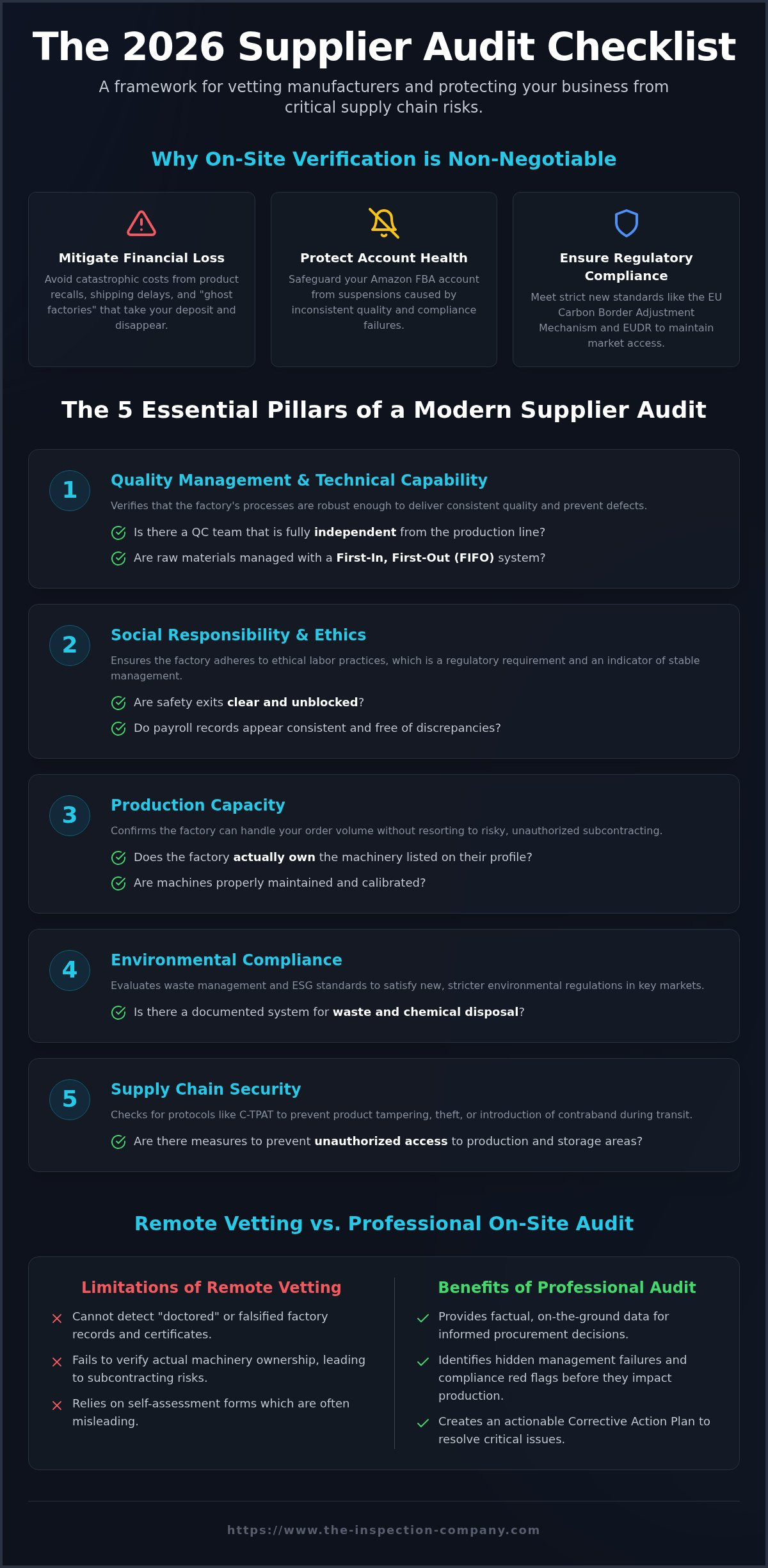
The 5 Essential Pillars of a Modern Supplier Audit Checklist
A modern supplier audit checklist must move beyond basic contact details. It must serve as a forensic tool to strengthen your supply chain against hidden vulnerabilities. In 2026, importers need transparency that remote vetting cannot provide. This verification prevents the common risk of "ghost factories" where a trading company poses as a manufacturer only to outsource your order to an unvetted, lower-quality facility.
Pillar 1: Quality Management and Technical Capability
One critical question to ask is: Does the factory have a dedicated QC team independent of the production line? If the staff producing the goods are also responsible for approving them, the risk of bias is unacceptably high. Inspectors must also verify raw material storage. Implementing First In, First Out (FIFO) protocols ensures that older materials don't degrade and compromise the final product's integrity. These technical details are the difference between a reliable partner and a costly mistake.
Pillar 2: Social Responsibility and Ethics
Social compliance is no longer a "nice to have" feature; it's a regulatory requirement. Auditors look for red flags like blocked safety exits, poor dormitory conditions, and inconsistent payroll records. These issues often signal deeper management failures that lead to production delays. You can find more details on how this differs from standard QC in our guide on factory audit vs. inspection.
The remaining pillars of a robust supplier audit checklist include:
- Production Capacity: Verifying the factory actually owns and maintains the machinery required for your order volume.
- Environmental Compliance: Evaluating waste management and ESG standards to meet 2026 EUDR requirements.
- Supply Chain Security: Checking C-TPAT standards to prevent transit tampering or unauthorized access.
If you have concerns about a specific manufacturer's legitimacy, you can consult with our regional experts for an on-site evaluation.
DIY Checklist vs. Professional Factory Audits: Bridging the Gap
A digital supplier audit checklist is a valuable starting point, but it cannot verify what you cannot physically see. While remote forms and software promise efficiency, they often fail to detect "doctored" records or staged production lines. Professional inspectors look beyond the paperwork to identify inconsistencies that a remote checklist would miss. A checklist is a map, but a professional inspector is the scout who walks the terrain.
Consider the return on investment for professional intervention. The cost of an audit is negligible compared to the financial catastrophe of a rejected container or a total product recall. High-stakes manufacturing requires more than just a signed document; it requires a formal quality agreement. Even outside the medical sector, the FDA guidance on quality agreements highlights how clearly defined responsibilities prevent costly operational failures.
When to Use a DIY Checklist
Use a DIY supplier audit checklist during the initial screening phase. It's an effective way to filter through dozens of potential leads on platforms like Alibaba. This tool helps you establish internal alignment on your brand’s "deal-breaker" criteria, such as specific ISO certifications or material requirements, before you invest in deeper due diligence.
When to Book a Professional Audit
Professional verification is essential before placing any order exceeding $10,000 or launching a new product line. If you're scaling production, you need boots on the ground to confirm that the factory's reality matches their digital profile. Booking TIC’s factory audit services provides the on-site verification needed to secure your investment and protect your Amazon account health.
Don't leave your supply chain to chance. Contact our team today to schedule a professional evaluation of your next manufacturing partner.
Turning Audit Results into Action: Your Path to a Risk-Free Supply Chain
A completed supplier audit checklist is merely a diagnostic tool. To secure your supply chain, you must translate these findings into a rigorous improvement strategy. Data without action is simply an overhead expense. High-performing importers use the audit report as a roadmap for supplier development rather than just a pass-fail test. This proactive approach ensures that your manufacturing partners grow alongside your business.
- Analyze the Findings: Distinguish between non-conformities. "Critical" issues involve legal or safety failures and often require immediate termination. "Major" non-conformities affect product functionality, while "Minor" issues are typically cosmetic.
- Issue a CAP: Don't accept vague promises of improvement. Issue a formal Corrective Action Plan (CAP) that includes specific remedial steps and hard deadlines. If a factory cannot commit to a timeline, they aren't a viable partner.
- Verify Implementation: On-site follow-up is non-negotiable. You must schedule a verification visit to ensure changes weren't just performed for the camera.
- Final Decision: Walking away from a risky supplier is often the most profitable decision you can make for your brand’s longevity.
How to Read a TIC Audit Report
TIC delivers comprehensive reports within 24 hours. These documents provide exhaustive photo evidence of factory conditions, equipment maintenance, and payroll records. This transparency allows you to make rapid, fact-based decisions without second-guessing the data. You can find further guidance on Mastering the Supplier Management Process to ensure your sourcing remains risk-free throughout 2026.
Managing Suppliers for Long-Term Growth
Shift your mindset from "checking" to "partnering" through regular annual audits. Consistency is the enemy of quality fade. While the initial supplier audit checklist establishes the baseline, Pre-Shipment Inspections maintain that standard for every individual order. This combination creates a bulletproof barrier against operational friction and protects your Amazon account health from inconsistent manufacturing standards.
Securing Your Manufacturing Future in 2026
Navigating the complexities of Asian manufacturing requires more than a digital form. While a comprehensive supplier audit checklist identifies potential red flags, true security comes from on-site verification and rigorous European management standards. You've learned that distinguishing between critical and minor non-conformities is essential for prioritizing risk. By converting audit findings into a formal Corrective Action Plan, you transform a simple inspection into a long-term partnership strategy.
With over 700 specialized inspectors across Asia and a 24-hour report turnaround, TIC provides the transparency you need to make high-stakes decisions with absolute certainty. Don't let quality fade or unauthorized subcontracting jeopardize your brand's reputation. Secure your supply chain; book a professional Factory Audit with TIC today. Take control of your production and build a resilient, risk-free supply chain for the years ahead.
Frequently Asked Questions
What are the most common red flags in a supplier audit?
Common red flags include unauthorized subcontracting, blocked fire exits, and inconsistent payroll records. Inconsistent production records or a lack of internal quality control independence also signal high risk. These indicators suggest the factory does not have full control over its quality or labor standards. Detecting these issues early prevents product recalls and financial loss, particularly when vetting manufacturers across diverse Asian manufacturing hubs.
Can I use a supplier audit checklist for Amazon FBA sourcing?
Yes, you can and should use a supplier audit checklist specifically tailored for Amazon FBA sourcing. Amazon’s strict account health requirements mean that even minor quality deviations can lead to listing suspensions. A professional audit ensures the factory understands FBA packaging and labeling standards. This preventative step minimizes the risk of customer returns and negative reviews that would otherwise damage your seller ranking and long-term profitability.
How long does a professional factory audit typically take?
A professional factory audit typically takes one full man-day to complete on-site. This timeframe allows the inspector to conduct a thorough walkthrough, interview staff, and review management documentation. Larger facilities or complex production lines may require additional time or multiple inspectors. After the site visit, TIC delivers a detailed report with photo evidence within a 24-hour window, enabling rapid decision-making for your procurement team.
What is the difference between an ISO certification and a factory audit?
An ISO certification is a third-party document proving a factory has a management system, while a factory audit is a real-time verification of those systems in practice. Many factories hold ISO 9001:2015 certificates but fail to follow the protocols during actual production. An on-site audit confirms the factory is currently operating to those standards. It bridges the gap between a paper claim and manufacturing reality.
Should I tell my supplier I am using a checklist before the audit?
Transparency is generally beneficial, so sharing your quality expectations and supplier audit checklist categories beforehand is recommended. This sets a clear standard for the partnership and allows the supplier to prepare necessary documentation. However, the specific on-site verification should remain an independent assessment. If a supplier refuses to cooperate with your audit requirements, it is often a sign of underlying transparency issues or potential "ghost factory" operations.