

What if the inspection meant to protect your shipment is influenced by the supplier it is supposed to assess? Pressure on inspectors, selectively presented goods, or unclear acceptance criteria can turn a quality check into a biased decision. A conflict of interest in quality control is not always obvious, but the consequences can be: approving nonconforming products and absorbing the costs after shipment.
A detailed report is useful only if the inspection behind it is impartial and based on agreed criteria. Importers need more than an assurance of independence. They need transparent procedures and objective evidence to support shipment decisions.
This article explains where bias can enter the QC process and how to reduce its influence. You’ll learn how to agree on acceptance criteria, assess finished lots, document inspection limits, and use independent inspection and timely, photo-backed reporting. We also cover safeguards such as inspection-body accreditation and documented anti-bribery controls. These measures strengthen accountability, though no single safeguard removes every risk.
Key Takeaways
- Consider whether competing interests could affect or appear to affect impartial judgment, without treating every commercial relationship as proof of bias.
- Identify where a conflict of interest in quality control could arise, and distinguish restricted access or incomplete information from evidence of misconduct.
- Strengthen inspection integrity by agreeing on acceptance criteria in advance, documenting scope, preserving evidence, and recording shipment decisions.
- Look for practical accountability safeguards, including ISO certifications and an inspector anti-bribery contract, while recognizing that no single measure removes every risk.
What Conflict of Interest in Quality Control Means for Importers
A conflict of interest in quality control exists when competing financial, personal, or operational interests could affect, or appear to affect, an inspector’s impartial judgment. For importers, this matters because inspection findings can inform whether goods are approved for shipment. A decision based on incomplete or biased evidence can leave the buyer facing nonconforming products after they have shipped.
The concern is not simply that people involved have commercial relationships. Buyers, suppliers, and inspection bodies naturally interact during a transaction. The key question is whether another interest could influence the assessment or undermine confidence in it. The general concept of a conflict of interest helps explain why both actual bias and the appearance of compromised judgment matter.
Who pays for an inspection, and who is being assessed?
A buyer may commission and pay for an independent inspection of goods made by a supplier. Payment alone does not prove that findings are biased: the inspection assesses products against agreed criteria, rather than simply favoring the party funding it. Still, payment can raise questions about perceived independence, especially when the inspection scope, criteria, or reporting process is unclear. Transparent procedures and documented evidence help show how the assessment was conducted.
How a QC conflict differs from a quality-process failure
Not every poor inspection or disputed result signals misconduct. A conflict involves competing interests that may distort judgment. A process failure can happen without anyone trying to influence the outcome. Unclear specifications, weak sampling, or inconsistent procedures can produce unreliable findings even when the inspector acts in good faith.
For example, an importer and supplier may disagree about whether a visible defect meets the agreed acceptance criteria. Review the specification, sample, and inspection records before drawing conclusions. The disagreement alone does not establish intentional bias. Separating process weaknesses from conflicts helps buyers identify the right corrective action and make shipment decisions based on documented evidence.
Where Conflicts Can Enter a Supplier Quality-Control Process
Risk can arise at several points, not just during the physical inspection. Booking arrangements and scope setting determine what will be checked. Factory access affects what the inspector can observe, sampling shapes which products are examined, and reporting determines how findings reach the buyer. Financial ties are one potential risk. Opaque procedures and gaps in evidence can also weaken confidence, even without proof of improper influence.
For example, a supplier may provide production figures or product records to help arrange an inspection. If access to certain areas or finished goods is restricted, the inspector may have less evidence than planned. That limitation does not prove bias, but it should be recorded so the buyer understands what the findings cover and what they do not.
Incentives, relationships, and pressure to alter findings
Repeat assignments, supplier hospitality, or pressure to meet a shipment deadline may create incentives or expectations that could affect judgment. They are not proof that an inspector acted improperly. They are reasons to follow clear conduct rules, document relevant interactions, and tie findings to observable evidence. A dated record can help the buyer understand what was inspected and when.
Scope, sampling, and reporting decisions
Vague acceptance criteria invite disputes: one person may consider a defect minor while another sees it as unacceptable. Before inspection, define the applicable specifications, defect categories, sampling approach, and decision thresholds. The ISO/IEC 17020 standard for inspection bodies provides a framework for inspection-body competence and impartiality. Applying pre-shipment inspection criteria consistently makes findings easier to review.
AQL sampling and acceptance limits help make lot decisions more consistent when agreed in advance. The report should explain the scope, sample examined, observations, and any access limitations. This lets buyers evaluate a possible conflict of interest in quality control alongside the inspection evidence, rather than infer bias from a disappointing result alone. The Inspection Company provides pre-shipment inspections to help buyers assess products against defined requirements. To plan an inspection around clear criteria, discuss your inspection requirements.
How Importers Can Reduce Conflict-of-Interest Risk in QC
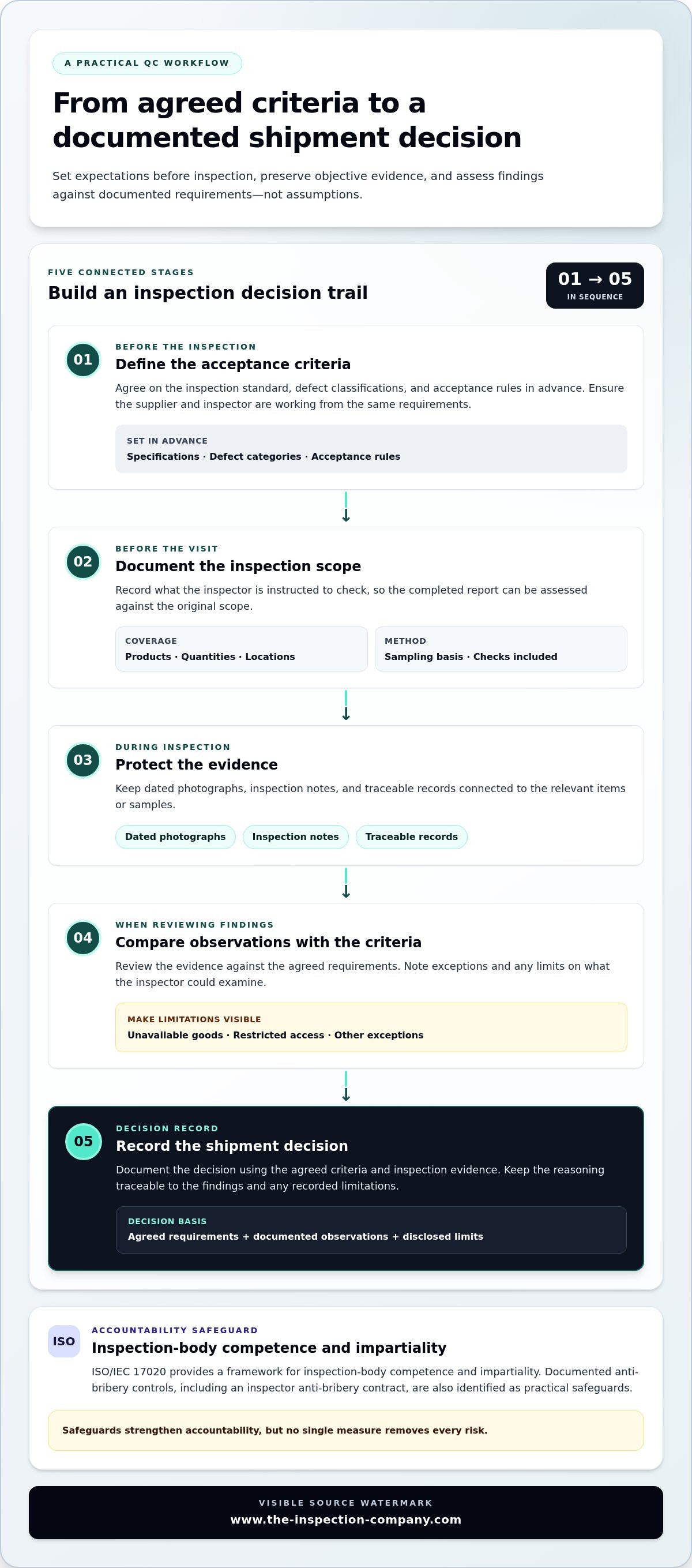
Good controls make it easier to see how an inspection decision was reached. To reduce conflict-of-interest risk in QC, set expectations before the visit, preserve evidence, and make shipment decisions against documented criteria rather than assumptions.
- Define criteria: Agree on the inspection standard, defect classifications, and acceptance rules before the inspection. Make sure the supplier and inspector are working from the same requirements.
- Document scope: Record the products, quantities, locations, sampling basis, and checks included, so the report can be assessed against the original instructions.
- Protect evidence: Keep dated photographs, inspection notes, and traceable records linked to the relevant items or samples.
- Review findings: Compare observations with the agreed criteria and note any exceptions, unavailable goods, or access limitations.
- Record decisions: Document the evidence considered and the reason for approving, holding, or rejecting the shipment.
A practical impartiality checklist for buyers
Before relying on a report, check that it states the scope, sampling basis, and acceptance rules. Look for evidence supporting each finding, consistent defect classifications, and records traceable to the inspected goods. Confirm that exceptions, restricted access, or disagreements over findings are recorded and reviewed. These checks help distinguish an evidence gap from suspected influence.
How independent inspection adds a separate evidence source
An independent inspector can provide an on-site account that complements supplier-provided information. The value is not simply having another party present. It is having findings documented against the buyer’s criteria, with evidence that can be reviewed before shipment approval. The Inspection Company’s product inspection services provide this separate inspection record. For anti-bribery risk controls, the U.S. Department of Justice provides guidance on Foreign Corrupt Practices Act compliance.
These safeguards reduce risk, but no checklist can guarantee an unbiased outcome in every case. Consistent records make decisions more transparent and concerns easier to assess. Discuss your inspection requirements to plan an evidence-based approach for your shipment.
How The Inspection Company Builds Accountability into Quality Control
Independence is stronger when supported by documented controls. The Inspection Company is ISO 9001:2015 certified and an ISO/IEC 17020 Accredited Type A Inspection Body. These credentials support a structured approach to inspection, while the company’s anti-bribery commitment adds a direct conduct safeguard: every inspector signs an anti-bribery contract after each inspection.
What documented safeguards can and cannot show
Credentials and formal commitments are meaningful indicators of a structured approach, not proof that every risk has disappeared or that a particular result is guaranteed. Consider them alongside the inspection’s documented scope, the evidence collected, and the clarity of the report. A clear record shows what was examined, which criteria were applied, and where limitations may affect the findings.
Connect impartial findings to shipment decisions
Timely reporting matters. The Quick Report is delivered on the inspection day, followed by a detailed, photo-backed report within the next 24 hours. This gives buyers a basis for reviewing defects against agreed acceptance criteria before deciding whether goods are ready to ship. A pre-shipment inspection documents product condition before shipment approval.
For importers concerned about a conflict of interest in quality control, visible evidence and transparent reporting make findings easier to assess, but no safeguard can eliminate every possibility of bias. The goal is a decision trail connecting the inspection scope, observations, and buyer’s shipment decision. That record replaces guesswork with documented information when the commercial stakes are high.
Talk with our inspection team about your inspection needs and the evidence required to support your shipment decision.
Make Inspection Integrity Part of Every Shipment Decision
Impartiality is not a box to tick after an inspection. Build it into your quality-control process before the next order is ready: agree on acceptance criteria, decide what evidence your team needs, and define how exceptions will be reviewed. This preparation gives everyone a clear basis for assessing findings and helps prevent uncertainty from driving a costly shipment decision.
Managing conflict of interest in quality control is an ongoing discipline, not a promise that every risk can be removed. The practical goal is to make decisions traceable, consistent, and grounded in evidence. Review your current inspection approach, identify where judgment or access could be unclear, and address those gaps before they affect approval.
For a clear next step, discuss your quality-control inspection needs with The Inspection Company. Set up an inspection process that gives your team documented findings to support its shipment decision.
Frequently Asked Questions
Is a conflict of interest in quality control always caused by who pays for the inspection?
No. Payment may create an actual or perceived competing interest, but it does not by itself show that findings were biased. A buyer can pay to assess supplier-produced goods, so the payer and the party being evaluated are not necessarily the same. To assess the risk, consider the full arrangement: who sets the criteria, what the inspector can access, how evidence is recorded, and how results are reported.
Can a third-party quality inspector be fully independent if the buyer pays them?
A buyer-funded inspection can offer a separate source of evidence from the supplier’s own account, but payment does not make bias impossible. Independence depends on more than who commissions the work. Clear acceptance criteria, documented procedures, findings supported by observations, and controls against improper influence all matter. For example, a report should explain why a sampled item failed rather than rely only on a general pass-or-fail statement.
How can importers identify a conflict of interest in a factory inspection?
Look for undisclosed relationships, pressure to change findings, an unclear scope, unexplained evidence gaps, or inconsistent use of agreed criteria. These are warning signs to investigate, not proof of misconduct on their own. Compare the report with the original inspection instructions and check whether the recorded sample, photographs, and limitations support the conclusions. A factual, specific review is more useful than assuming intent.
What happens if an inspection report appears biased or conflicts with the supplier's account?
Start by reviewing the agreed criteria and scope, then compare the report with photographs, defect classifications, sampling details, and any recorded access limits. A supplier may dispute a finding without the inspector being biased, so separate differences in fact or interpretation from allegations of influence. Write down the specific discrepancies and use the documented reporting process to clarify them before deciding whether to approve the shipment.
Does ISO/IEC 17020 accreditation guarantee that a quality inspection has no conflict of interest?
No. Accreditation is a meaningful credential, but it should not be treated as proof that every inspection is free of conflict or that every finding will be undisputed. Consider the accreditation scope relevant to the work, then assess the specific inspection’s criteria, evidence, and reporting. A credential provides context; the report still needs to show what was examined and how the conclusion follows from the recorded findings.