

What if the sample looked perfect, but the production line still turned out products that missed your specifications? A first article inspection helps answer a key question before mass production: can the factory’s actual tooling and process make the product to your approved requirements? A missed measurement or unclear specification can lead to defects, rework, or scrap across an order.
A supplier’s assurance is useful, but it isn’t a substitute for checking production output. This guide explains how to plan a first article inspection, compare an initial production unit with approved requirements, and record issues while they’re still manageable. You’ll learn what to verify, how to set acceptance criteria, and how to communicate technical requirements clearly with an overseas supplier.
We’ll also distinguish FAI from pre-shipment inspection, which checks a completed batch before shipping. The goal is to gather evidence about the production setup before defects can multiply.
Key Takeaways
- Use first article inspection to check initial production output against the approved drawing and specifications before authorizing the full run.
- Don’t rely on a handmade prototype alone. Check a unit made with the actual production tooling and process.
- Set FAI expectations in your purchase order, including which requirements and measurements to document and who approves the result.
- Keep inspection stages distinct: pre-production checks happen before the line starts, while pre-shipment inspection evaluates a completed batch before shipping.
What is First Article Inspection (FAI) and Why is it Critical?
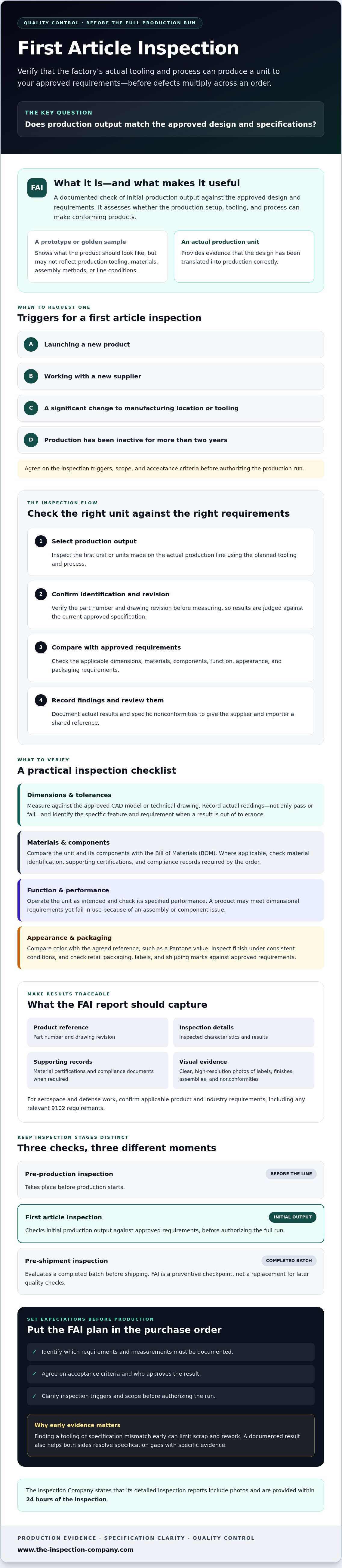
First article inspection (FAI) is a documented check of initial production output against the approved design and requirements. It looks beyond whether a unit appears acceptable: the purpose is to assess whether the production setup, tooling, and process can produce conforming products. As a high-level overview explains, First Article Inspection checks whether production output meets specified requirements.
FAI provides evidence that the factory has translated the design into production correctly. A golden sample or handmade prototype shows what a product should look like, but it may not reflect the production tooling, materials, assembly methods, or line conditions. Checking output from the actual process can reveal gaps between the approved design and production before those gaps affect more units.
Timing is important. A pre-production inspection takes place before the line starts, while FAI assesses initial output from the line. For a separate check before production begins, see the pre-production inspection process.
When Should You Request an FAI?
Plan an FAI when launching a new product or working with a new supplier. It can also be prudent after a significant change to the manufacturing location or tooling, because an earlier inspection record may no longer reflect current production conditions. A production lapse of more than two years is another common trigger for a full FAI. Agree on the triggers, inspection scope, and acceptance criteria before authorizing the run.
The Financial Case for FAI
Finding a tooling or specification mismatch early can limit scrap and rework before the issue spreads across an order. By contrast, discovering a systemic defect after a hypothetical 5,000-unit order has shipped could bring replacement, handling, and reputational costs. FAI is a preventive checkpoint, not a substitute for later quality checks. Its documented findings also give the supplier and importer a shared reference for resolving specification gaps.
The Step-by-Step First Article Inspection Process
A useful first article inspection starts by identifying the unit and confirming the correct requirements, then checks dimensions, materials, and function as applicable. Select the first unit or units made on the actual production line using the planned tooling and process. Before measuring, confirm the part number and drawing revision. Otherwise, even accurate measurements could be judged against an outdated specification.
- Measure against the drawing: Check specified dimensions and tolerances against the approved CAD model or technical drawing. Record actual readings, not just pass or fail, and identify the specific feature and requirement for any out-of-tolerance result.
- Verify materials and components: Compare the finished unit and its components with the Bill of Materials (BOM). Where applicable, check material identification and supporting certifications, and confirm any compliance records required by the order.
- Test function: Operate the unit as intended and check its specified performance. A product can meet dimensional requirements yet fail in use because of an assembly or component issue.
For aerospace and defense work, align inspection records with applicable requirements. The International Aerospace Quality Group maintains information on global quality standards, including the 9102 standard. Confirm the requirements that apply to your product and industry before production begins.
Documentation: The FAI Report
Create a traceable record that identifies the part number, drawing revision, inspected characteristics, and results. Attach material certifications and compliance documents when the specification or order requires them. Add clear, high-resolution photos of labels, finishes, assemblies, and any nonconformities. Photos and recorded results help both sides review specific findings instead of relying on vague descriptions.
Verifying Aesthetic and Packaging Specs
Compare color with the agreed reference, such as a Pantone value, and inspect finish quality under consistent conditions. Check retail packaging, labels, and shipping marks against approved requirements. For sellers preparing products for Amazon, an Amazon FBA inspection can help verify relevant product and packaging expectations. The Inspection Company provides detailed inspection reports with photos within 24 hours of the inspection, supporting a timely review of findings.
FAI vs. Pre-Production Inspection: Understanding the Difference
These checks take place at different stages and answer different questions. A pre-production inspection happens before the line starts and can review readiness, including raw materials, components, and production arrangements. A first article inspection checks the initial output from the line, focusing on the finished unit and whether the actual tooling and process produce it to specification. Quality Magazine’s overview of first article inspection provides further context on this production-stage verification.
Think of pre-production inspection as a check on inputs and readiness, and FAI as a check on production output. Checking materials before production won’t show whether a newly set-up tool creates an out-of-tolerance feature. Likewise, a conforming first unit doesn’t confirm that the correct materials were prepared for the run. A pre-production inspection can help assess readiness before manufacturing begins, while FAI provides evidence from the actual production process.
Can You Skip One if You Do the Other?
Not automatically. For complex mechanical or electronic products, assembly, tooling, or functional requirements may make FAI an important part of the quality plan. Confirm the scope with your supplier. For simple, low-risk goods with straightforward specifications and no critical production-dependent features, a pre-production inspection may be proportionate. Base the decision on product complexity, the impact of a defect, process changes, and customer requirements. Don’t treat the inspections as interchangeable.
How FAI Fits with PPAP
In automotive manufacturing, FAI principles can support the broader Production Part Approval Process (PPAP), but FAI and PPAP aren’t identical. FAI findings can contribute evidence about initial production output, while PPAP may require additional records and approvals. Once requirements are agreed, use relevant FAI criteria to inform later Pre-Shipment Inspections. To discuss which inspection checkpoints suit your production plan, contact the inspection team.
Implementing FAI in Your Asian Supply Chain
Set out the first article inspection requirements in the purchase order before production starts. Identify the approved drawing and revision, the characteristics to measure, any required material or compliance records, the photo evidence needed, and who can approve or reject the first unit. Define acceptance criteria in clear terms, such as the applicable dimension and tolerance, so the supplier and inspector can assess results consistently.
Agree on a review window as well. A detailed report with photos within 24 hours of the inspection can help you make a timely go or no-go decision while production is underway. The Inspection Company provides reports within 24 hours of inspection, giving importers a basis for reviewing findings promptly.
If the first article fails, don’t approve the run by default. Record each nonconformity, compare the result with the specified requirement, and ask the supplier to identify the cause and corrective action. Then decide whether the affected characteristics need to be rechecked before production continues. An on-site inspection can verify the unit against your criteria and provide evidence for that decision, rather than relying only on the factory’s self-check.
Working with Third-Party Inspectors
Independent verification gives you a separate view of the result, particularly when schedule pressure could affect the factory’s internal reporting. Before the inspection, provide the current drawing, relevant gauges or functional testers, and clear criteria for each check. The Inspection Company is based in Hong Kong with European management, and its inspectors operate across key Asian manufacturing hubs.
Securing Your 2026 Production Runs
Keep inspection records, photographs, and approval status together so everyone reviewing the result can refer to the same evidence. If you use a digital quality platform, confirm what it supports before relying on it for approvals. The priority is a clear, traceable decision, not technology for its own sake. Consistent FAI records also give you a reference for future production and help keep discussions with the supplier grounded in agreed requirements.
Compare the available inspection services to identify a suitable quality-control checkpoint for your production plan.
Protect Your Production Run Before It Scales
A first article inspection checks whether the actual production process can meet approved requirements, not just whether a prototype looks right. Verify key dimensions, materials, assembly, and function as applicable, then document the results before defects can spread through an order. Keep the stages clear: pre-production checks readiness before the line starts, while FAI examines initial production output.
Use the findings to make a clear go or no-go decision. If the unit fails, document the mismatch and resolve it with your supplier before approving continued production. The initial quality record can guide later checks and support more precise communication with the factory.
The Inspection Company provides quality control and product inspection services for businesses purchasing goods from Asia. Its team of more than 700 inspectors operates across key Asian manufacturing hubs, and detailed inspection reports with photos are provided within 24 hours of the inspection.
Make initial verification part of your production plan, not an afterthought. Discuss an inspection for your initial production output and make your next production decision with documented findings.
Frequently Asked Questions
Is First Article Inspection the same as a sample approval?
No. Sample approval usually confirms that a reference sample meets expectations, while a first article inspection checks a unit made using the actual production process. A handmade prototype may not reflect the production tooling, materials, or assembly methods. FAI documents whether the initial production output meets the approved requirements, providing evidence that a sample alone can’t.
How many units are typically checked during an FAI?
There’s no universal unit count. The inspection may cover one or more units, depending on product complexity, variations, customer requirements, and the agreed inspection plan. Select representative units from initial production output rather than relying only on a prototype made outside the line. Specify the quantity and any variant coverage in advance so the supplier and inspector share the same expectations.
What happens if the First Article fails the inspection?
If the first article fails, document each nonconformity and hold approval for mass production until the issue is reviewed. Ask the supplier to identify the cause, propose corrective action, and provide a corrected unit or evidence for reinspection. For example, a dimension outside the drawing tolerance may point to a tooling or setup issue. Clear records help the supplier address the problem before it affects more units.
How long does a typical First Article Inspection take to complete?
There’s no fixed completion time. The duration depends on the number and complexity of characteristics, access to the production unit, required functional tests, and documentation scope. Plan for onsite inspection separately from report turnaround. The Inspection Company provides detailed inspection reports with photos within 24 hours of the inspection, helping importers review findings promptly.
Does FAI apply to simple products like garments or only complex machinery?
FAI principles can apply to both simple and complex products, but the inspection scope should match the product and its risks. For garments, checks might cover measurements, construction, stitching, materials, color, and labeling against approved requirements. Complex machinery may need additional dimensional, component, and functional checks. In either case, the purpose is to assess whether production output meets the agreed specification.