

How much does a "passed" shipment actually cost you when your customers start returning the product? If you're struggling with high defect rates or constant friction with suppliers over what constitutes a fail, the problem isn't always the factory. Often, it's the documentation. Learning how to create a quality control checklist that functions as a strategic risk-management tool is the only way to protect your profit margins in 2026.
You've likely experienced the anxiety of reviewing a Pre-Shipment Inspection report that feels too vague to be actionable. We recognize that ambiguity in the field leads directly to operational friction and financial loss. This guide will help you master the industry-standard defect classification system, ensuring every inspector and supplier knows exactly where your tolerances lie. We'll examine how to categorize critical, major, and minor defects under the latest ISO 9001:2026 framework so you can make confident, data-driven decisions before you authorize that final payment.
Key Takeaways
- Establish a clear hierarchy by defining critical, major, and minor defects to eliminate ambiguity in your inspection reports and prevent costly safety recalls.
- Apply the Form, Fit, and Function (FFF) framework to objectively assess whether a defect impacts your product's branding, assembly, or core utility.
- Learn how to create a quality control checklist that serves as a strategic risk-management tool to protect your profit margins and brand reputation.
- Integrate defect classifications and AQL standards directly into your Purchase Orders to ensure supplier accountability before you authorize the final balance payment.
The Foundation of Your Checklist: The Three-Tier Defect System
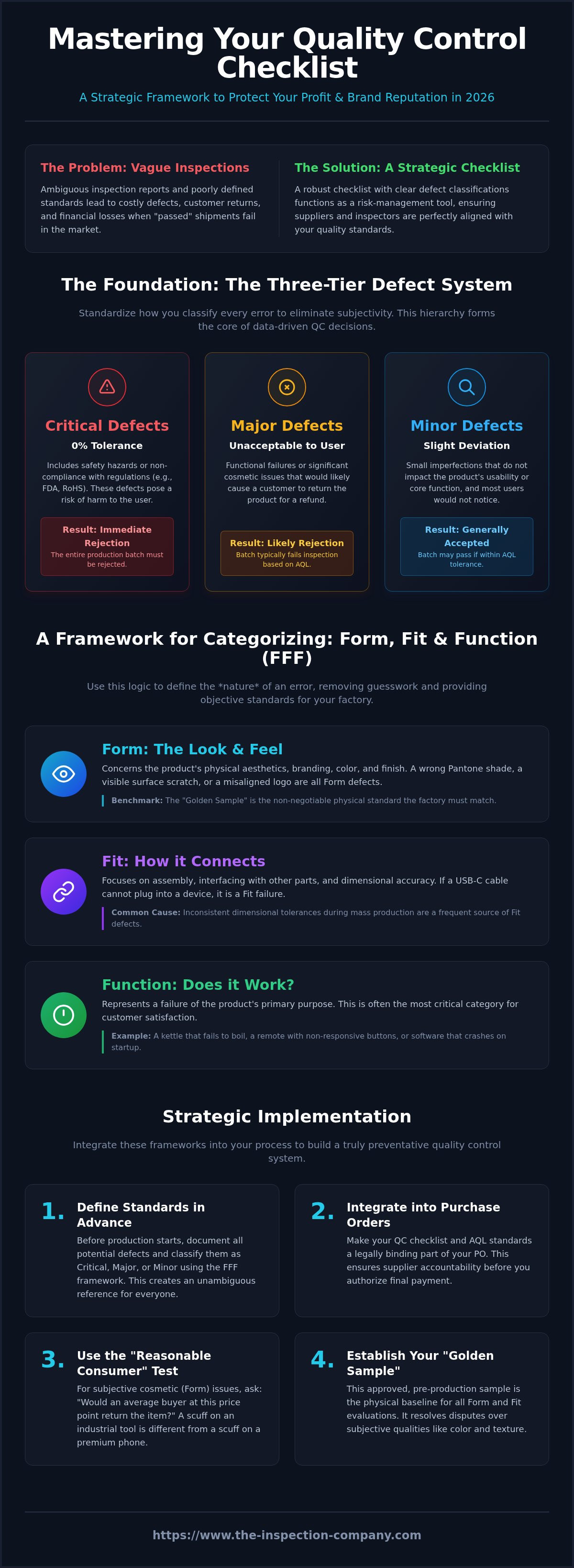
Quality control is more than a cursory glance at a finished product. It's a rigorous process of risk mitigation. When you're learning Quality control (QC) fundamentals, you'll find that subjectivity is your greatest enemy. Standardizing how you classify errors is the only way to ensure your factory and your inspection team are aligned. Without these definitions, a "pass" on paper can quickly turn into a "fail" in your customer's hands. A robust checklist utilizes three distinct tiers to categorize every possible error.
- Critical Defects: These represent the highest risk level. They include safety hazards that could cause harm to a user or non-compliance with legal regulations. A critical defect necessitates an immediate rejection of the entire batch.
- Major Defects: These are functional failures that prevent the product from working as intended or significant cosmetic issues that would cause a typical customer to return the item.
- Minor Defects: These are small deviations from specifications, such as a slight color mismatch or a tiny scratch. They don't impact usability but represent a lapse in production quality.
The Financial Impact of Defect Misclassification
Mislabeling a major defect as minor is a recipe for financial friction. If an inspector marks a broken hinge as a "minor cosmetic issue," you might authorize a shipment of unsellable goods. The cost of a product recall or mass returns far outweighs the preventative investment of a professional pre-shipment inspection. Accurate classification ensures you only pay for inventory that protects your brand reputation and your bottom line. Knowing how to create a quality control checklist with these clear boundaries allows for faster, more confident decision-making.
Regulatory Compliance and Critical Risks
Regulatory standards leave no room for error. For medical device importers, failing to meet the updated FDA QMSR standards effective as of February 2026 is an automatic Critical classification. Similarly, any failure regarding RoHS compliance must be categorized as Critical. These aren't just quality issues; they're legal liabilities. Effective safety testing identifies these hidden risks before they reach the port, allowing you to maintain total control over your supply chain. Knowing how to create a quality control checklist that prioritizes these tiers is essential for long-term operational security.
A Framework for Categorizing Defects: Form, Fit, and Function
While the three-tier system defines severity, the Form, Fit, and Function (FFF) framework defines the nature of the error itself. This logic is vital when determining how to create a quality control checklist that handles unexpected production variances without halting your entire supply chain. By categorizing flaws through this lens, you remove the guesswork from your inspection reports and provide your factory with clear, objective standards.
- Form: This concerns the physical aesthetics and branding. A wrong Pantone shade on a logo or a visible surface scratch falls here.
- Fit: This focuses on assembly and interface. If a USB-C cable cannot plug into a device due to a misaligned housing, it is a Fit failure.
- Function: This is the most critical category. It represents a failure of the product's primary purpose, such as a kettle that fails to boil or a remote control with non-responsive buttons.
Not every flaw is a clear-cut fail. We recommend using the "Reasonable Consumer" test for grey areas. Ask yourself: would an average buyer at your specific price point return the item or demand a discount? A minor scuff on the underside of a heavy industrial tool might be acceptable. That same scuff on a premium smartphone screen is a Major defect. Utilizing a quality control check sheet during the design phase helps you map these expectations before mass production begins.
Form vs. Function: Setting the Baseline
Your "Golden Sample" is the non-negotiable baseline for all Form evaluations. It is the physical manifestation of your specifications that the factory must match. Without it, a manufacturer might argue that a "near-enough" color match is acceptable. When a cosmetic Form issue crosses the line into a Major defect, it is usually because the flaw damages the perceived value of your brand or suggests poor internal build quality to the end user.
The Fit Test for Electronics and Hardlines
In mass production, dimensional tolerances are often the source of Fit defects. Parts that seem fine individually may not assemble correctly when combined. Implementing a during production inspection is the best way to catch these issues while the factory can still rectify the process. It is a proactive step that prevents a warehouse full of incompatible components. If you are refining your specifications, you can consult with our technical team to ensure your dimensional tolerances are realistic for your chosen manufacturing process.
Industry-Specific Examples for Your Quality Control Checklist
A generic template won't protect your brand. When you're determining how to create a quality control checklist, you must tailor your criteria to the specific risks of your product category. A defect's severity is never static; it's defined by the item's purpose and the user's expectations. For instance, a superficial scratch on a heavy-duty industrial wrench is a minor cosmetic issue. That same scratch on a high-end tablet screen is a major functional failure that triggers an immediate return. Defect severity must be evaluated relative to the product's retail price point and the specific quality expectations of your target market.
Utilizing detailed inspection checklists ensures your inspectors know exactly what to look for during a site visit. This level of specificity removes the "grey areas" that often lead to disputes with suppliers over whether a batch should pass or fail.
Softlines and Textiles Checkpoints
- Minor Defects: These include loose threads that can be easily trimmed, slight color shading variations between panels, or small oil stains in inconspicuous areas like an internal hem.
- Major Defects: Open seams, holes in the fabric, incorrect sizing that falls outside your stated tolerance, or broken needles left embedded in garments represent significant failures that make the product unsellable.
Electronics and Hardlines Checkpoints
- Minor Defects: Superficial scratches on non-viewing surfaces, slight packaging scuffs, or minor font alignment issues on a secondary instruction label are typically tolerated in small quantities.
- Major Defects: Non-functioning buttons, battery failure, or sharp edges on a children’s toy are critical failures. These issues directly impact the product's utility or the end user's safety.
Developing these lists requires a deep understanding of manufacturing limitations. If you're unsure where to set your tolerances or need a professional assessment of your current standards, contact our regional managers to discuss your specific product requirements. Learning how to create a quality control checklist with these industry-specific nuances is a preventative investment that secures your long-term profitability.
Implementing Your Checklist: Negotiating with Asian Factories
A checklist is only as effective as the contract that supports it. To ensure supplier accountability, you must append your defect classifications as a formal annex to your Purchase Order (PO). This step ensures the factory cannot claim ignorance regarding your specific standards. Integrating AQL (Acceptable Quality Limit) standards directly with your defect tiers provides a mathematical threshold for acceptance. It's the most objective way to quantify risk and decide whether to authorize the final balance payment.
Accountability also requires a clear "Rework and Sorting" clause. If a batch fails, your agreement should define who bears the cost of sorting the goods and the subsequent re-inspection. High-stakes international trade demands this level of precision. Maintaining transparency throughout the supplier management process discourages factories from hiding flaws or cutting corners. When a manufacturer knows your standards are enforceable and your inspections are rigorous, they're more likely to prioritize your quality requirements during the production cycle.
The Role of the Digital Inspection Report
Modern quality management relies on data, not just intuition. Utilizing the TIC Quality Platform allows you to review digital reports within 24 hours of an inspection. You aren't just looking at a simple pass or fail; you're identifying trends in defect types over time. If you notice a consistent rise in minor defects, you can use this data as leverage to negotiate unit discounts or secure free replacements in future orders. This proactive approach turns your inspection reports into a tool for continuous financial recovery.
Closing the Loop: Corrective Action Plans
Finding a defect is only half the battle. You must close the loop by implementing a Corrective Action Plan (CAP) to prevent the issue from recurring. If a specific defect repeats across multiple shipments, it points to a systemic failure in the factory's equipment or training. We often recommend a professional factory audit to identify and rectify these root causes. Mastering how to create a quality control checklist is the foundation of your strategy, but enforcing it through CAPs and audits is how you secure your long-term profit margins.
Securing Your Supply Chain Through Precision Documentation
A well-defined defect classification system is your strongest defense against financial loss and operational friction. By mastering how to create a quality control checklist that integrates the three-tier severity system and the Form, Fit, and Function framework, you remove the ambiguity that often leads to passed shipments of unsellable goods. These standards aren't just guidelines; they're enforceable benchmarks that protect your profit margins and brand reputation when you codify them into your supplier agreements.
The Inspection Company (TIC) provides the local expertise and European management necessary to enforce these standards across Asia. With over 700 expert inspectors on the ground and detailed reports delivered within 24 hours, we turn your checklist into an actionable reality. This proactive oversight ensures you make informed decisions before the final balance is paid. Secure your next shipment with a professional Pre-Shipment Inspection. Don't leave your product quality to chance when you can have total control over your results.
Frequently Asked Questions
What is the difference between a critical and a major defect?
A critical defect involves a safety hazard or a breach of mandatory regulations that risks legal action or a total product recall. In contrast, a major defect is a functional failure or a significant aesthetic issue that makes the product unsellable or likely to be returned by a customer. While both are serious, a critical defect represents an immediate threat to the user or your business's legal standing.
Can a product with minor defects still be sold on Amazon?
Yes, products with minor defects can typically be sold on Amazon, provided they don't violate the platform's strict condition guidelines. However, you must monitor your return rates and customer feedback closely. If minor defects like small surface scuffs or loose threads become a recurring theme in reviews, Amazon may suppress your listing. Professional Amazon FBA Service inspections help you filter these out before they reach the warehouse.
How many minor defects are allowed in a standard AQL 2.5/4.0 inspection?
The number of allowed minor defects depends entirely on your total lot size and the corresponding sample size as defined by the AQL tables. For example, in a lot of 3,200 units with a General Inspection Level II, the sample size is 125 units. Under an AQL of 4.0 for minor defects, the batch passes if 10 or fewer defects are found but fails if 11 are detected.
What happens if an inspection report shows a single critical defect?
A single critical defect results in an automatic "Fail" for the entire shipment, regardless of how many other units passed. In the context of how to create a quality control checklist, your tolerance for critical defects should always be zero. Finding even one safety hazard, such as an exposed wire or a sharp edge, necessitates a full stop of the shipment and a mandatory 100% sorting of the batch.
How do I define quality standards if I don’t have a physical sample?
If you lack a physical sample, you must rely on high-resolution CAD drawings, detailed technical specification sheets, and digital "Golden Images." You should clearly define your tolerances for color, dimensions, and materials in writing. Learning how to create a quality control checklist without a physical reference requires even greater precision in your documentation to ensure the factory understands your non-negotiable requirements before production begins.