
Manufacturing defects aren't just production errors; they're the symptoms of a failed communication and oversight framework between an importer and the factory. If you're struggling with how to prevent manufacturing defects while managing overseas partners, you've likely felt the financial drain of paying for inventory that arrives unsellable. When customer returns spike and your brand's reputation takes a hit, the lack of visibility into your production lines becomes a critical liability that you can't afford to ignore.
This guide provides the strategic blueprint you need to regain control of your supply chain. We'll show you how to implement rigorous inspection protocols that eliminate errors at the source, protecting your bottom line from operational friction. We'll also examine the 2026 regulatory landscape, including the new ISO 9001:2026 standards and AI-driven detection tools that now reach up to 99% accuracy. By following these frameworks, you'll establish a repeatable quality assurance system that ensures confidence in every shipment before you authorize the final payment.
Key Takeaways
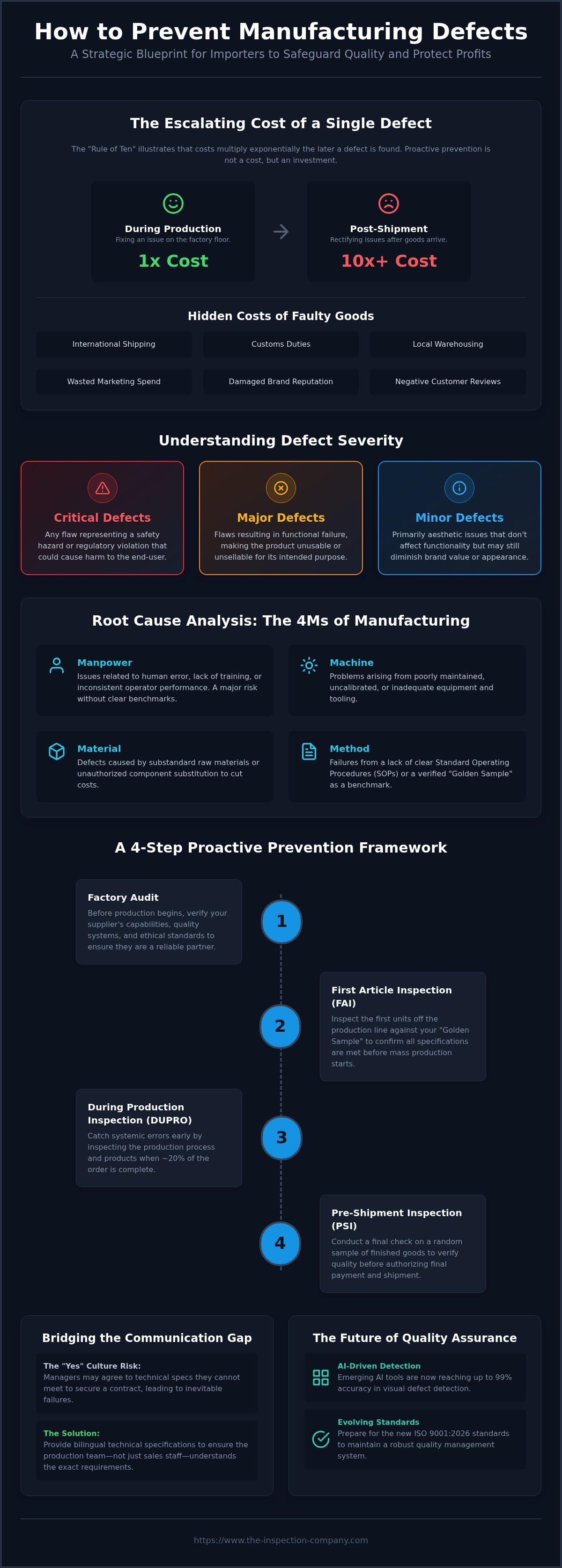
- Establish clear quality benchmarks by categorizing deviations into Critical, Major, and Minor tiers to ensure your factory understands non-negotiable standards.
- Analyze the "4Ms" of manufacturing—Material, Machine, Manpower, and Method—to identify root causes and prevent issues like unauthorized material substitution.
- Master how to prevent manufacturing defects by implementing a strategic oversight framework that begins with comprehensive Factory Audits and First Article Inspections.
- Reduce the risk of mass production failures by utilizing During Production Inspections (DUPRO) to catch errors when only 20% of the order is finished.
- Secure your brand equity and bottom line by shifting from reactive defect detection to a proactive, multi-stage prevention investment.
Understanding Manufacturing Defects: Definitions and Business Impact
A Product defect is any deviation from the rigorous standards established in your agreed-upon Product Specification Sheet. In the context of international trade, these flaws represent more than just production errors; they're financial liabilities that erode your margin. Understanding how to prevent manufacturing defects starts with a clear classification of failure points within your production run.
Industry standards typically categorize these deviations into three distinct levels of severity:
- Critical Defects: These represent the highest risk level, involving safety hazards or regulatory violations.
- Major Defects: These flaws result in functional failure, making the product unusable or unsellable for its intended purpose.
- Minor Defects: These are primarily aesthetic issues that don't affect functionality but may still diminish brand value.
A Critical Defect is any flaw that could cause harm to the end-user or result in legal non-compliance. Identifying these early is vital for risk mitigation.
Effective quality management relies on the "Rule of Ten." This principle states that catching a defect during the production phase is ten times cheaper than discovering it after the goods have been shipped. Once a product leaves the factory floor, the costs of rectification skyrocket as you lose leverage over the supplier.
The True Cost of Poor Quality Control
The unit price of a defective item is only the surface of the loss. When you import faulty goods, you've already sunk capital into international shipping, customs duties, and local warehousing. These costs are non-refundable, even if the inventory is unsellable. Additionally, every defective unit represents wasted marketing spend that failed to convert into a satisfied, repeat customer.
For e-commerce brands, the stakes are even higher. High return rates and negative reviews directly damage your Amazon Seller Central health. This leads to suppressed listings, lower marketplace rankings, and potential account suspension. To protect your digital presence, you can find a deeper dive in our guide on Understanding Product Defects. Implementing these definitions into your quality manual is the first step in learning how to prevent manufacturing defects effectively.
Root Cause Analysis: Why Defects Occur in Asian Manufacturing
To master how to prevent manufacturing defects, you must first identify the systemic failures that create them. Using a professional Root Cause Analysis allows importers to look past the surface of a broken product to the underlying manufacturing variables. Defects are rarely random; they're usually the result of a breakdown in one of the "4Ms" of manufacturing: Material, Machine, Manpower, or Method.
Material substitution is a particularly common risk in Asian regional hubs. Factories might swap specified high-grade components for sub-standard raw materials to preserve their margins, leading to unexpected failures during stress tests. Consistency also requires a defined Method. Without clear Standard Operating Procedures (SOPs) and a verified "Golden Sample," floor-level operators don't have a definitive benchmark for quality. Environmental factors like high humidity or extreme temperatures can also compromise production if the facility lacks proper climate control for sensitive electronics or adhesives.
Communication Gaps and Cultural Nuances
The "Yes" culture often complicates oversight. Many factory managers agree to technical specifications they can't actually meet to avoid a perceived loss of face or to secure the contract. You can mitigate this by providing bilingual technical specifications. This ensures that the production team, not just the English-speaking sales staff, understands the exact requirements. Clear communication is the foundation of any strategy focused on how to prevent manufacturing defects.
Inadequate In-House Quality Management
Relying on a factory's internal QC team is a significant risk. Their priority is production speed and meeting shipping deadlines, which creates a direct conflict of interest with product accuracy. Self-inspection rarely uncovers systemic flaws because the inspectors are incentivized to keep the line moving. If you're concerned about your current supplier's internal standards, contact our regional experts to discuss an independent assessment of your production line.
A 4-Step Prevention Strategy for Importers
Relying on a factory's promise of quality is a high-stakes gamble that often results in financial loss. To master how to prevent manufacturing defects from a distance, you must implement a structured oversight framework that influences the production cycle at every milestone. This proactive approach shifts the burden of quality back onto the manufacturer before the goods ever reach a shipping container.
- Step 1: Supplier Vetting. Conduct a comprehensive Factory Audit to verify a supplier's technical capability. This process ensures the facility adheres to fundamental Good Manufacturing Practice (GMP) regulations and has the machinery necessary to meet your tolerances.
- Step 2: First Article Inspection. Never allow mass production to proceed without a First Article Inspection (FAI). Verifying the first units off the line confirms that the factory's setup is accurate.
- Step 3: Contractual AQL. Establish Acceptable Quality Limits (AQL) as a non-negotiable contractual requirement. This defines the maximum number of defects allowed before a batch is rejected.
- Step 4: Data Feedback Loops. Use the data from every inspection report to identify recurring flaws. Sharing this data with your factory allows them to adjust their methods and prevents the same errors from appearing in future runs.
The Power of the Golden Sample
A Golden Sample is your most effective tool for eliminating subjective quality disputes. This reference sample should be produced by the factory, approved by you, and then sealed by your third-party inspection company. During subsequent inspections, the inspector compares mass-produced units directly against this sealed sample. This physical benchmark removes any ambiguity regarding color, texture, or finish, providing a clear path for how to prevent manufacturing defects caused by "interpretation" errors.
Contractual Quality Terms
Your Purchase Order (PO) must be more than a price agreement; it's a quality contract. Integrate specific penalty clauses for failed inspections to ensure the factory has "skin in the game." By using standardized AQL standards, you provide a transparent, industry-recognized metric for what constitutes a failed batch. This clarity prevents the factory from pressuring you to accept sub-standard goods. To secure your next production run with these rigorous standards, book a consultation with our quality team.
Mitigating Risk with Third-Party Inspections
Third-party inspections act as the final execution layer of your quality strategy. While previous sections discussed root causes and planning, these on-site interventions provide the visibility you need to understand how to prevent manufacturing defects in real-time. By deploying inspectors at various stages, you create multiple fail-safe points that protect your capital and ensure your factory remains accountable to your specifications.
- Pre-Production Inspection: This stage focuses on verifying raw materials and components before the machines start. It's your first defense against material substitution.
- During Production Inspection (DUPRO): DUPRO is a critical tool for how to prevent manufacturing defects at scale. It allows you to catch systemic errors when only 20% of the order is finished, preventing a small mistake from ruining the entire batch.
- Pre-Shipment Inspection (PSI): As the final gatekeeper, the PSI verifies that the finished goods meet all AQL standards before you authorize the balance payment.
- Container Loading Supervision: This ensures your goods are packed correctly to prevent transit damage and verifies that the quantity being shipped matches your invoice exactly.
Why Third-Party Oversight Beats Internal QC
Unbiased reporting is the primary advantage of external oversight. Unlike factory-internal QC teams, independent inspectors work exclusively for the buyer. This eliminates the conflict of interest where production speed is often prioritized over product accuracy. You receive digital reports within 24 hours, complete with photo and video evidence, allowing for immediate corrective actions if a deviation is found. You can explore our full range of Quality Inspection Services to find the right fit for your specific product category.
Selecting the Right Inspection Partner in Asia
Selecting the right partner requires a balance of international standards and local presence. Look for an organization that maintains ISO 17020 accreditation, which is the global benchmark for inspection body competence. Combining European management standards with over 700 professional inspectors across Asian hubs ensures that your quality manual is interpreted correctly on the factory floor. This blend of expertise is essential for navigating the 2026 regulatory landscape and maintaining a repeatable system for quality assurance. Book your inspection today to secure your 2026 production runs and gain confidence in your shipment quality before final payment.
Securing Your 2026 Production Standards
Mastering how to prevent manufacturing defects requires a fundamental shift in your procurement strategy. Quality isn't a final check. It's a series of proactive investments that forestall massive financial losses. By integrating multi-stage inspections like DUPRO and PSI into your supply chain, you replace uncertainty with verifiable data. This methodical approach ensures your factory remains accountable from the first article to final container loading.
The Inspection Company offers a localized presence backed by European management standards. Our network of over 700 professional inspectors delivers detailed digital reports within 24 hours. This provides the transparency you need for critical decision-making. Global brands and Amazon FBA sellers rely on this meticulous oversight to protect their brand equity. Protect your supply chain—get a professional inspection quote now. With the right quality framework in place, you can eliminate the anxiety of overseas production and grow your brand with total confidence.
Frequently Asked Questions
How do you identify manufacturing defects early?
Identifying defects early requires a multi-stage oversight strategy rather than a single end-of-line check. You can achieve this by implementing a First Article Inspection (FAI) to verify initial units and a During Production Inspection (DUPRO) once 20% of the run is finished. These milestones allow you to spot systemic errors before they affect the entire batch. It's the most effective way to understand how to prevent manufacturing defects at scale.
What are the most common causes of manufacturing defects in Asia?
Most defects stem from breakdowns in the "4Ms": Material, Machine, Manpower, and Method. In Asian manufacturing hubs, material substitution is a frequent root cause where factories swap specified components for cheaper alternatives. Lack of standardized operating procedures and inadequate machinery maintenance also contribute significantly. Without a sealed Golden Sample to guide production, floor-level operators often lack the clarity needed to maintain consistent quality standards.
Can a Pre-Shipment Inspection (PSI) completely prevent defects?
A Pre-Shipment Inspection (PSI) acts as a final gatekeeper rather than a prevention tool. While it effectively identifies defects before goods leave the factory, it happens too late to stop them from occurring. To truly master how to prevent manufacturing defects, you must move further up the production timeline. PSI ensures you don't pay for sub-standard inventory, but earlier inspections like DUPRO actually stop the errors from being replicated across the entire order.
What is the difference between a major and a minor defect?
The distinction lies in functionality and marketability. A major defect involves a functional failure that makes the product unusable or unsellable for its intended purpose. Conversely, a minor defect is typically an aesthetic deviation, such as a small scratch or color variance, that doesn't affect performance but might diminish brand value. Critical defects, the most severe tier, involve safety hazards or legal non-compliance that could result in consumer harm or product recalls.
How much does a third-party inspection service typically cost?
The cost of third-party inspection services depends on several variables, including the factory's geographic location, product complexity, and the required man-days. Professional firms typically charge a flat daily rate per inspector. It's best to view these fees as a preventative investment. Spending a small percentage of your total order value on oversight can forestall much larger financial losses resulting from unsellable inventory, shipping fees for returns, and brand damage.
What should I do if my inspection report shows a failed result?
If your report shows a failed result, you should immediately halt the final balance payment to the supplier. Use the detailed photo and video evidence provided in the 24-hour report to negotiate a corrective action plan. This usually involves the factory performing a full product sorting to remove defective units or reworking the batch at their own expense. A failed report is your strongest leverage to ensure the final shipment meets your agreed-upon standards.