

A single shipment of unsellable inventory can erase an entire year's profit margin in the time it takes to unload a container. With the new EU Product Liability Directive taking effect on December 9, 2026, the financial and legal stakes for quality failures have reached a critical point. You've likely felt the anxiety of finding manufacturing defect examples like structural flaws or contamination that lead to warehouse rejections and negative reviews. It's a frustrating reality for many importers, but these issues are preventable operational failures that you can catch before the title transfers.
This guide provides the strategic framework you need to identify and eliminate defects at the source. You'll learn how to establish clear quality standards for supplier contracts and implement methodical inspection processes that ensure zero critical defects reach your customers. We'll examine 2026 recall trends and explore how the upcoming ISO 9001:2026 update impacts your quality management systems. By the end, you'll have a roadmap to protect your brand reputation and bottom line through proactive, fact based risk mitigation.
Key Takeaways
- Understand how to classify defects into Critical, Major, and Minor categories using the AQL standard to make data-driven shipping decisions.
- Learn to distinguish between design, marketing, and manufacturing defect examples to identify whether problems originate in the blueprint or on the assembly line.
- Discover how Factory Audits and robust Quality Management Systems (QMS) mitigate legal risks under the new 2026 product liability regulations.
- Implement Pre-Shipment Inspections (PSI) as a strategic gatekeeper to catch quality failures before final payment and title transfer.
What are Product Defects? Defining Quality Risks in the Supply Chain
A Product defect is any deviation from the specified requirements or consumer expectations that impacts safety, function, or appearance. In the high stakes environment of international trade, a product defect is a failure to meet predefined quality standards, safety regulations, or functional requirements. These issues rarely occur in isolation. Instead, they stem from systemic failures within the production cycle.
Common manufacturing defect examples arise from three primary sources:
- Raw material inconsistencies: Using substandard or unverified components that fail under stress.
- Poor workmanship: Human error during assembly or inadequate training on the factory floor.
- Environmental factors: Humidity or temperature fluctuations during mass production that compromise material integrity.
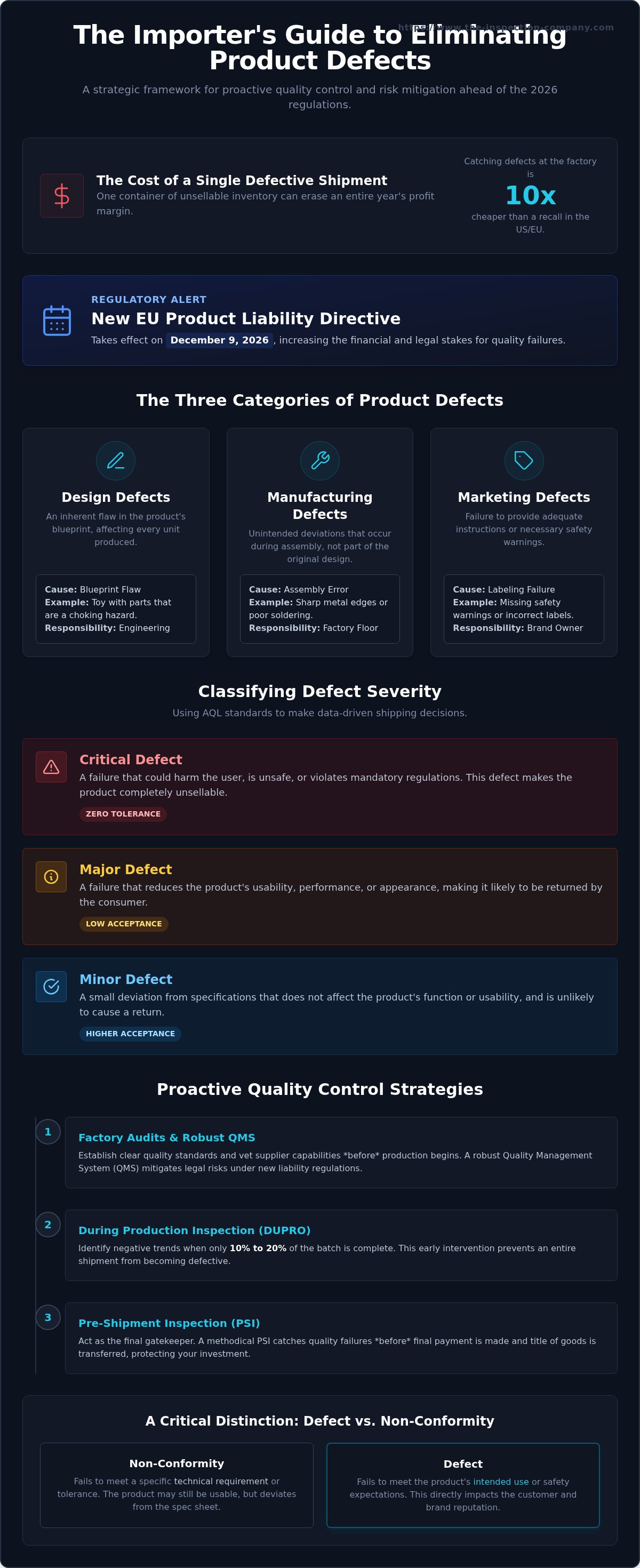
Catching these errors early is a critical financial strategy. Industry data suggests that identifying a defect at the factory gate in Asia costs approximately ten times less than managing a full scale product recall in Europe or the US. When goods reach your warehouse, the window for cost effective correction has already closed. You're then left with unsellable inventory and potential legal liabilities.
Defect vs. Non-Conformity: A Critical Distinction
Understanding the difference between a defect and a non-conformity is essential for an effective supplier management process. A non-conformity occurs when a product fails to meet a specific technical requirement or tolerance. While it's an error, it doesn't always render the product unusable. In contrast, a defect is a failure to meet the product's intended use or safety expectations. Distinguishing between these manufacturing defect examples allows you to prioritize critical risks over minor aesthetic deviations, ensuring your quality control resources are deployed where they protect your brand most.
The Three Categories of Product Defects: Design, Manufacturing, and Marketing
To mitigate risk effectively, you must understand exactly where a failure originates. Product errors are generally categorized into design, manufacturing, and marketing defects. While design defects are inherent in the blueprint and affect every unit produced, manufacturing defects are unintended deviations that occur during the assembly stage. Marketing defects involve failures in providing adequate instructions or essential safety warnings. Analyzing manufacturing defect examples across these categories helps you assign accountability and implement the correct corrective actions.
| Category | Primary Cause | Real-World Example | Responsibility |
|---|---|---|---|
| Design | Blueprint flaw | Toy with choking hazard | Engineering |
| Manufacturing | Assembly error | Sharp metal edges | Factory Floor |
| Marketing | Labeling failure | Missing safety warnings | Brand Owner |
Manufacturing Defect Examples in Mass Production
Mass production often introduces variability that deviates from the approved golden sample. Common manufacturing defect examples include poor soldering in electronics, incorrect color matching in textiles, or structural weaknesses in plastic molding. These issues don't just affect aesthetics; they compromise the fundamental safety of the product. Implementing a During Production Inspection (DUPRO) allows you to identify these negative trends when only 10% to 20% of the batch is finished. This proactive step prevents the entire shipment from becoming unsellable inventory.
Marketing Defects and Regulatory Compliance
Marketing defects are frequently overlooked but carry significant legal weight and operational risk. For Amazon FBA sellers, missing safety warnings or incorrect packaging labels can lead to immediate account suspension or costly warehouse rejections. Compliance is not optional in 2026. Ensuring RoHS compliance in your labeling and material safety is vital for entering regulated markets. If you're concerned about your current batch's compliance, you should speak with a quality expert to secure your supply chain.
Classifying Severity: Critical, Major, and Minor Defects
Professional quality management relies on the AQL (Acceptable Quality Limit) standard. This statistical tool allows inspectors to evaluate a production batch without checking every single unit by using a mathematically proven sampling plan. By categorizing manufacturing defect examples by severity, you can make objective pass or fail decisions based on data rather than gut feeling.
Defects are typically classified into three distinct levels to prioritize risk mitigation:
- Critical Defects: These pose a safety risk or violate mandatory regulations. Manufacturing defect examples at this level include exposed wiring, lead paint contamination, or sharp metal edges. Most importers maintain a zero tolerance policy for these.
- Major Defects: These are functional failures that render the product unsellable. For instance, a coffee maker that won't turn on or a garment with a missing sleeve. These lead to high return rates and immediate financial loss.
- Minor Defects: These represent aesthetic deviations that don't impact function. Think of small scratches or slight color variations. While they won't trigger a recall, they can damage brand trust over time if they become a trend.
How Many Defects are 'Acceptable'?
The AQL sampling plan determines the maximum number of defects allowed before a batch is rejected. Professional inspectors use these levels to define the boundary between acceptable quality and operational risk. Implementing proactive quality control strategies means setting these thresholds long before production begins. You must embed these requirements into a detailed inspection checklist to hold your supplier accountable. Without clear standards, you have no leverage when a shipment arrives with quality issues. If you're unsure which AQL levels suit your product, contact our technical team today to define your quality standards.
How to Prevent Product Defects: Proactive Quality Control Strategies
Prevention is your most effective defense against financial loss. While legal guides focus on litigation after damage occurs, a proactive strategy stops issues at the factory gate. A Pre-Shipment Inspection (PSI) acts as a final gatekeeper. It identifies manufacturing defect examples like structural flaws or functional failures before you release final payment. Utilizing professional China inspection services provides the localized expertise needed to navigate complex production environments. Third-party inspection is the only reliable way to verify quality before title transfer.
Implementing a Zero-Defect Culture
Quality starts long before the assembly line moves. A Factory Audit confirms your supplier possesses a robust Quality Management System (QMS) capable of meeting your standards. To set a clear benchmark, conduct a First Article Inspection (FAI) at the start of the production cycle. This ensures the first unit off the line matches your specifications perfectly. By communicating strict AQL limits early, you establish a culture of accountability that discourages the shipment of substandard goods.
Digital Transparency and Real-Time Data
Speed is essential in global trade. Modern digital platforms deliver detailed reports with photo evidence within 24 hours of the inspection. This transparency allows you to make informed "go/no-go" decisions without delay. You shouldn't rely on the supplier's word when manufacturing defect examples can be documented and verified independently. Over time, this historical data becomes a powerful tool for vetting future suppliers and building a more resilient supply chain. This methodical approach transforms quality control from a cost center into a strategic investment.
Protecting Your Brand through Strategic Quality Management
Managing a global supply chain requires more than just trust; it demands a methodical approach to risk mitigation. By classifying manufacturing defect examples and implementing the AQL standards discussed, you shift from reactive damage control to proactive brand protection. Success in 2026 depends on identifying vulnerabilities before goods leave the factory floor through rigorous, independent inspection protocols.
The Inspection Company provides the essential oversight needed to secure your operations. With European management and over 700 expert inspectors across Asia, we act as your reliable partner for high stakes quality management. You'll receive detailed photo reports within 24 hours, providing the transparency required to make "go or no-go" decisions with total confidence. Preventing even one bad shipment pays for the entire investment in quality control.
Secure your supply chain and prevent costly defects: Contact our experts today. We're here to help you maintain clear standards and achieve the zero-defect results your brand deserves.
Frequently Asked Questions
What is the most common cause of manufacturing defects?
Human error and process variability are the primary drivers of quality failures. This includes inadequate worker training, fatigue, or the use of uncalibrated machinery on the production line. In mass production, even small fluctuations in the factory environment, such as humidity levels or power surges, can lead to widespread failures. Identifying these manufacturing defect examples early through during-production checks prevents these systemic errors from compromising an entire batch.
Can a product have a design defect even if it meets all manufacturing specs?
Yes, a design defect exists when the product is inherently dangerous or flawed despite being built exactly as intended. If the blueprint itself contains a safety hazard, every unit coming off the assembly line is defective. While manufacturing errors are deviations from the plan, design flaws are errors within the plan. You should use sample testing to verify design integrity before committing to full scale mass production runs.
How do I hold my supplier accountable for defects found after shipping?
Accountability is difficult once the final payment is made and the goods have left the port. Your strongest leverage is a clear quality agreement in the initial contract that references AQL standards. If issues arise later, you must provide detailed photo evidence and inspection reports to negotiate credit notes or replacements. However, the only certain way to ensure accountability is catching errors before the title transfer occurs.
What is the difference between a major and a minor defect in quality control?
A major defect is a functional failure that makes the product unsellable or likely to be returned, such as a zipper that doesn't close. A minor defect is an aesthetic issue that doesn't impact function, like a small scratch or a loose thread. While minor issues are often accepted in small quantities, major manufacturing defect examples typically trigger a batch rejection based on your predefined AQL thresholds to protect your profit margins.
How does an Amazon FBA inspection help prevent product defects?
Specialized Amazon FBA inspections focus on the platform's strict packaging and labeling requirements. These checks prevent defects like incorrect barcodes, missing suffocation warnings on polybags, or damaged shipping cartons that lead to warehouse rejections. By verifying these details at the source, you avoid the high costs of Amazon removal orders and protect your seller metrics from negative customer feedback regarding damaged or incomplete items arriving at their doorstep.