

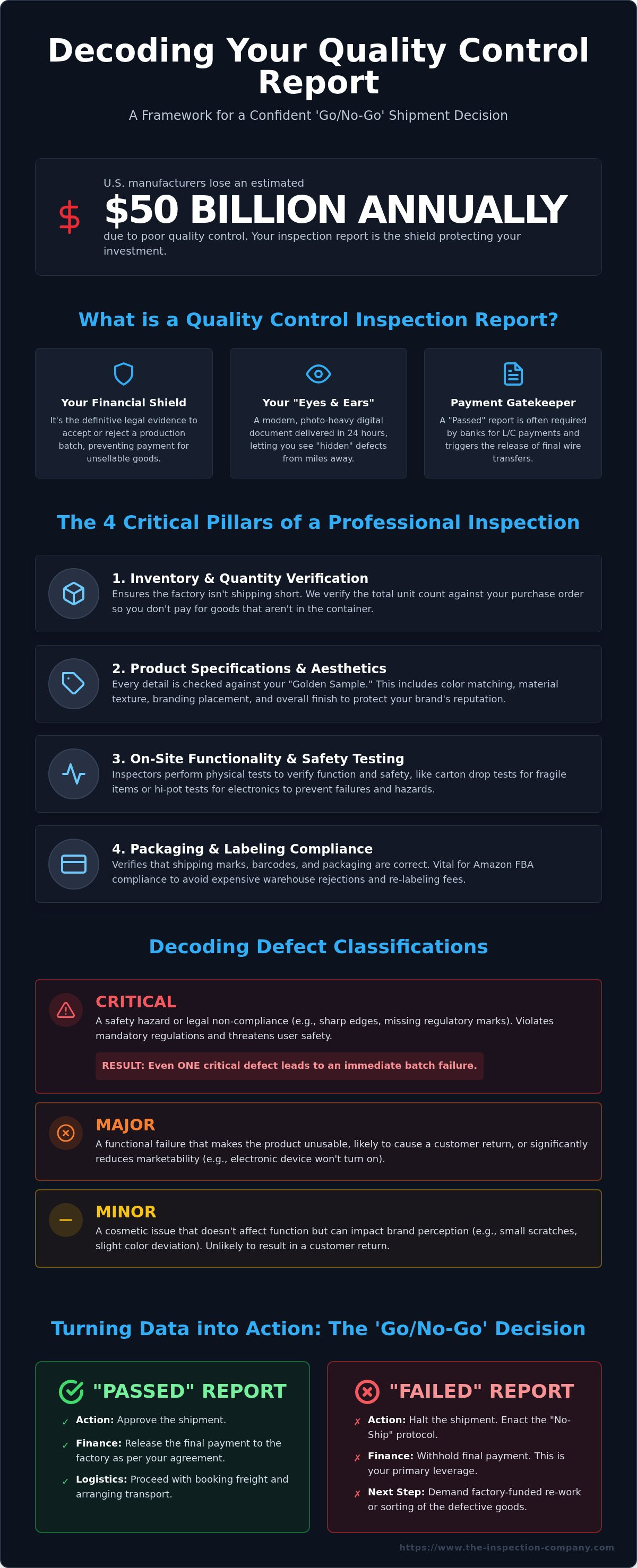
Is your 50-page quality control inspection report a genuine safety net, or just an expensive piece of paper? With U.S. manufacturers losing an estimated $50 billion annually due to poor quality control, the stakes for your next shipment couldn't be higher. It's a high-stakes moment where the pressure to meet a shipping deadline often clashes with the risk of a bad batch hitting your warehouse.
We understand the anxiety that comes with deciphering technical sampling terms and the fear of missing a "hidden" defect in a sea of data. This guide will teach you how to decode a professional report to eliminate shipping risks, protect your brand reputation, and ensure your factory meets the agreed standards. You'll gain a clear "Go/No-Go" decision-making framework to reduce financial losses from customer returns or Amazon rejections. We'll break down the 2026 landscape of quality management, from AQL classifications to acting on results before goods leave the port.
Key Takeaways
- Establish the report as your definitive legal evidence for accepting or rejecting a production batch before ownership transfers.
- Identify critical verification steps for inventory and product aesthetics to ensure the factory delivers exactly what you ordered.
- Learn how to navigate AQL tables in a quality control inspection report to quickly identify if defect counts exceed acceptable limits.
- Adopt the "No-Ship" protocol to leverage your inspection results for factory-funded re-work and avoid costly Amazon FBA rejections.
- Build a professional decision-making framework that transforms complex technical data into a confident "Go/No-Go" shipment approval.
What is a Quality Control Inspection Report?
A quality control inspection report is the definitive record of your product's condition, quantity, and compliance before it leaves the factory floor. It serves as your primary evidence to either approve or reject a batch of goods. In essence, it's the "eyes and ears" of your business on the ground in Asia. What is an Inspection? It's a systematic evaluation to ensure your specifications are met. This document provides the transparency needed to manage high-stakes international trade from a distance.
By 2026, the industry has moved beyond outdated paper logs. Today's standard is a digital, photo-heavy document delivered within 24 hours. These reports provide granular detail that old-fashioned methods can't match. High-resolution images and real-time data allow you to spot "hidden" defects from thousands of miles away. This documentation is a critical output of the pre-shipment inspection process. Without it, you're flying blind.
The Legal and Financial Importance of the Report
Think of your quality control inspection report as a financial gatekeeper. It acts as a shield against "scam" shipments or the common "bait and switch" where a factory substitutes quality components for cheaper alternatives. It's your final shield. From a financial perspective, the report is often a non-negotiable prerequisite for closing a deal.
- Banks typically require a "Passed" report for Letter of Credit (L/C) payments.
- It serves as the objective trigger for releasing final wire transfers.
- It provides the contractual leverage needed to halt payment if results are "Failed."
This prevents the nightmare scenario of paying for a container full of unsellable products. A professional quality control inspection report isn't just a document; it's a preventative investment that forestalls much larger financial losses. It bridges the gap between Western quality expectations and the reality of Asian manufacturing.
Critical Components of a Professional QC Inspection Report
A professional quality control inspection report must be granular to be effective. It shouldn't just summarize; it needs to prove compliance through specific data points and photographic evidence. These reports operate within the framework of international standards for quality management, ensuring that the methodologies used are both consistent and globally recognized. Without this level of detail, you're essentially making a multi-thousand dollar gamble on your shipment's integrity.
The report's core consists of four primary verification pillars:
- Inventory and Quantity: This ensures the factory isn't shipping short. We verify the total unit count against your purchase order so you don't pay for goods that aren't in the container.
- Product Specifications & Aesthetics: Every detail is checked against your original "Golden Sample." This includes color matching, material texture, and branding placement.
- On-Site Testing: Inspectors perform physical tests to verify functionality and safety. This might include carton drop tests for fragile items or hi-pot tests for electronics to ensure they won't short-circuit.
- Packaging and Labeling: We verify that shipping marks and barcodes are correct. This is vital for Amazon FBA compliance, as incorrect labeling can lead to expensive warehouse rejections or re-labeling fees.
A high-quality quality control inspection report transforms raw observations into actionable data. It provides the transparency needed to bridge the gap between your expectations and the factory's reality. If you're struggling to define your specific checklist, you can speak with a quality specialist to refine your requirements before production begins.
Decoding Defect Classifications: Critical, Major, and Minor
Interpreting your results requires understanding how defects are categorized. A Critical defect is a safety hazard or legal non-compliance, such as sharp edges or missing regulatory marks; even one instance results in an immediate failure. Major defects are functional failures that make the product unsellable to the end user. Minor defects are cosmetic issues, like small scratches, that don't affect function but can impact brand perception. For a deeper look at specific examples, see our guide on Understanding Product Defects.
How to Read and Evaluate Your Inspection Results
Reading a quality control inspection report requires a methodical approach to avoid costly oversights. You shouldn't just skim the first page; you need to understand the relationship between the raw data and the final conclusion. Mastery of the Fundamentals of Quality Inspection allows you to interpret these findings with the same precision as a seasoned professional. This skill is your best defense against accepting a batch that could damage your brand's reputation.
Follow these four steps for every report you receive:
- Check the Overall Result: Locate the Pass, Fail, or Pending status on the summary page. This is your immediate indicator of the batch's health.
- Review AQL Tables: Examine the defect counts against the "Reject" limit. Even a "Pass" can be borderline if the defect count is just one unit away from the rejection threshold.
- Analyze Photo Evidence: High-resolution images are non-negotiable. Look for clear shots of the product, packaging, and any identified defects to confirm they match your standards.
- Scrutinize Inspector Comments: These notes often contain critical nuances, such as minor factory delays or equipment issues, that aren't captured in the numerical tables.
Understanding the AQL Sampling Logic
Professional inspections rely on the ISO 2859-1 standard for random sampling. This mathematical approach ensures that the sample size is statistically significant for the entire lot without requiring you to check every single unit. It is vital to remember that a "Pass" on a sample doesn't guarantee 0% defects in the entire lot; it simply means the defect rate is within your pre-defined tolerance. For a deeper breakdown of how to choose your sampling levels, consult our AQL Explained guide.
Spotting Red Flags in Factory Behavior
A quality control inspection report can reveal more than just product quality; it can expose a supplier's integrity. Be wary of comments indicating factory interference, such as an inspector noting that the "factory refused to allow carton opening" or limited access to certain production areas. Additionally, a "Pending" result is a significant red flag. It usually means the inspector found an issue that requires your specific judgment or that the factory failed to provide necessary testing equipment. If you encounter a "Pending" or "Failed" result and aren't sure how to proceed, contact our technical team for an immediate review.
Turning Data into Action: What to Do After the Report
Receiving your quality control inspection report is a pivotal moment in your supply chain. However, the data is only as valuable as the actions you take based on its findings. You must treat this document as a binding verdict on the shipment's readiness. Adopting a proactive stance here prevents the logistical nightmare of receiving thousands of defective units at your warehouse. It's about maintaining control when the stakes are highest.
The "No-Ship" rule is your most powerful tool for risk mitigation. You should never authorize shipment for a "Failed" report without a comprehensive resolution plan in place. Once the goods leave the factory, your financial leverage evaporates. Use the report's objective data to force the factory to address defects at their own expense. This isn't just about one batch; it's about setting a standard for your partnership. By using a Quality Platform, you can track these defect trends over time to identify if a supplier is improving or becoming a liability. Relying on a Western-managed 3rd party inspection company ensures that the results aren't influenced by local factory relationships, giving you the unbiased truth needed for critical decisions.
Protocol for a Failed Inspection
If your quality control inspection report comes back with a "Fail" status, follow this strict protocol to protect your investment:
- Request 100% Sorting: Demand that the factory inspects every single unit to remove or fix defects. For high-value batches, utilizing professional Product Sorting services is often the safest route to ensure accuracy.
- Schedule a Re-inspection: Don't take the factory's word that issues are fixed. A follow-up inspection is mandatory to verify the re-work.
- Hold Final Payment: Do not release the remaining balance until the re-inspection results are "Passed."
The 24-Hour Advantage: Why Speed Matters
In international trade, time is literally money. Receiving a report within 24 hours is essential to prevent expensive port storage fees and avoid missed shipping windows. Delays in data delivery can lead to rushed decisions or missed vessel departures. TIC's commitment to delivering detailed reports within 24 hours provides the rapid transparency required for modern, high-speed global supply chains. This speed allows you to act while the goods are still on the factory floor, where corrections are still possible and cost-effective.
Secure Your Supply Chain for 2026
A quality control inspection report is your final defense against shipment failure and financial friction. By mastering AQL sampling logic and enforcing the "No-Ship" protocol, you transform a technical document into a strategic asset. You don't have to navigate these complexities alone. Reliable data is the foundation of every successful sourcing partnership in Asia. It's the difference between a profitable quarter and a logistical crisis.
The Inspection Company (TIC) provides the transparency you need to manage global operations with total confidence. With European management oversight and over 700 professional inspectors stationed in key manufacturing hubs, we deliver the ground-level truth when you need it most. Our commitment to speed ensures you receive detailed reports within 24 hours; this allows you to act before port delays or storage fees eat into your margins. We bridge the gap between your quality expectations and factory reality.
Don't leave your brand reputation to chance. Take control of your production standards today and ensure your goods meet the mark every time.
Secure your next shipment with a professional inspection report
Frequently Asked Questions
What is the most important section of a quality control inspection report?
The summary page is the most critical section because it provides the immediate "Pass," "Fail," or "Pending" status. This high-level overview allows you to make rapid logistical decisions without initially digging into technical data. However, you must always cross-reference this result with the AQL defect tables to understand the specific nature of any identified risks.
Can I trust an inspection report provided by the factory’s own QC team?
You shouldn't rely on results generated by a factory's internal staff. Internal teams face a clear conflict of interest and are often pressured to approve shipments to meet production quotas or shipping deadlines. An independent quality control inspection report from a third-party provider is the only way to ensure unbiased data and protect your brand from costly defects.
What does a "Pending" result mean on my inspection report?
A "Pending" result indicates that the inspector encountered an issue that requires your specific judgment or authorization before a final verdict is reached. This often happens if a functional test fails or if a product specification deviates from the "Golden Sample" in a way not explicitly covered by your checklist. You must resolve these ambiguities with your supplier before authorizing the shipment.
How many photos should be included in a professional QC report?
A professional report typically includes 60 to 100 high-resolution images depending on the complexity of the order. These photos must document the mass production environment, retail packaging, shipping marks, and every defect identified during sampling. Clear visual evidence is your primary tool for proving non-compliance and negotiating re-work with the factory management.
Is a quality control report valid for Amazon FBA requirements?
A comprehensive quality control inspection report is essential for meeting Amazon FBA compliance standards. Professional inspectors verify specific Amazon requirements during the process, such as FNSKU labeling accuracy, carton weight limits, and moisture protection. Verifying these details before the goods leave the factory floor prevents expensive warehouse rejections and protects your Amazon seller account health.