

Your pre-shipment inspection report is the only legal and financial leverage you have before your goods leave the factory floor. Once that container is sealed and the balance is paid, your ability to demand corrections vanishes. It's natural to feel anxious when reviewing these documents, especially with the update to the ISO 2859-1:2026 standard and new CPSC eFiling mandates requiring precise safety data. You shouldn't have to guess whether your shipment is safe to board a vessel or if it will be rejected at the border.
We know the pressure of making the right call under tight shipping deadlines. This guide provides a clear framework to help you interpret your pre-shipment inspection report with total confidence. You'll learn how to navigate AQL tables, identify critical defects, and gain the authority to challenge your supplier on quality issues. We'll show you how to turn technical data into a decisive Go/No-Go decision that protects your capital and ensures consistent quality across every production run.
Key Takeaways
- Understand why conducting inspections when 80% of production is finished provides the ultimate leverage for order approval.
- Learn to verify the anatomy of a professional pre-shipment inspection report, including the critical role of high-resolution photographic evidence.
- Establish a clear "Go/No-Go" decision framework to differentiate between minor defects and deal-breaking quality failures.
- Secure your supply chain by integrating report findings into a formal resolution process that holds factories accountable for necessary repairs.
The Pre-Shipment Inspection Report: Your Final Shield Against Quality Risk
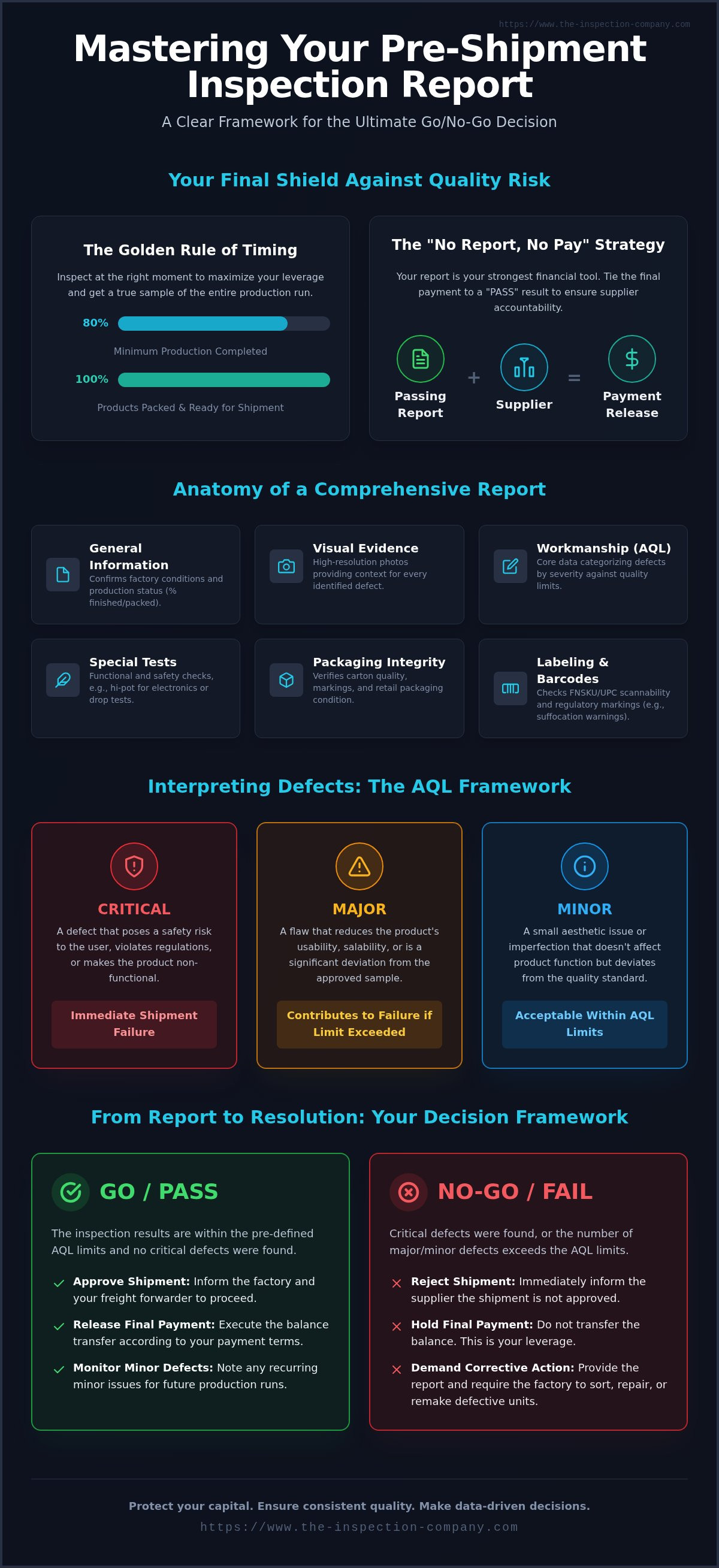
A Pre-shipment inspection (PSI) report serves as the definitive document for order approval. It's not just a checklist; it's the final gatekeeper that stands between your capital and a shipment of unsellable goods. By the time you receive this document, production should follow the industry's "80/20 rule." This means at least 80% of your order is finished and 100% is packed. Inspecting at this stage ensures the sample is truly representative of what your customers will receive. It provides an unbiased, third-party verification of potential product defects, giving you the facts needed to stop a bad shipment before it leaves the factory floor.
Why a Professional Report is Non-Negotiable in 2026
Supply chains across Asia have grown increasingly fragmented and complex. Relying on "factory-sent photos" is a high-risk strategy that often hides more than it reveals. A factory will rarely photograph its own mistakes. In contrast, an independent pre-shipment inspection offers a standardized, transparent view of the production floor. It removes the guesswork and replaces it with data-driven evidence. In a year where shipping costs remain volatile and profit margins are thin, guessing about quality is no longer a viable business strategy.
The Link Between the Report and Your Payment Terms
Your pre-shipment inspection report is your strongest tool for financial leverage. If you're using a Letter of Credit (L/C), the report often serves as a mandatory document for bank release. Beyond formal banking requirements, savvy importers adopt a "No Report, No Pay" strategy. This ensures the supplier remains accountable until the very end of the production cycle. By tying the balance payment to a "Pass" result, you create a powerful incentive for the factory to maintain high standards. It's a simple equation: quality verification must precede capital transfer.
Anatomy of a Comprehensive PSI Report: What Every Importer Must Verify
A professional pre-shipment inspection report is a multi-layered document designed to eliminate ambiguity. It begins with the General Information section, which provides a snapshot of the factory's current conditions and confirms exactly how much of your order is finished and packed. This section is vital for verifying that the factory hasn't misrepresented its production status. These reports are governed by international standards, such as those outlined in the WTO Agreement on Preshipment Inspection, which ensures a transparent and non-discriminatory process for global trade.
Visual evidence is the backbone of any reliable report. You should expect high-resolution photographic evidence for every defect identified. These images shouldn't just show the flaw; they should provide context, such as the location on the product and the specific carton it came from. Without clear visuals, a pre-shipment inspection report lacks the necessary weight to challenge a supplier. Additionally, the Special Tests section records functional and safety checks tailored to your product category, such as hi-pot tests for electronics or drop tests for fragile items. If you have unique testing requirements, you can discuss customized protocols with our team to ensure your specific risks are covered.
Workmanship and AQL Sampling Results
The core of the report is the AQL sampling results. This section categorizes workmanship issues into three distinct levels:
- Critical Defects: Issues that pose safety risks or violate regulations. These usually result in an immediate fail.
- Major Defects: Flaws that reduce the product's usability or salability.
- Minor Defects: Small aesthetic issues that don't affect function but deviate from the golden sample.
Packaging, Labeling, and Amazon FBA Compliance
A failed shipment often starts with a crushed carton or a misprinted barcode. The report details carton markings, retail packaging integrity, and labeling accuracy. For sellers utilizing Amazon FBA inspection services, this section is critical. It verifies that FNSKU barcodes are scannable and that polybag suffocation warnings meet strict Amazon requirements. Avoiding warehouse rejections and costly relabeling fees depends entirely on the meticulous verification of these packaging details before the goods leave Asia.
Interpreting the Data: Understanding Pass, Fail, and Pending Results
Receiving your pre-shipment inspection report within 24 hours of the site visit is essential for maintaining your shipping schedule. This document provides objective data, but you remain the final authority on the "Go/No-Go" decision. A "Pass" result indicates the batch falls within your pre-defined AQL limits. However, "Fail" and "Pending" statuses require immediate strategic action to protect your capital. These results often align with the framework found in the International Trade Administration guide on pre-shipment inspections, which highlights the PSI as a tool for ensuring both regulatory and contractual compliance.
Don't treat the report as a mere formality. It's your last chance to stop a bad shipment. If you're unsure how to interpret specific technical findings or need help weighing the risks of a certain defect, contact our technical team for a professional consultation. We provide the transparency you need to manage factory disputes without the usual friction.
The 'Fail' Result: How to Negotiate Repairs and Re-Inspections
A "Fail" status doesn't always mean the order is lost. It's a signal that the risk of shipping is too high without intervention. You should immediately demand a corrective action plan from the factory. This typically involves a full "sorting" process where the factory identifies and removes defective units. In cases where the factory's internal QC isn't reliable, utilizing professional product sorting services ensures only compliant goods reach the container. Once the re-work is finished, a re-inspection is mandatory to confirm the issues are resolved.
The 'Pending' Status: Navigating Grey Areas
Reports are marked "Pending" when the inspector can't confirm a specific detail. This often happens due to missing certification labels, unconfirmed specifications, or tests that require external lab results. To resolve a pending status quickly, follow these steps:
- Review the inspector's comments for the specific reason for the "Pending" tag.
- Ask the supplier for the missing documentation or clarification immediately.
- Cross-reference the "Pending" issue with your original purchase order to see if it's a deal-breaker.
From Report to Resolution: How to Handle Defects and Approve Shipments
The pre-shipment inspection report is the final bridge between the production floor and your customer's hands. It must be integrated into your broader supplier management process to ensure quality isn't just a one-time event but a consistent standard. Once defects are identified, your priority shifts to accountability. You need a documented commitment from the factory stating exactly how and when they'll rectify every issue before the container is sealed. This isn't just about fixing products; it's about securing your capital.
Without a smooth transition to container loading, the integrity of your inspection is at risk. It's a common anxiety for importers that a factory might swap inspected goods for inferior stock during the final loading phase. A professional inspector stays on-site to verify that the specific cartons listed in your pre-shipment inspection report are the ones actually placed into the container. This end-to-end oversight eliminates the "bait and switch" risk that can lead to costly returns and damaged reputations.
Closing the Quality Loop with Your Supplier
Every failed or pending report should trigger a formal Corrective Action Plan (CAP). This document forces the factory to analyze the root cause of workmanship issues rather than just treating the symptoms. Use the report findings to set new benchmarks for your next production run. If a specific defect keeps appearing, it's a sign that the factory's internal processes need adjustment. It's about moving from reactive fire-fighting to proactive quality management that protects your long-term interests.
Why The Inspection Company is the Preferred Choice in Asia
Managing quality across borders requires a blend of European management standards and deep localized expertise. We project the image of a partner suitable for critical, high-stakes operations. Our team of 700+ inspectors delivers detailed reports within 24 hours, giving you the speed and transparency to make risk-free decisions. We act as your eyes and ears on the ground, ensuring your standards are met every single time. Don't leave your shipment to chance; book an inspection today to secure your supply chain.
Secure Your Capital with Data-Driven Quality Control
Mastering the technical details of your pre-shipment inspection report is the final step in securing your supply chain. By utilizing the 80/20 rule and insisting on high-resolution visual evidence, you transform a simple document into a powerful financial shield. This systematic approach ensures that only goods meeting your exact standards reach your customers, protecting your brand reputation and your bottom line.
Success in international trade depends on speed and accuracy. Our team of over 700 certified inspectors across Asia operates under strict European management standards to deliver the clarity you need. We understand that in logistics, every hour counts. That's why we guarantee a 24-hour turnaround on all documentation, allowing you to make confident "Go/No-Go" decisions without delaying your timeline.
Don't leave your next production run to chance. Secure your shipment today and get a professional pre-shipment inspection report within 24 hours. You've built a business that deserves reliable quality; we're here to help you maintain it.
Frequently Asked Questions
What is included in a standard pre-shipment inspection report?
A standard pre-shipment inspection report contains a comprehensive breakdown of production status, workmanship, and safety. It includes an AQL defect list, product specifications, packaging integrity checks, and functional test results. Every identified flaw is supported by high-resolution photographic evidence to eliminate ambiguity. This detailed documentation provides the transparency needed to verify that your shipment matches the approved golden sample before it leaves the factory.
How long does it take to receive the inspection report after the visit?
You'll receive your report within 24 hours of the inspector completing the on-site visit. This rapid turnaround is a core standard of our European-managed operations, designed to eliminate the anxiety of shipping delays. By providing data-driven insights quickly, we ensure you have the necessary information to approve or reject a shipment without disrupting your logistics schedule or missing critical vessel departures.
Can I use the PSI report to refuse payment to my supplier?
Yes, the report is your primary tool for financial leverage against a supplier. Most international trade agreements and Letters of Credit require a "Pass" result as a prerequisite for releasing the balance payment. Using the pre-shipment inspection report as a legal and financial gatekeeper ensures you don't pay for defective goods. It provides the objective evidence required to demand corrections or negotiate a discount before the transaction is finalized.
What is the difference between a major and a minor defect in the report?
Major defects are flaws that impair the product's function or salability, whereas minor defects are slight aesthetic deviations. For example, a non-functional power button is a major defect, while a small smudge on the packaging is typically minor. While a few minor defects might be acceptable, major defects often trigger a failed result if they exceed specific AQL thresholds. Critical defects, which pose safety risks, always result in an immediate fail.
What should I do if my pre-shipment inspection report shows a 'Fail'?
You should immediately withhold shipment and demand a formal "sorting" or "re-work" from the factory. A "Fail" result indicates that the risk of receiving defective goods is too high. Require the supplier to identify the root cause and provide a corrective action plan to fix the batch. Once the factory claims the issues are resolved, schedule a re-inspection to verify the corrections before authorizing the goods for container loading.