
A failed quality inspection report isn't a disaster. It's the most powerful piece of leverage you have to ensure you only pay for the quality you ordered. When you're staring at a report filled with critical defects, the anxiety of production delays or a potential Amazon account suspension can feel overwhelming. However, knowing exactly what to do when a quality inspection fails is the difference between a total financial loss and a successful recovery.
We understand that conflict with factory management is the last thing you need when deadlines are tight. This guide provides the professional steps required to mitigate risk and force factory accountability based on current ISO 2859-1:2026 standards. You'll learn how to analyze inspection evidence, demand effective rework, and establish a clear path to resolving defects. We'll show you how to turn a failed result into a documented mandate for quality that protects your bottom line.
Key Takeaways
- Halt the shipment immediately and withhold final balance payments to maintain your financial leverage and prevent defective inventory from reaching your customers.
- Understand the precise professional steps regarding what to do when a quality inspection fails to force factory accountability and mitigate long-term operational risks.
- Analyze the inspection report by categorizing defects into Critical, Major, and Minor issues to determine the exact safety and compliance impact on your batch.
- Demand a formal Corrective Action Plan (CAP) from the factory and require 100% product sorting to ensure every defective unit is identified and removed.
- Use the failure as a strategic opportunity to update your quality checklists and assess if the factory remains a reliable partner for future production runs.
Immediate Crisis Management: Why You Must Halt the Shipment
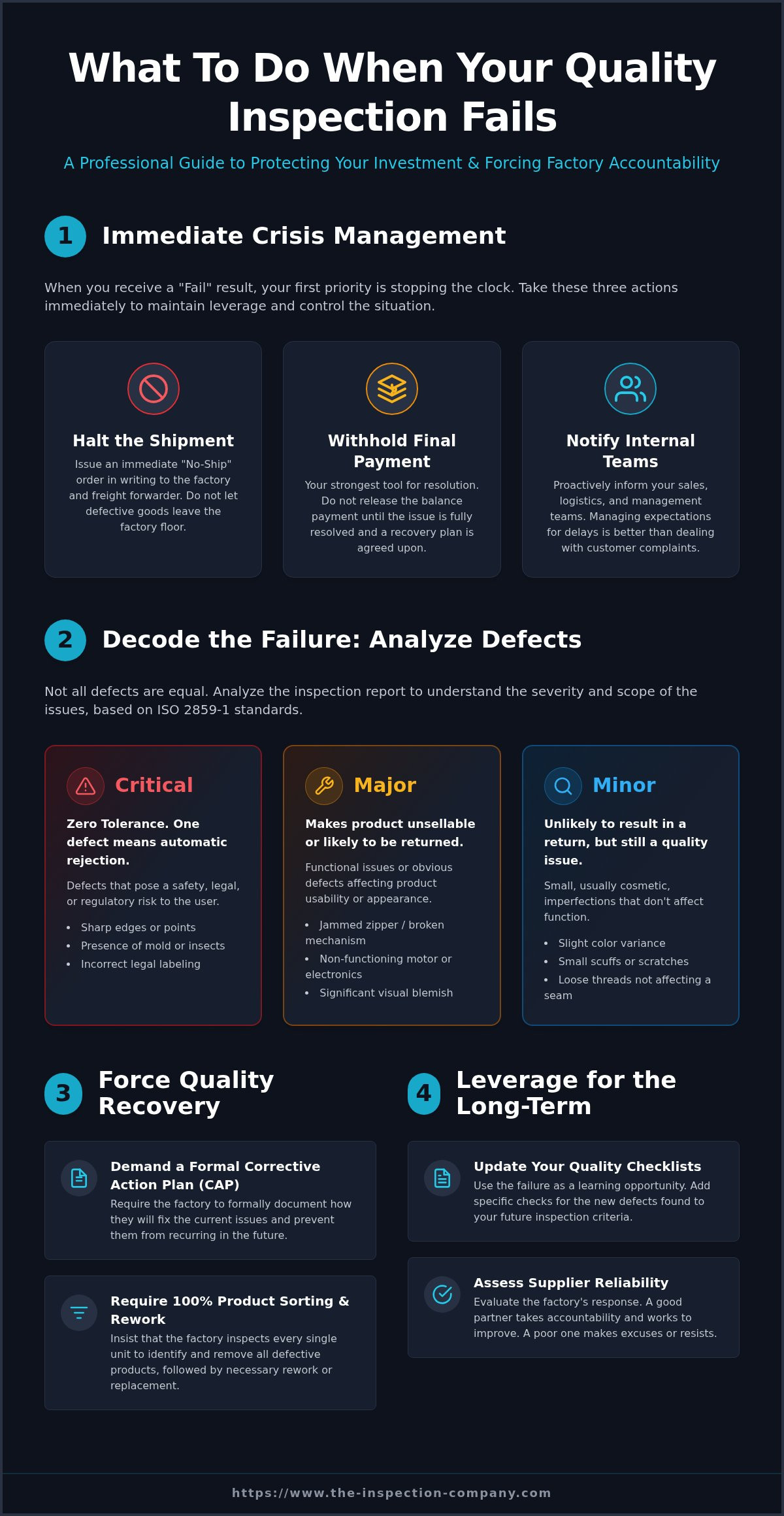
When you receive a "Fail" result, your first priority is stopping the clock. Many importers hesitate, but knowing what to do when a quality inspection fails starts with a total freeze on movement. You must issue an immediate "No-Ship" order to both the factory and your freight forwarder. If the goods leave the factory floor, you lose your primary leverage. Once the shipment is on the water, the cost of rectification increases exponentially. It's much cheaper to fix a problem in the factory than it is to process a global product recall.
Financial control is your strongest tool for resolution. Withhold the final balance payment until the failure is fully investigated and a recovery plan is agreed upon. A factory that has already been paid in full has little incentive to perform costly rework or sorting. Use the inspection report as objective evidence in a formal notice to factory management. This document should clearly state that the goods don't meet the agreed-upon standards and that the current batch is rejected based on the data provided.
Internal transparency is equally critical. Notify your sales, logistics, and Amazon teams immediately. Lead times will shift, and it's better to manage a delay now than a wave of negative reviews or an Amazon account suspension later. Proactive communication within your organization ensures that everyone is prepared for the revised timeline while you work to secure the inventory.
The "No-Ship" Protocol: Protecting Your Capital
Verbal agreements have no weight in international trade disputes. You must document the shipment hold in writing via email or your official communication platform. Factories often apply heavy pressure to ship "as-is" to meet a vessel deadline. They might claim the defects are minor or promise to fix them on the next order. Don't yield to these tactics. A Pre-Shipment Inspection failure means the contractual terms of your purchase order haven't been met, and shipping anyway validates the factory's poor quality control.
By halting the shipment, you're initiating a necessary Corrective and Preventive Action (CAPA) process. This isn't just about this specific batch; it's about protecting your capital from long-term damage. Stand firm on your PO terms. If the factory realizes you're serious about your quality standards, they'll be more inclined to collaborate on a fix rather than pushing for a quick, defective exit. This professional stance establishes a precedent for all future production cycles.
Decoding the Failure: Analyzing Major, Minor, and Critical Defects
Once you've stopped the shipment, you must dissect the report to understand why it failed. A "Fail" result is often a numerical conclusion based on the ISO 2859-1:2026 sampling plan. You need to look beyond the summary and examine the specific defect counts. Understanding what to do when a quality inspection fails requires a clinical analysis of whether the issues are systemic or isolated. If your Major defect count is 15 but the Acceptable Quality Limit (AQL) was 14, you have a technical failure that requires immediate attention.
Defects are not created equal. Critical defects are zero-tolerance items that pose safety, legal, or regulatory risks, such as sharp edges or mold. One critical defect is an automatic rejection. Major defects include functional issues that make the product unsellable or likely to be returned, like a jammed zipper or a non-functioning motor. Minor defects are usually cosmetic issues, such as slight color variances or loose threads. Regulatory bodies use similar rigorous standards for classifying product defects to ensure consumer safety and product integrity.
The Decision Matrix: When to Accept a "Failed" Report
There are rare situations where you might waive a minor failure. If the defects are purely cosmetic scuffs on internal packaging that won't be seen by the customer, you might choose to accept the batch to avoid a critical stock-out. However, you should consult an Understanding Product Defects guide to benchmark these issues against industry standards before making a final call.
For Amazon sellers, "shipping anyway" is a high-stakes gamble. Defective inventory leads to a spike in your Order Defect Rate (ODR), which can trigger immediate account suspension. Utilizing a specialized Amazon FBA Inspection helps identify these risks before they reach a fulfillment center. If you're unsure how to interpret your results, it may be time to speak with a quality expert to evaluate your options. Protecting your seller metrics is often more valuable than meeting a single shipping deadline.
The Corrective Action Plan (CAP): Forcing Quality Recovery
Identifying the technical failure is only half the battle. You must now dictate the terms of the recovery. Understanding what to do when a quality inspection fails requires you to demand a formal Corrective Action Plan (CAP) from the factory management. Don't accept a vague promise to "do better." Instead, require them to identify the specific root cause of the failure. This methodical approach mirrors FDA guidance on Corrective and Preventive Actions, which focuses on systemic fixes rather than temporary patches. If the factory doesn't understand why the defect occurred, it's guaranteed to happen again in the next production run.
Once the cause is identified, require a 100% Product Sorting of the entire batch. This is a non-negotiable part of what to do when a quality inspection fails to ensure no defective goods reach your warehouse. The factory must manually inspect every unit to separate the compliant items from the defective ones. It's standard industry practice that the factory bears the cost of this labor, along with the fees for any re-inspections. You must establish a firm, written timeline for this rework. Delays are expected, but an open-ended schedule puts your retail deadlines at risk.
Managing the Rework and Sorting Process
Don't trust the factory to "self-sort" without third-party supervision. There's an inherent conflict of interest. A factory worker under pressure to meet shipping quotas may overlook defects that an objective inspector would catch. Implementing a During Production Inspection is the most effective way to verify that rework is actually occurring. This oversight ensures that "repaired" items aren't simply the same defective units repackaged in new boxes.
Set the threshold for your re-inspection at zero tolerance for the previously identified defects. If the initial report found functional failures, the follow-up must show that those specific issues have been eliminated. This level of scrutiny forces the factory to take your standards seriously. If you're struggling to get a factory to comply with your recovery plan, contact our team to implement professional oversight immediately.
Leveraging Failure for Long-Term Supplier Management
A failed report is more than a hurdle; it's a diagnostic tool that reveals the health of your supply chain. Once the immediate crisis is resolved, you must decide what to do when a quality inspection fails to prevent a recurrence. Start by updating your Quality Control Checklist. Every defect identified in the failed report should be added as a specific checkpoint for future inspections. This ensures the factory knows you're tracking their historical weaknesses with meticulous detail.
You also need to determine if the failure was a one-time operational error or a systemic breakdown. If the factory continues to struggle with consistency, a comprehensive Factory Audit is necessary to evaluate their management systems and machinery. Use the documented failure as leverage in your next contract negotiation. You might demand better payment terms or a higher percentage of the final balance held until after a successful inspection is confirmed. This professional stance transforms a negative event into a structural improvement for your business.
Updating Your Inspection Strategy for 2026
The landscape of international trade in 2026 requires a proactive approach. Relying solely on final checks is a high-risk strategy that often leads to friction. For complex or high-value items, transition from Pre-Shipment Inspections to Pre-Production Inspections. This allows you to catch material issues before the factory has invested weeks into a defective run. It's an essential part of what to do when a quality inspection fails to ensure future batches remain compliant.
If a supplier has a history of failures, implement stricter AQL levels. Reducing your tolerance for minor defects forces the factory to upgrade their internal QC processes. By integrating the principles found in Mastering the Supplier Management Process, you move from a reactive stance to a position of total control. This shift ensures that quality management is no longer a series of fire drills but a reliable, structural capability that supports your company's growth.
Securing Your Supply Chain for Sustainable Growth
A failed inspection is not the end of a supplier relationship; it's a critical pivot point for your quality control strategy. By halting shipments immediately and demanding a formal Corrective Action Plan, you protect both your capital and your brand reputation. Knowing exactly what to do when a quality inspection fails transforms a potential shipment disaster into a controlled, professional management process. This methodical approach ensures that only compliant goods reach your customers, which is essential for protecting your Amazon metrics and long-term bottom line.
The Inspection Company (TIC) provides the objective oversight needed to resolve these failures with precision. With over 700 inspectors across major Asian manufacturing hubs and European management standards, we deliver detailed reports within 24 hours. This rapid response allows you to address production errors before they escalate into damaging financial losses. To secure your inventory and force factory accountability, Book a Re-inspection or Sorting Service with TIC today. You have the power to turn production failures into documented victories for your quality standards.
Frequently Asked Questions
Who should pay for the re-inspection after a failure?
The factory is responsible for the cost of re-inspection according to standard international trade practices. You should ensure this clause is explicitly included in your initial purchase order (PO) to avoid negotiation delays. When you're deciding what to do when a quality inspection fails, deduct the re-inspection fee from the final balance payment to the supplier. This practice holds the factory financially accountable for their production errors and encourages better quality control in future runs.
Can I ship a failed order if the defects are only minor?
You can choose to ship a failed order, but doing so carries significant risks to your brand reputation and seller metrics. While minor defects are often cosmetic, a high concentration of them can still trigger a "Fail" result based on AQL standards. For Amazon sellers, shipping goods that failed inspection often leads to a spike in customer returns and negative reviews. It's safer to require a sorting service to remove the defective units before the shipment leaves the factory floor.
How long does a factory usually take to perform rework?
Rework timelines vary based on the defect complexity and batch size, but most factories require seven to fourteen days for a thorough recovery. This period includes time for product sorting, repairing functional issues, and repackaging. You must demand a clear schedule in the Corrective Action Plan to prevent the factory from deprioritizing your order. Constant monitoring during this window ensures the factory stays on track to meet your revised shipping deadline.
What happens if the factory refuses to fix the defects found in the report?
If a factory refuses to rectify defects, your primary leverage is the withheld final balance payment. You should present the inspection report as objective evidence of a breach of the purchase order terms. If the deadlock continues, you may need to involve a third-party mediator or consider the long-term viability of the partnership. Knowing what to do when a quality inspection fails involves standing firm on your quality standards to protect your company from receiving unsellable inventory.
Is a "Pending" result the same as a "Failed" result?
A "Pending" result is not the same as a "Failed" result, though both require your immediate attention. "Pending" usually indicates that the inspector encountered an issue they couldn't resolve on-site, such as missing documentation or a lack of specific testing equipment. It can also mean the result is borderline and requires your final decision. In contrast, a "Failed" result is a definitive statement that the batch did not meet the statistical AQL requirements for your order.