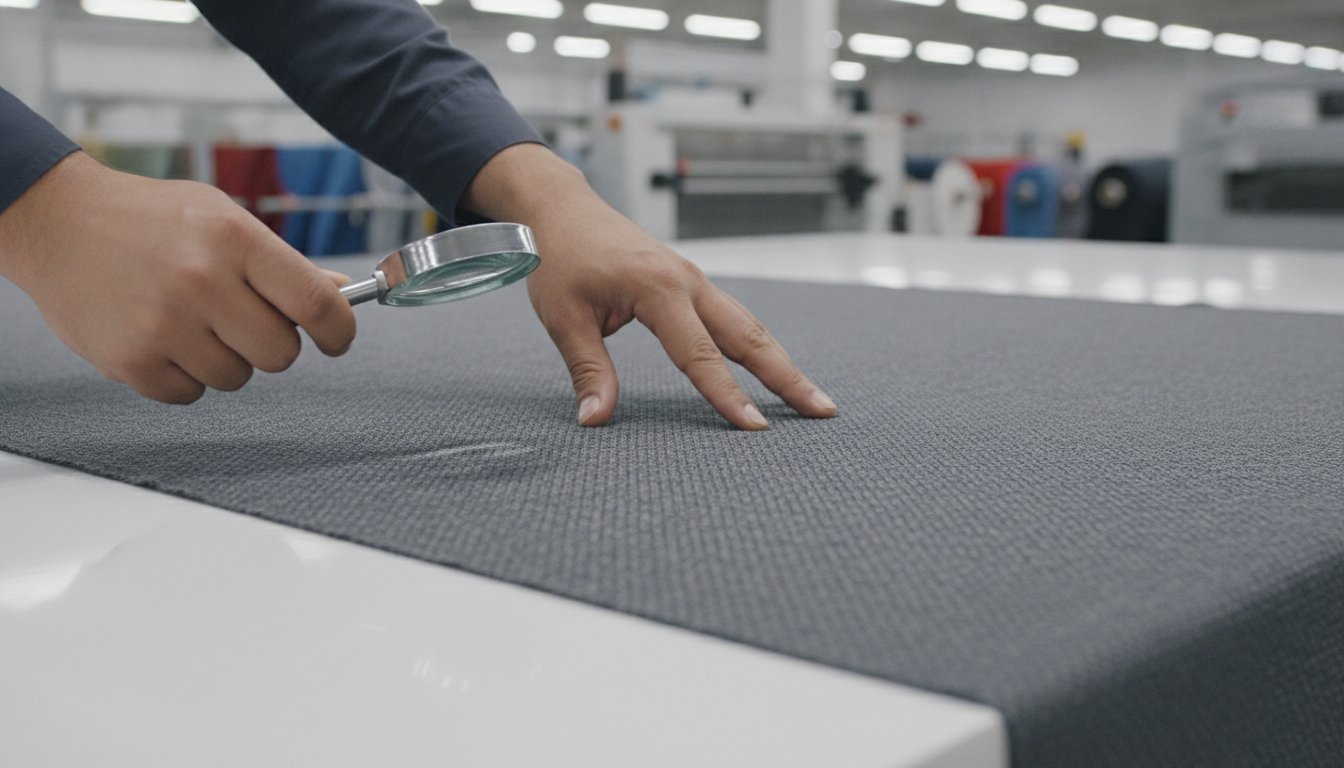

With inbound defect fees jumping as high as $5.72 per unit in 2026, a single labeling error can now erase your entire profit margin on a shipment. You've likely felt the pressure of Amazon's recent policy shifts, particularly the total discontinuation of their internal prep and labeling services. It's a high-stakes environment where a minor oversight at a factory in China leads to thousands of dollars in return shipping costs and damaging account health warnings. We understand that maintaining your seller standing feels like a constant battle against evolving logistics rules.
By implementing a professional FBA product inspection checklist, you can regain control and ensure every unit meets Amazon's rigorous 2026 compliance standards before it leaves the factory. This article provides a methodical breakdown of the new requirements, from mandatory FNSKU labeling for non-brand owners to updated polybag specifications. You'll learn how to identify critical defects and validate GS1 barcodes to prevent costly rejections and keep your fulfillment pipeline moving efficiently.
Key Takeaways
- Learn how a comprehensive FBA product inspection checklist serves as your final defense against "Unsellable" inventory and costly removal order fees.
- Master the AQL framework to accurately categorize critical, major, and minor defects using industry-standard statistical sampling.
- Ensure 100% compliance with 2026 labeling mandates, including FNSKU scannability and specific polybag suffocation warning requirements.
- Understand the strategic advantage of independent Pre-Shipment Inspection (PSI) in mitigating operational risks before your goods leave the factory.
Why an FBA Product Inspection Checklist is Your Account’s Best Defense
A professional FBA product inspection checklist serves as the final gatekeeper for your inventory before your capital is locked within Amazon’s complex fulfillment ecosystem. Once your goods arrive at a US fulfillment center, you lose direct control over their status. If the products don't meet Amazon’s strict 2026 standards, they are marked as "Unsellable" or "Defective," effectively freezing your investment. Professional inspection protocols ensure that quality and compliance are verified at the source, preventing these logistical dead ends.
Why risk your entire business on a factory's promise? Using a standardized FBA product inspection checklist bridges the critical communication gap often found when working with manufacturers in Asia. Language barriers and differing quality standards lead to catastrophic misunderstandings regarding packaging or labeling. A detailed checklist leaves no room for interpretation. It forces the factory to adhere to your specific requirements, protecting your seller account from "Product Authenticity" or "Safety" complaints triggered by a single batch of non-compliant goods.
One bad shipment can result in a permanent "Account Health" warning. Amazon’s automated systems are quick to flag deviations in weight, packaging thickness, or barcode accuracy. These flags often lead to manual reviews that can suspend your listing for weeks. By verifying compliance before the container is sealed, you mitigate the risk of operational friction and maintain your standing as a reliable seller.
The High Cost of Non-Compliance at Amazon Fulfillment Centers
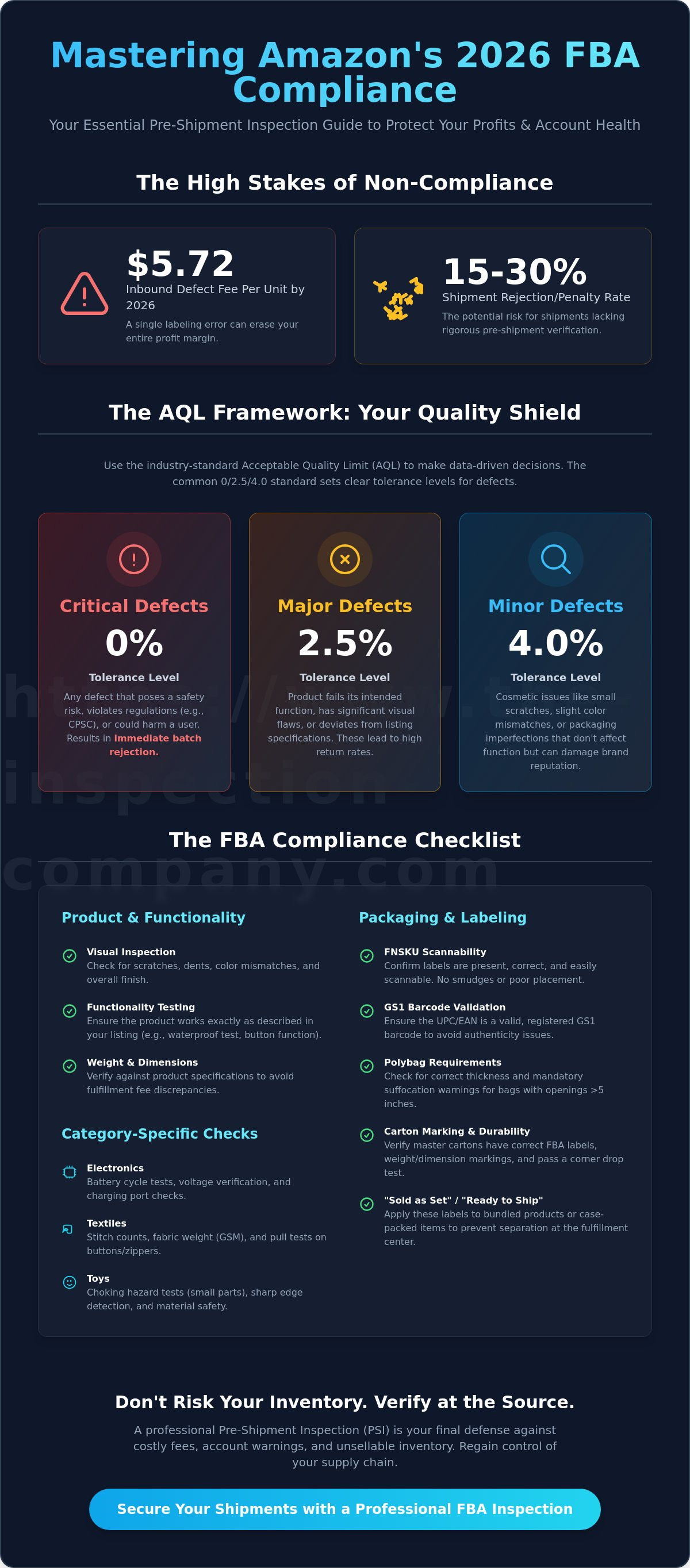
The financial penalties for ignoring compliance are severe. You face a compounding list of expenses: international return shipping, long-term storage fees for stranded inventory, and unplanned service fees that reach up to $5.72 per unit in 2026. If the inventory is deemed a safety risk, Amazon may even charge you for its disposal. Industry data indicates that up to 15-30% of shipments may face rejection or penalties if they lack a rigorous verification process. Utilizing a specialized Amazon FBA Service provides the necessary oversight to avoid these friction points and secure your profit margins.
Physical Product & Functionality: The Core Inspection Criteria
Achieving compliance goes beyond avoiding shipping delays; it's about ensuring every unit mirrors the promise made in your Amazon listing. To achieve this with statistical precision, your FBA product inspection checklist must be built upon the Acceptable Quality Limit (AQL) framework. This industry-standard methodology allows you to determine the maximum number of defective units in a batch before the entire lot is rejected, providing a clear, data-driven path for decision-making during the quality control process.
AQL Standards and Defect Classification
Setting your AQL levels is a strategic balance between procurement costs and customer satisfaction. Most seasoned sellers utilize a 0/2.5/4.0 standard. Under this system, zero critical defects are tolerated. You can find a deeper dive into these metrics in our guide on AQL Explained. Defect classification is typically broken down into three tiers based on severity:
- Critical Defects: These involve safety risks or violations of CPSC regulations. Any unit that could harm a user or trigger a legal recall falls here. These are immediate grounds for batch rejection.
- Major Defects: These occur when the product fails to function as described or shows significant visual flaws. If a "waterproof" speaker fails a submersion test, it is a major defect that will lead to high return rates.
- Minor Defects: These are cosmetic issues like small scratches or slight material mismatches. While they don't impede function, they can still damage your brand reputation if they appear in high volumes.
Customizing Your Checklist for Specific Product Categories
A generic list is insufficient for high-risk categories. For electronics, your FBA product inspection checklist should include battery cycle testing and voltage verification. Textiles require stitch count checks and pull tests for buttons. Toys demand even higher scrutiny, focusing on choking hazards and sharp edge detection. For products requiring chemical analysis or specialized durability trials, incorporating Sample Testing ensures your goods meet international safety benchmarks. If you're unsure which specific tests your category requires, you can reach out to our team for a tailored inspection protocol designed for your specific SKU.
Packaging, Labeling, and FBA Cartmarking Requirements
Amazon’s fulfillment centers operate as high-speed transit hubs, not storage warehouses. If your packaging fails to meet technical specifications, the inventory is flagged for "Unplanned Services," incurring fees that erode your margin. A rigorous FBA product inspection checklist must prioritize these four critical steps to ensure seamless intake:
- FNSKU Label Verification: Every barcode must be scannable and perfectly matched to the SKU in your shipping plan.
- Polybag Compliance: Any bag with an opening of 5 inches or larger must display a clear suffocation warning to meet safety standards.
- Carton Marking: Box dimensions and weights must match your Seller Central shipping plan exactly; deviations often lead to inbound defect penalties.
- Bundling Labels: Products sold as a unit require "Sold as Set" or "Do Not Separate" stickers to prevent warehouse staff from breaking apart the bundle.
Ensuring Structural Integrity: The ISTA 1A Drop Test
Amazon’s conveyor systems and automated sorting machines are notoriously rough on inventory. To simulate this environment, a professional inspection includes the ISTA 1A drop test, which is a standardized 10-drop sequence performed on a single shipping carton. Fragile items specifically require protection that can withstand a 3-foot drop to ensure they survive the journey from the fulfillment center to the customer's doorstep. This test is vital for identifying packaging weaknesses that lead to product defects before the goods are shipped overseas.
The "Scannability" Audit
A barcode that doesn't scan is a barcode that doesn't exist in Amazon's system. Inspectors must verify that FNSKUs and 2D barcodes are printed with high contrast on non-reflective surfaces to avoid manual processing fees. Beyond Amazon's internal rules, you must satisfy Basic Labeling Requirements for international trade, including a visible "Made in [Country]" origin label. This is a legal necessity for US and EU customs clearance. To ensure your next shipment is 100% compliant, contact our compliance experts for a comprehensive packaging audit.
How to Execute Your FBA Inspection with Professional Precision
Timing your quality control is a strategic decision that separates successful sellers from those facing account suspensions. Utilizing a Pre-Shipment Inspection (PSI) is the industry "Gold Standard" because it occurs when the order is 100% finished and at least 80% packed. This is your final opportunity to apply the FBA product inspection checklist and catch errors before the goods are loaded and your leverage with the supplier disappears.
Relying on factory-provided QC is a high-stakes gamble. Factories often overlook minor defects to meet shipping deadlines. Our European management presence in Asian manufacturing hubs acts as a critical safeguard against "factory-inspector" collusion. This oversight ensures that your reports are objective, transparent, and strictly aligned with international quality standards. It provides the peace of mind that a neutral third party is defending your interests on the factory floor.
Once the results are in, you enter the "Approval Loop." An inspection report isn't just a status update; it's a powerful negotiation tool. If the FBA product inspection checklist reveals non-compliance, you have the data needed to demand immediate repairs or financial discounts before releasing the final payment. This proactive approach prevents unexpected issues from reaching Amazon's docks.
Reading Your Inspection Report: Approval vs. Rejection
Your report's "Photo Evidence" section is the most vital component. It provides a visual record of the actual batch, not just a sample. If a report is marked as "Pending," it typically means minor issues were found that require your specific sign-off. You can manage these results and track historical quality trends through our Quality Platform, which streamlines the decision-making process for high-volume sellers.
Transitioning from Inspection to Container Loading
Passing the product inspection is only half the battle. Implementing a Container Loading Inspection prevents "quantity discrepancies" that often trigger Amazon inbound defect fees. An inspector verifies the final carton count, checks the container's structural condition for leaks, and records the seal number. This ensures that the exact inventory you paid for is what arrives at the FBA dock, free from transit damage or tampering.
Secure Your Amazon Marketplace Standing in 2026
Amazon's fulfillment centers are no longer safety nets for poorly prepared goods; they're high-speed hubs with punitive fee structures for any non-compliance. Implementing a rigorous FBA product inspection checklist at the factory level is the only way to ensure your capital doesn't get trapped in "Unsellable" inventory. By focusing on scannable labeling, structural packaging integrity, and precise defect classification, you mitigate the risks of return shipping and account health warnings.
Success in international trade requires dependable oversight that factory-provided QC simply cannot offer. We maintain European management standards across our Asian hubs to ensure total transparency and prevent collusion. With over 700 inspectors ready to deploy, we deliver detailed reports within 24 hours of the site visit. Don't leave your profit margins or your account standing to chance. Secure your Amazon business with a professional FBA Inspection today and keep your fulfillment pipeline moving with confidence.
Frequently Asked Questions
Does Amazon require a third-party inspection for FBA products?
Amazon doesn't explicitly mandate third-party inspections, but they hold sellers entirely responsible for every compliance detail. Without a professional FBA product inspection checklist, you assume 100% of the financial risk for inbound defects. If your goods arrive with labeling errors or packaging violations, you'll face immediate unplanned service fees or total shipment rejection.
What happens if my products fail an FBA inspection at the factory?
A failed result gives you the necessary leverage to demand repairs or "re-work" from the manufacturer before the goods leave Asia. You shouldn't release the final payment until the factory provides evidence that they've corrected the issues identified in the report. This prevents defective inventory from reaching the US and protects your seller account from safety or authenticity complaints.
How much does a professional FBA product inspection cost?
The investment required for a professional inspection typically depends on the factory's geographic location and the number of man-days needed to complete the sampling. It's an essential preventative measure that forestalls much larger financial losses. Avoiding just one rejected shipment or a batch of inbound defect fees often covers the cost of inspection services for an entire year.
Can I use the factory’s internal QC report for Amazon compliance?
Relying on internal factory reports is a high-stakes gamble due to the manufacturer's inherent conflict of interest. Factories are naturally incentivized to ship goods quickly to maintain their production schedules. Independent inspectors provide the objective transparency needed to catch subtle non-compliance issues, such as incorrect FNSKU placement, that factory staff might intentionally or accidentally overlook.
What are the most common reasons for FBA shipment rejection?
Labeling inaccuracies and packaging failures are the primary causes for inventory being flagged at the fulfillment center dock. Common triggers include unscannable barcodes, missing suffocation warnings on polybags, and cartons exceeding the mandatory 50lb weight limit. Since Amazon discontinued their internal prep services in 2026, these errors now result in immediate financial penalties and potential listing suppression.